

Bandwidth & Broken Hearts: How Telcos Became the Unrequited Lovers of the Digital Age
Telcos need to stop selling mere gigabytes and start owning their impact: show the world the lives changed, communities uplifted, and societies transformed by every connection they deliver. A look!

In today’s world, experience is everything—visibility is everything. Consumers flock to services and products that make life easier, more delightful, and more “seamless.” We cheer for digital platforms, apps, and tools that are visible, narrate their magic, and make friction vanish in everyday moments. The curated, and frictionless premium digital experiences are so valuable for us that, we’ll happily pay $2000 a year for a browser—just for the privilege of ordering Chipotle more smoothly. Take the recent LinkedIn post from Perplexity’s CEO: a user points out you can use the Comet browser to seamlessly order Chipotle, dodging aggregator app fees and clunky websites. It’s positioned as a breakthrough: easier, cheaper, neater. And thousands “like” it.
In entertainment, Netflix gets the love, not the global network of fiber and content delivery behind it.
For commerce, Amazon is adored for one-click orders—not for the logistics pipes and networks that guarantee delivery.
In software, flashy AI app builders like lovable win headlines, while cloud compute and storage quietly enable them in the background. unless its Nvidia of course but thats a different story.
Even in fintech, the visible front-end wallet or payment app is prized, not the core payment rails that never get a moment in the spotlight.
The hunger for visible convenience means that industries working behind the scenes, no matter how transformative, risk fading from public affection. In the digital era, brand love, value, and pricing power concentrate where the experience is visible, narratable, and emotional—not where the hardest technical work or investment happens. Narrative and visibility aren’t just marketing—they’re survival strategies. Whoever frames the daily magic wins hearts, growth, and premium status.
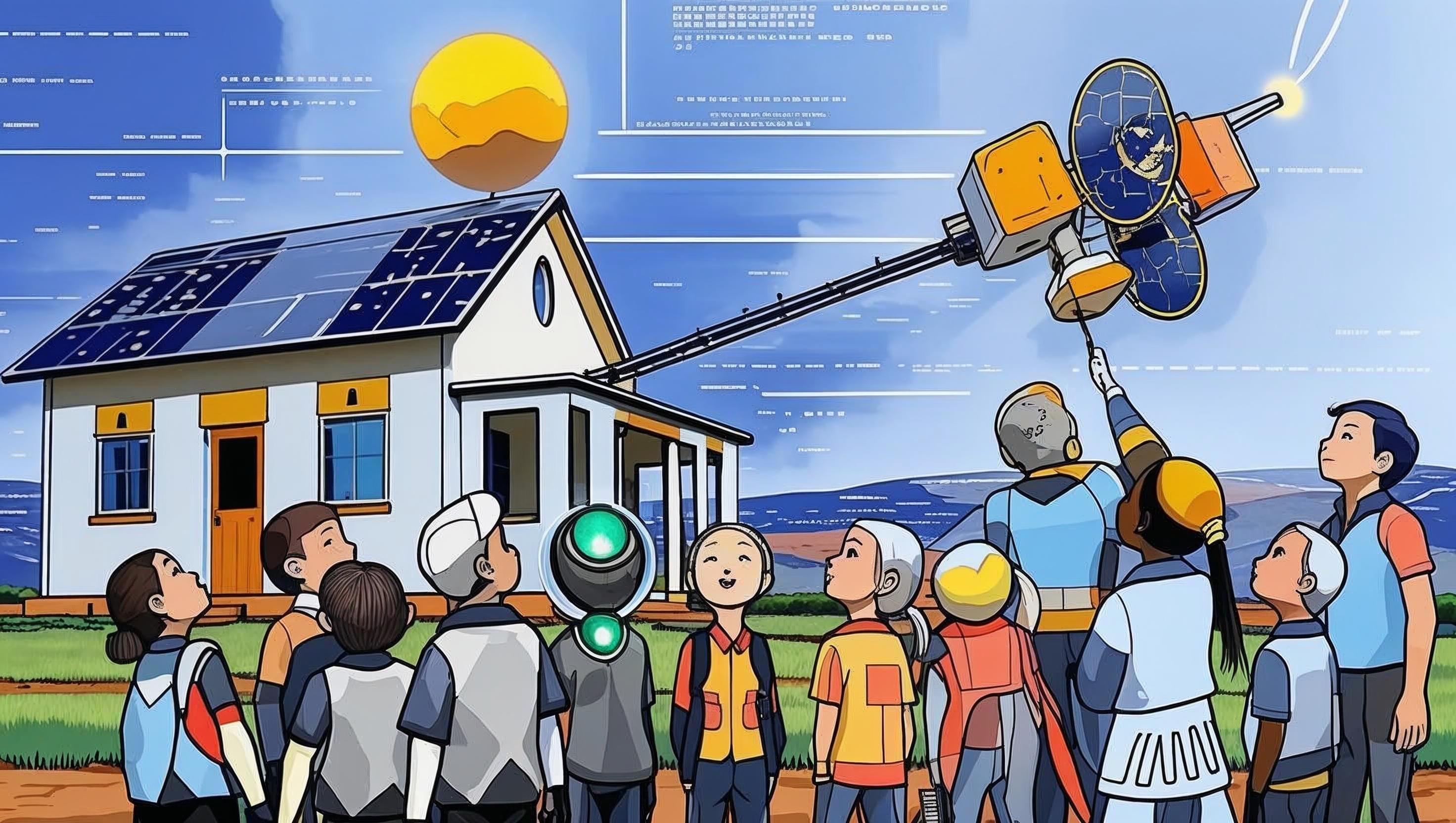
Now imagine a small team of engineers, working through the night on a remote hilltop, brings mobile connectivity to a village—quietly empowering children’s learning, fairer markets, and family reunions, one signal at a time. Telecom, for instance, powers every message, call, payment, and viral moment, yet gets little credit, loyalty, or mindshare, simply because its greatest value is invisible when it’s working well. the network industry that has quietly made all this online convenience possible—collapsing the cost of mobile data, multiplying speeds, blanketing cities in coverage—still can’t sell even basic upgrades without resistance. Telcos remain the uncelebrated infrastructure, unable to command premium pricing or inspire affection, while new digital brands market the joys of order-tracking and instant checkout as major innovations.
It’s a paradox: Consumers celebrate paying more for a browser to get a better burrito, but balk at the prospect of paying telcos for exponentially better, cheaper, and more reliable access to everything online. The narrative belongs to whoever frames the experience—not necessarily the true enabler behind the curtain, and for every founder or industry: this is sort of a lesson—don’t just build the value, own the experience and make sure the world sees it. storytelling and relevance, not just reliability, win hearts (and wallets) in the digital age. Until telcos rewrite their narrative—from utility to experience-maker—the credit, the love, and the margin will keep going elsewhere.
But was this always the story? Where did the things go wrong?
Lets take a deeper look unpack the paradox, quantify the progress, explore the perception gap, and outline a playbook for change.
From “Miracle Talking Wires” to the Lost Romance of the Platform Age : A Short History of Telco Love
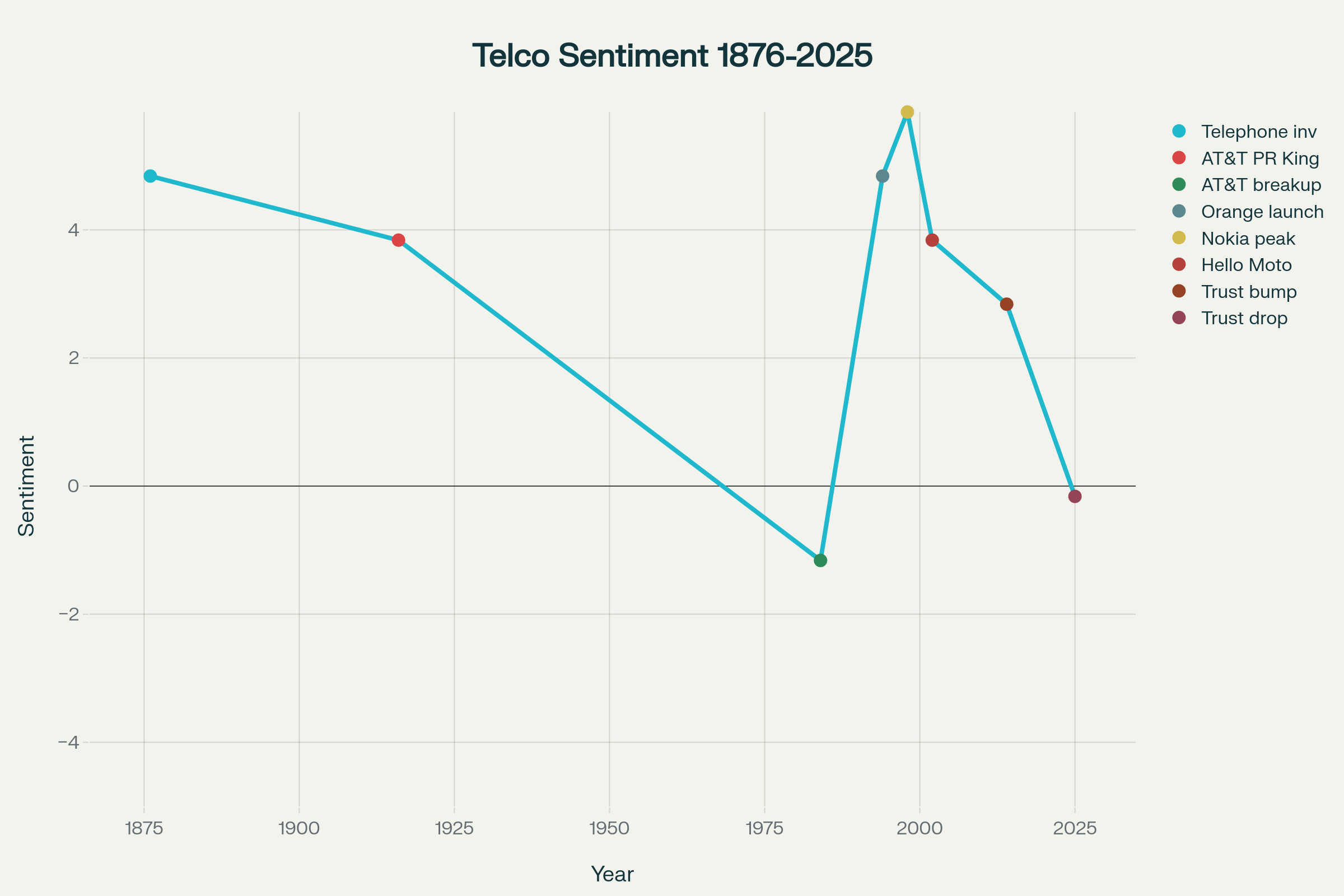
Before smartphones and 5G, the telephone itself was magic. Over 150 years, public affection for the companies that supplied that magic has risen, plateaued, and then faded. The timeline below tracks pivotal “love moments” and shows how sentiment crested in the late-1990s mobile boom before sliding into today’s indifference.
1. The Awe-and-Wonder Era (1876 – 1920)
Wins
Pure enchantment. Newspaper columns hailed Alexander Graham Bell’s device as a “new nerve of civilization,” promising to shrink distances and advance democracy.
Celebrity status. Early subscribers—often doctors, journalists, and merchants—were local influencers; switchboard operators became cultural icons of calm competence.
Losses
Sticker shock. Annual fees of £15–£20 in Britain exceeded a clerk’s wage, sparking editorials that only the elite could afford “the costly toy”.
Usability pain. Crank handles, party lines, and manual exchanges produced mis-dials and privacy fears, sowing early frustration.
Mind-set
Optimism tempered by Victorian morals: critics worried the phone would encourage gossip and erode letter-writing decorum, yet overall sentiment netted strongly positive (+4 on our index).
2. The Monopoly Paternalism Era (1920 – 1984)
Wins
Universal-service mythos. AT&T’s 1916 manifesto, The Kingdom of the Subscriber, cast the Bell System as benevolent steward of national progress.
Reliability worship. Engineers delivered five-nines uptime; the phrase “We are the phone company” signified authority—and a certain comfort.
Losses
Price resentment. Controlled tariffs and equipment rental stifled choice; waiting lists for new lines stretched months.
Antitrust backlash. By the 1970s the U.S. Justice Department framed Ma Bell as a “trust to be busted,” culminating in the 1984 breakup that fractured public confidence.
Mind-set
A blend of grudging respect and silent irritation. Telcos were necessary, even admired for engineering prowess, but rarely loved.
3. Deregulation & Brand Romance (1984 – 2000)
Wins
Freedom to choose. Competition slashed long-distance rates and introduced colourful newcomers—Sprint’s pin-drop ads, MCI’s “Friends & Family.”
Lifestyle rebrand. In 1994 Orange launched with the human promise “The future’s bright” and 45% brand awareness within two weeks—an emotional shockwave in a market of grey utilities.
Global mobile boom. By 1998 Nokia owned 40% of handset share; the mantra “Connecting People” resonated across cultures and ages, embedding genuine affection for a telco-rooted brand.
Losses
Network glitches. Early GSM drop-outs dented credibility.
Rising churn. Pre-pay SIMs made loyalty fickle even as advertising spend soared.
Mind-set
Hopeful, hip, and increasingly personal. For a brief moment telcos were consumer technology.
4. The Early-Smartphone Peak (2000 – 2007)
Wins
Pop-culture cachet. Motorola’s “Hello Moto” blitz tied phones to fashion runways and club scenes, helping the brand rebound against Nokia.
SMS mania. Texting volumes exploded, and carriers basked in the glow of New Year’s Eve messaging records.
Losses
Billing rage. Roaming shocks and opaque WAP charges triggered tabloid scandals.
Apple’s entrance. The 2007 iPhone shifted the centre of consumer excitement from network to device, relegating operators to billing rows on the screen.
Mind-set
Excitement mixed with a nascent fear of irrelevance as hardware and internet brands stole the spotlight.
5. The Platform & OTT Eclipse (2008 – 2020)
Wins
Infrastructure heroism. 4G roll-outs doubled median mobile speeds and enabled app stores, streaming, and social video—quietly.
Trust bump (brief). Edelman’s 2014 barometer showed telecom gaining 15 points in Australia, second only to energy, on reliability during crises.
Losses
Commodity trap. Unlimited bundles reframed data as a race to zero price.
Customer-service drag. ACSI ranked internet providers near the bottom of 40 industries for call-centre satisfaction throughout the 2010s.
Narrative hijack. Consumers thanked Netflix and Instagram for experiences delivered over telco pipes.
Mind-set
Functional gratitude but emotional neutrality. Operators became invisible backdrop to Big Tech.
6. The 5G-AI Paradox (2021 – Present)
Wins
Speed miracles. 5G median mobile speeds top 250 Mbps in leading markets, and networks carry 200 × more traffic than in 2010—largely without outages.
Pandemic resilience. Lockdown video calls highlighted telco indispensability.
Losses
Erosion of trust. In Edelman 2025 telco trust slipped to 64/100, trailing technology by 12 points and sliding into the lower half of industries.
Love gap. Consumers rate mobile brands’ emotional engagement 30% below that of digital platforms in Omdia’s 2024 engagement survey, blaming “transactional tone” and call-centre pain.
Mind-set
Respect for utility, disappointment in experience, and indifference to brand—a stark contrast with the late-1990s high-affection peak.
Telecom operators were once national marvels, then paternal monopolists, then pop-culture darlings—before drifting into the background of Big Tech’s stage. Each era’s love hinged less on raw technology and more on perceived human benefit and brand voice.
The progress however looks as impressive as it could be:
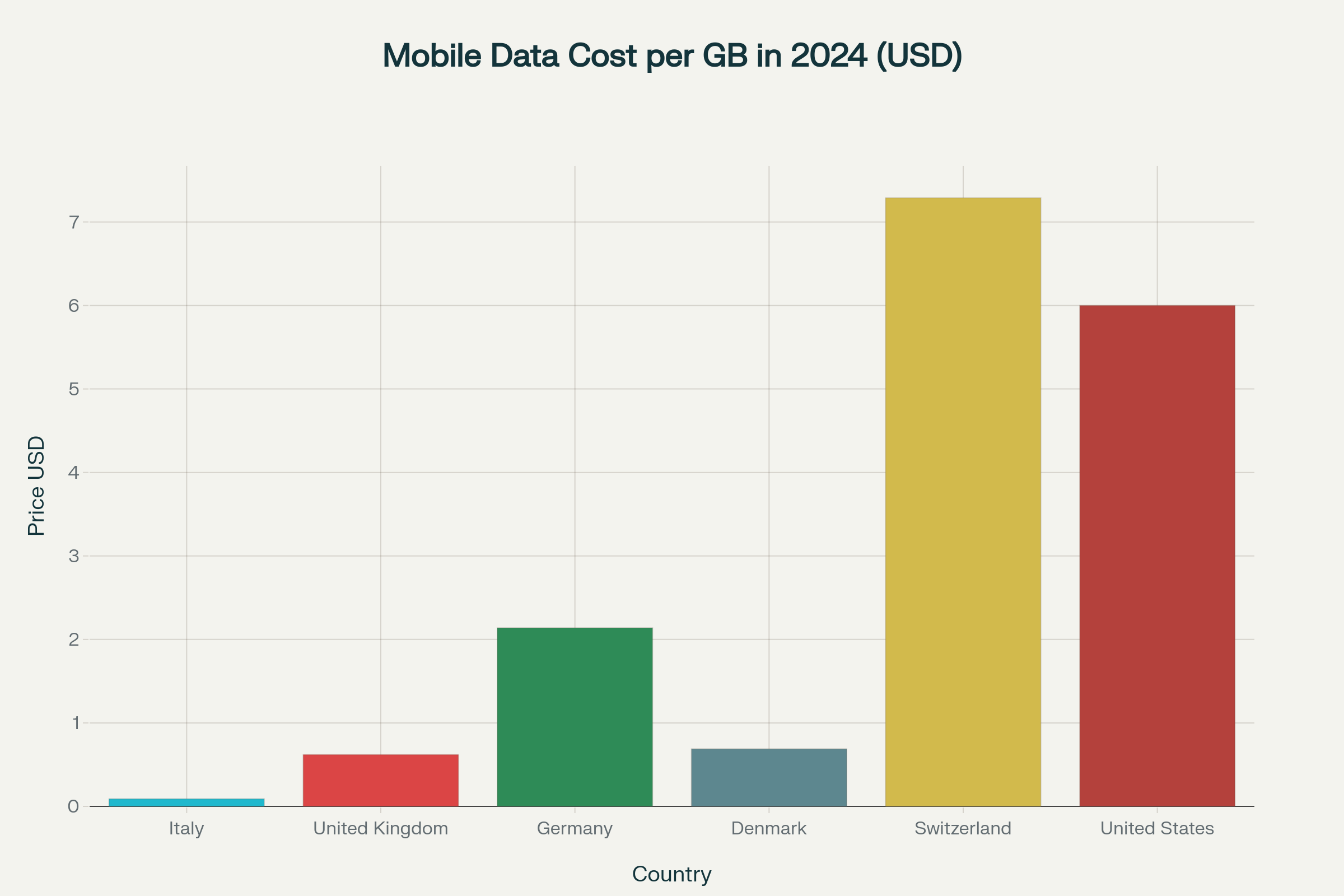
Mobile data now costs under $0.10/GB in Italy but over $7 in Switzerland, proving affordability gains are real yet uneven.
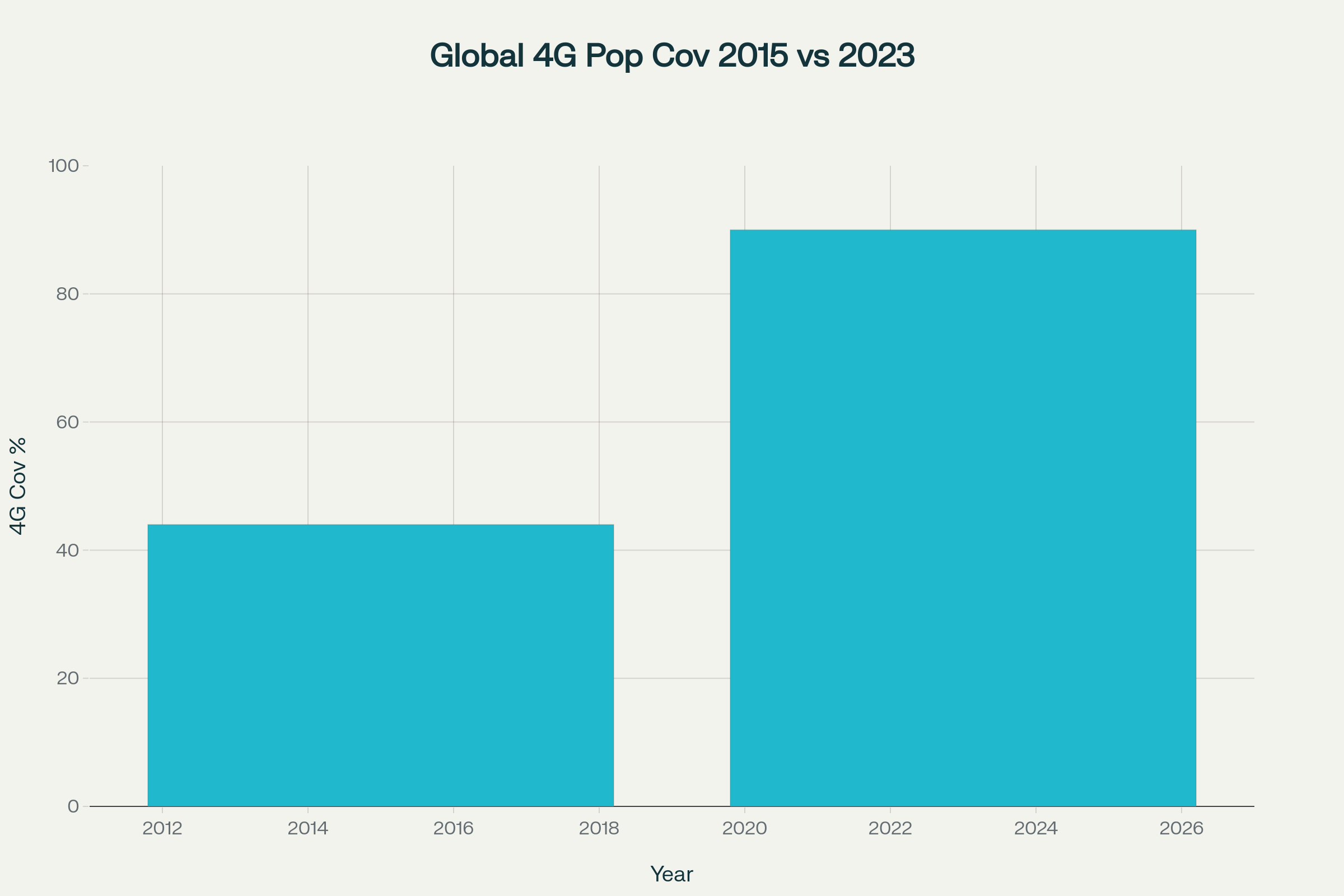
4G coverage expanded from 44 percent of the global population in 2015 to 90 percent in 2023, and 5G already reaches 51 percent.
Despite a cumulative $1.5 trillion mobile CAPEX bill expected for 2023-30, telcos’ capital intensity is falling as big 5G and fibre build-outs taper off.
Customer trust lags: in 2025 Edelman ranks telecom 16 points below technology and 28 points behind food & beverage.
Root causes cluster in three zones: invisibility (networks are hygiene factors), legacy service pain points (billing, call centres), and narrative failure (operators talk bits while digital brands sell meaning).
Winning back love requires shifting from “pipes” to “possibility” storytelling, closing experience gaps with AI-driven personalization, monetizing relevance (network-exposed APIs, B2B2X), and reframing CAPEX as purpose-led infrastructure.
Despite driving one of history’s most profound digital transformations—tripling connection speeds, pioneering global 4G/5G reach, and slashing data costs in many regions—telcos remain oddly unloved, scoring low on public trust and customer satisfaction. This paradox highlights a key future insight: as networks evolve to power AI, quantum security, and the smart grid, true differentiation will come from humanizing the telco brand and making value visible. Recognition will belong to operators who move beyond invisible pipes and position themselves as intelligent enablers of tomorrow’s connected societies. The future telco must win not just on performance, but by earning back public affection.
Telcos face tepid revenue CAGRs (~3%) and CAPEX pressure, but AI-driven efficiency and platform plays could lift margins. By reframing themselves as custodians of digital civilisation rather than SIM-card vendors, operators can reclaim narrative ground – and public affection. Re-winning hearts means reviving that voice: celebrating networks as enablers of everyday magic, fixing lingering service pain, and reclaiming narrative credit for the connective tissue of modern life.
The industry’s brand deficit is not a technology failure.
It is a storytelling and experience gap. Telcos own the arteries of the digital age yet speak like meter readers. By humanising infrastructure, fixing service pain points with AI, and evangelizing their indispensable role in everything from remote surgery to climate tech, operators can turn silent success into celebrated relevance – and finally earn the ovations their networks already deserve.
I hope you found this article interesting, informative, and useful. Do support by liking, subscribe, share it with you colleagues and friends and on social media — X, LinkedIn, or the platform of your choice. You can follow me on linkedin here.
PS I think this article needs a Part 2 : “Telco 2030 Outlook: How AI, Quantum & Semiconductors Will Redraw the Network Map” and More. coming up next month.