

Between Promise and Practice: The Real Story of AI Adoption
The Global AI Transformation: Insights from Enterprise Leaders on Adoption, Governance, and the Future of Work

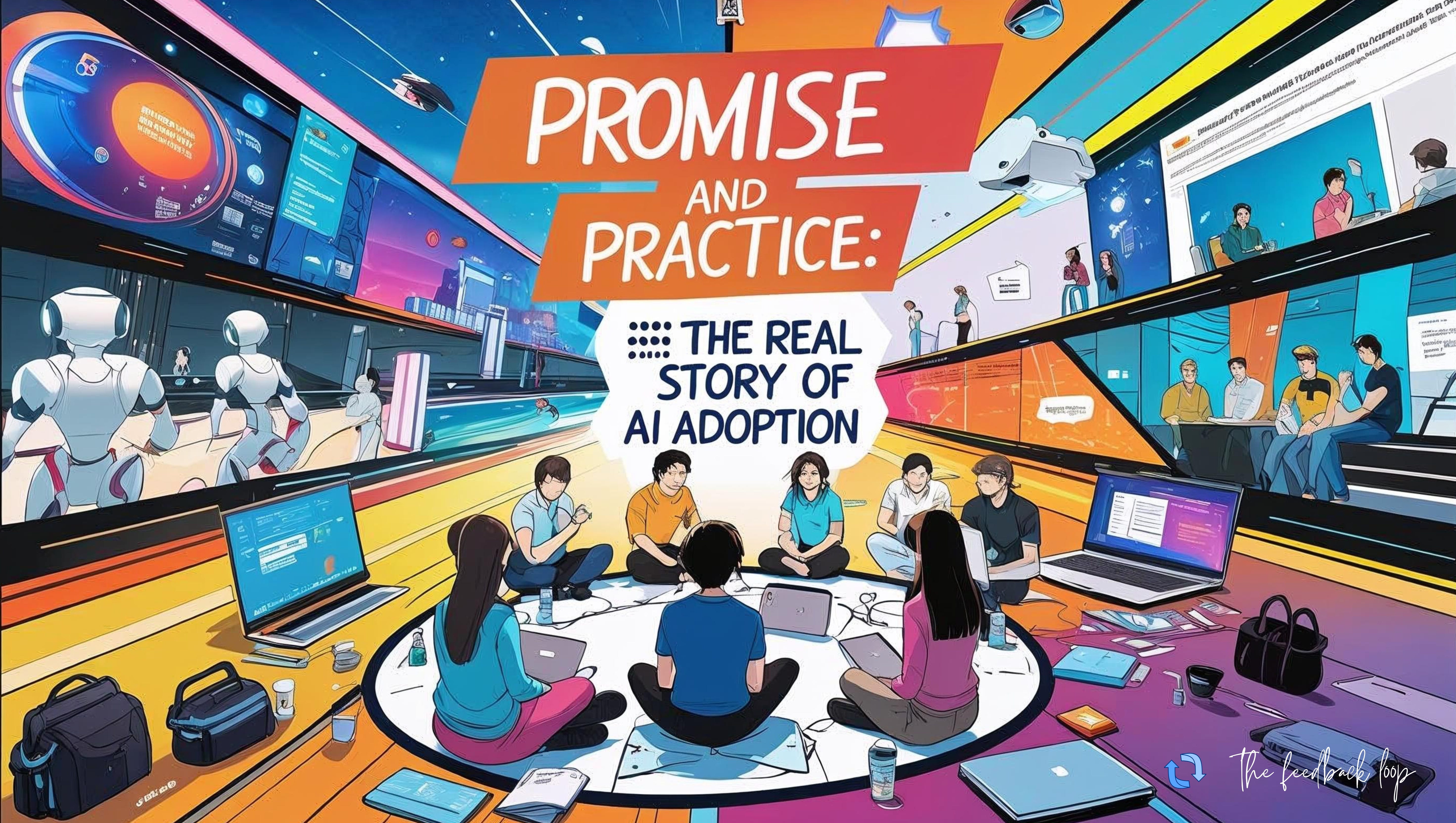
Its a good practice to keep an up to date instagram or similar account, because then you can easily scroll down to and revisit the last time you f’ed up. I din’t have to though because I never forgot the day that was Oct 17, 2017. I had a demo next day in Philly, and the hardware came in, but out cables. so with no colleagues in 100 miles radius to help, I ended up barging in to my customer’ s lab site in 1 New York Plaza, they were that cool yes, and I got the cables but also ended up attending a exec meeting in my pajamas. Today felt similar.
This article is a recap of our Online catch up call today on June 27, 2025, a 3rd in the monthly series. In my experiments with google meet, I messed up some host settings which I couldn’t apologize enough for. It would’ve been good to have our google expert Chandramouli Pandeya available, but alas. We still manage to conduct the call and an excellent discussion, but sadly many couldn’t join. the podcast calls it a tech comedy, was more tragic in my opinion, but since its done a good job of summarizing our conversation, I’d forgive it. It rarely listens to my instructions anyway.
I have prepared this article using perplexity lab, with call transcript and gemini notes as main sources. I’ve added instructions to use related stats to support the conversation with elevated insights and have done minimal editing. Canva was used to edit charts and create images. The podcast is created using NotebookLM and only uses the 2 source files. The article is contributed to participants - Adarsh S Lathika, Antonio Serrano, John Fawole, Matt Woodward, Premanand Natarajan, Rohit Khanna and Sash Mohapatra and Poonam Parihar.
In a world where artificial intelligence is rapidly reshaping industries, the gap between the promise of AI and its everyday practice remains wide and deeply human. This discussion brought together technologists, business leaders, educators, and researchers from across the globe to candidly explore the realities of enterprise AI adoption—not just the technical hurdles, but the cultural, psychological, and organizational challenges that define the human experience of technology.
Key stats to frame the discussion:
Over 75% of organizations now use AI in at least one business function, but only about a quarter have a clear, visible AI strategy.
Lack of understanding and fragmented regulations are top barriers to adoption, cited by 22% of business leaders as the biggest challenge.
AI is expected to have a $19.9 trillion global economic impact by 2030, but success depends on data quality, trust, and workforce readiness.
46% of professionals report skills gaps on their teams, mainly in tech and data.
This comprehensive analysis examines the current state of artificial intelligence adoption across enterprises, drawing from a recent discussion among AI practitioners and supplemented with the latest industry research and statistics. The conversation revealed critical insights about implementation challenges, regional governance approaches, and the evolving impact on global workforce dynamics.
Executive Summary
The AI revolution has reached a critical inflection point where 78% of global companies currently use AI technologies, yet only 26% have successfully scaled beyond proof-of-concept implementations. This disconnect between adoption enthusiasm and practical execution underlies many of the challenges discussed by industry practitioners, from individual contributors questioning whether they can build competitive AI solutions to enterprise leaders struggling with governance frameworks and workforce transformation.
The conversation highlighted a fundamental tension: while 92% of companies plan to increase AI spending in 2025, significant barriers remain, including inadequate training (47.5% of employees), lack of trust in AI results (36.4%), and insufficient board-level expertise (50% of organizations).
Enterprise AI Adoption: Current State and Challenges
The Confidence Gap in AI Development
A central theme emerged around individual practitioners' growing confidence in building AI solutions that companies typically charge thousands of dollars for. This sentiment reflects a broader democratization of AI capabilities, where tools like Perplexity Labs and other no-code platforms enable rapid prototyping and development. However, this confidence must be balanced against the complexity of enterprise-grade implementations, particularly around governance, security, and scalability.
Implementation Reality vs. Expectations
While 82% of global companies are either using or exploring AI, the reality is more nuanced. Large enterprises with over 10,000 employees show 60% adoption rates, significantly higher than smaller organizations. The conversation revealed that many organizations remain in experimental phases, struggling to move from individual productivity gains to systematic business transformation.

Major barriers preventing successful AI adoption across enterprises, highlighting the critical need for education and trust-building initiatives.
The barriers to successful AI adoption reflect both technical and organizational challenges, with inadequate training emerging as the most significant obstacle across all company sizes.
Regional AI Governance Landscape
Fragmented Global Approaches
The discussion touched on the fragmented nature of global AI governance, with participants noting that "there is no universal framework" and organizations are "stitching together various laws and frameworks from different regions". This observation aligns with current research showing distinct regional philosophies toward AI regulation.

Comparison of global AI governance frameworks showing the balance between regulatory strictness and innovation support across major regions.
The European Union's AI Act represents the most comprehensive regulatory framework, implementing a risk-based approach with strict penalties for non-compliance. Meanwhile, the United States maintains a more flexible, voluntary guidelines approach, prioritizing innovation over restrictive regulation. China employs the strictest oversight, requiring pre-market evaluations and integrating AI governance with social credit systems.
Compliance Challenges for Multinational Organizations
For multinational companies like IBM, which was discussed as a case study subject, navigating these diverse regulatory landscapes presents significant challenges. The EU AI Act alone requires complex compliance frameworks, particularly for high-risk AI applications in critical infrastructure, employment, and law enforcement.
Future of Work: Job Displacement vs Creation
Projected Impact Through 2030
The conversation explored various perspectives on AI's impact on employment, with participants discussing both job displacement fears and potential for job creation. Current projections show a complex picture: the World Economic Forum predicts 92 million jobs displaced but 170 million jobs created by 2030, resulting in a net gain of 78 million positions.

Projected growth of AI market value alongside cumulative job displacement and creation, showing net positive job creation despite significant disruption.
However, these optimistic projections contrast with more conservative estimates. McKinsey Global Institute suggests up to 400 million jobs could be displaced, while Goldman Sachs estimates 300 million globally. The variance in these projections reflects the uncertainty around adoption speed and implementation approaches.
Regional Employment Implications
Participants noted that advanced economies face higher exposure, with the IMF estimating 60% of jobs in developed countries at risk from AI automation, compared to only 40% in emerging economies. This disparity could significantly impact traditional migration patterns, as discussed in the conversation, particularly affecting countries like India that rely heavily on skilled worker emigration.
Productivity and Economic Impact
Measurable Business Benefits
Despite implementation challenges, organizations successfully deploying AI are seeing substantial returns. Companies using AI report 82% productivity improvements and 76% profitability gains. The impact varies significantly by organization size, with UK SMEs achieving up to 133% productivity gains while large enterprises typically see 60% improvements.

Significant productivity gains achieved through AI adoption across different organization sizes and types, with SMEs showing the highest improvements.
Enterprise-Scale Implementations
Real-world examples demonstrate AI's transformative potential. IBM reports $3.5 billion in productivity gains since January 2023, while PepsiCo operates over 1,500 AI bots, assistants, and agents across their value chain. These implementations suggest that AI could boost operating margins by 2% over the next five years, equivalent to approximately $55 billion in annual cost savings for large companies.
Market Growth Trajectory
The global AI market, valued at $638 billion in 2025, is projected to reach $3.68 trillion by 2034, representing a 19.20% compound annual growth rate. This explosive growth supports 97 million new AI specialist positions needed by end of 2025 to meet industry demand .
Key Barriers and Solutions
Trust and Literacy Challenges
The conversation revealed that 36.4% of workers don't trust AI results, creating a self-reinforcing cycle where lack of trust prevents the positive experiences needed to build confidence. Addressing this requires comprehensive AI literacy programs, as 74% of workers cite lack of training as their primary barrier to AI adoption.
Generational and Cultural Resistance
Participants discussed encounters with senior leadership resistant to AI adoption, highlighting generational gaps in technology acceptance. This aligns with research showing workers aged 18-24 are 129% more likely than those over 65 to worry about AI making their jobs obsolete.
Building Trust Through Demonstration
Successful adoption strategies involve trust-building through family and peer networks, as one participant demonstrated by installing ChatGPT for a skeptical friend's family members. This grassroots approach proves more effective than top-down mandates for overcoming resistance.
Strategic Recommendations
For Organizations
Prioritize AI Literacy: With 92% of marketing leaders believing AI literacy will be essential within 2-4 years, organizations must invest in comprehensive training programs.
Implement Staged Adoption: Rather than enterprise-wide rollouts, focus on specific departments and use cases where AI can deliver immediate, measurable value.
Develop Governance Frameworks: Only 26% of organizations have AI governance plans in place, leaving most vulnerable to compliance and ethical risks.
For Policymakers
Foster International Coordination: The conversation highlighted the need for more coordinated global approaches to AI governance, reducing compliance complexity for multinational organizations.
Support Workforce Transition: With 14% of workers expected to change careers due to AI by 2030, governments must invest in re-skilling and education programs .
Conclusion
The conversation among AI practitioners revealed an industry at a pivotal moment. While enthusiasm for AI adoption remains high, with 78% of companies using AI technologies and 92% planning increased investments in 2025, significant challenges persist around governance, trust, and practical implementation.
The discussion emphasized that successful AI transformation requires more than technological capability—it demands comprehensive change management, addressing everything from individual literacy to organizational governance and global regulatory coordination. As the AI market grows toward $3.68 trillion by 2034, organizations that can navigate these challenges while building trust and demonstrating clear value will emerge as leaders in the AI-driven economy.
The human element remains central to AI success, whether in building trust through peer networks, developing governance frameworks that balance innovation with safety, or ensuring that the 170 million new jobs created by AI provide meaningful opportunities for displaced workers. As one participant noted, the future will likely value human skills—emotional intelligence, creativity, and relationship-building—more highly as AI handles routine tasks, creating opportunities for those who can adapt and learn continuously.
AI adoption is accelerating, but the real story is about navigating uncertainty, building confidence, and making sure people aren’t left behind as technology races ahead.
AI’s impact is as much about people as it is about technology. The conversation underscored the need for better communication, more practical education, and a focus on building trust—both in the systems themselves and among teams. As one participant put it, “AI won’t make us dumber or smarter on its own—it’s how we adapt, learn, and use it together that matters most.”