

From Connectivity to Compounding Advantage
The hidden loop behind telco infrastructure, sovereign platforms, and open standards.

By 2026, every major voice in telco AI is repeating the same three stories: sovereign AI is strategic, telcos must become AI infrastructure providers, and that, open-source models are essential.
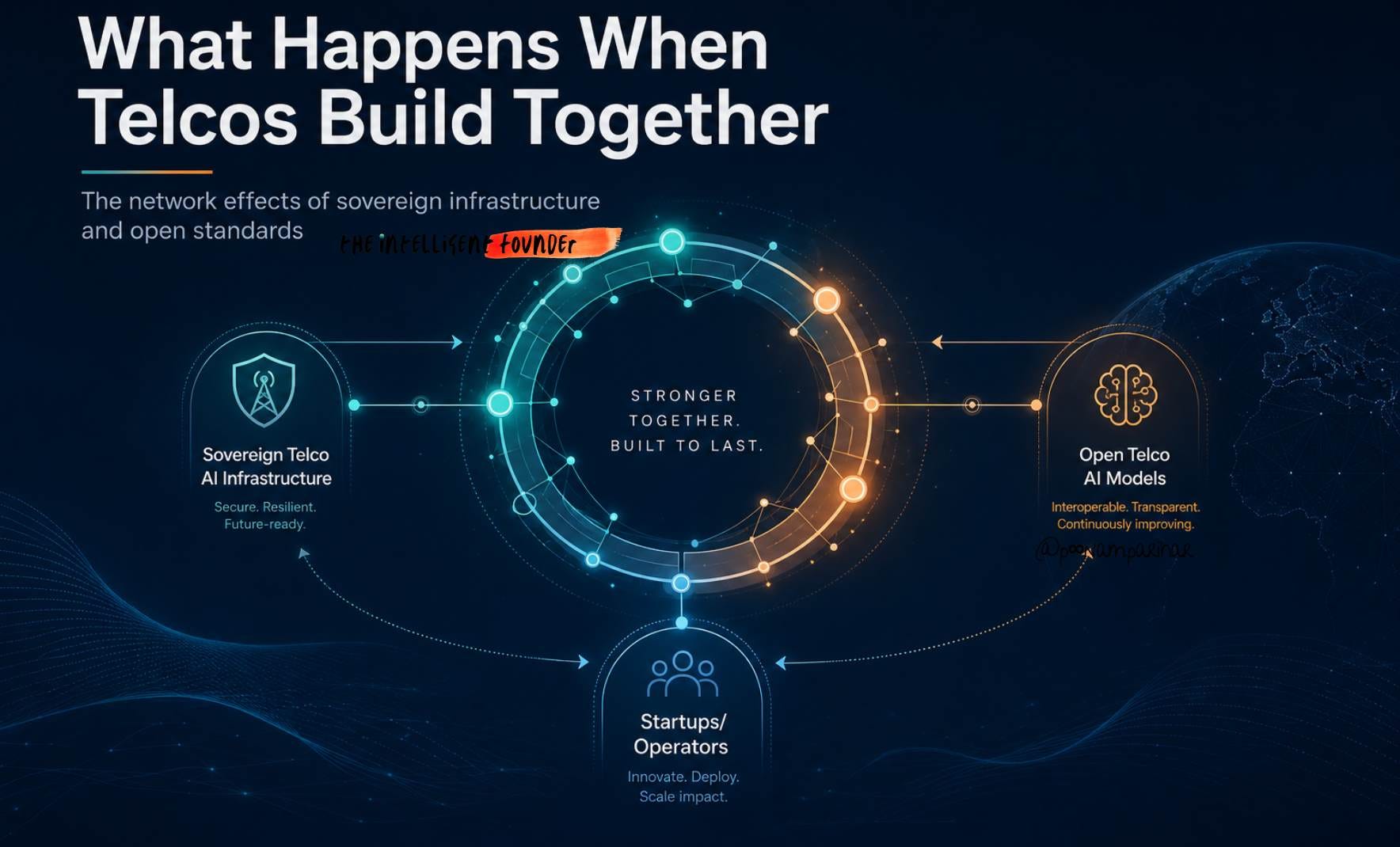
These themes are everywhere be it press releases, consulting reports, or analyst blog, but they’re stuck at the surface level. But the real story isn’t the themes themselves. It’s the flywheel that emerges when sovereign platforms and open models start reinforcing each other.
Right now, coverage treats sovereign AI as a compliance play and Open Telco AI as a collaboration portal. But neither angle explains the compounding advantage. for example,
how a sovereign stack becomes the default infrastructure that startups build on, or
how shared models get smarter because more operators contribute data.
The numbers backing these trends are undeniable. 89% of telcos will boost AI spending in 2026, and 90% say open-source models are critical, yet the narrative still talks about “ecosystems” in generic strategy language instead of concrete network effects.
Telco AI isn’t about choosing between sovereign or open.
It’s about the loop where sovereign infrastructure gives startups multi-operator reach, and open models give them a shared, improving brain to build on.
For founders, that changes the go-to-market math. For telcos, that’s the difference between becoming a data conduit and owning the compounding platform layer and thats exactly whats missing right now and what we are discussing in this deep dive.
There is a short high-level essay of this deep-dive on linkedin at the network effect. you can read it here. -
Table of Content -
Real story is the flywheel, not the themes.
Open Telco AI is the engine that makes the flywheel spin
The flywheel in action for founders
Sovereign and open reinforce each other
Extending the fabric: quantum and trust
Risks, failure modes, and what to watch
What to watch in 2026–2028
What an intelligent founder should do - the founder playbook
The shift: from isolated pilots to compounding platforms
1. The real story is the flywheel, not the themes
The real opportunity in telco AI is not any single theme on its own. It comes from the network effect that appears when sovereign platforms and open models begin reinforcing each other.
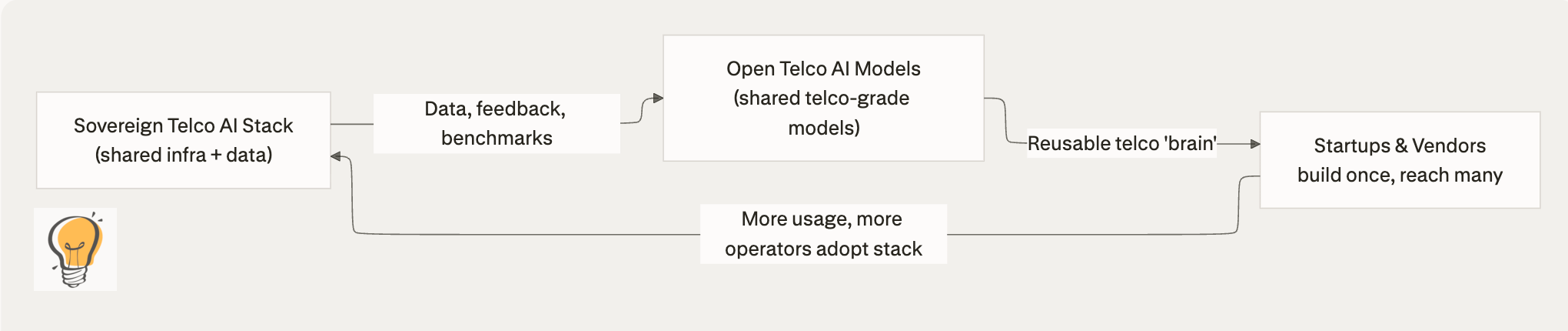
If we think of a sovereign telco AI stack as a national AI operating system for networks. It combines shared infrastructure such as data centres and GPUs, shared data such as telemetry and fraud signals, and shared tools tuned for telecom use cases. As more operators join, the stack gains more data, more deployment feedback, and more practical use cases. That makes the shared models better, which makes the platform more attractive to the next operator and to software vendors that want to integrate once and sell to many carriers.
That is the flywheel:
each new participant increases the value of the platform for everyone already inside it. Over time, the cost of building a separate stack becomes harder to justify, and the shared platform starts to become the default.
You can already see the shape of this in emerging telco AI initiatives.
When operators and vendors work on common telecom models instead of isolated in-house systems, every additional contribution, whether data, benchmarks, or deployment feedback, improves the shared base for the next participant. That is what turns sovereign infrastructure from a compliance story into a compounding platform advantage.
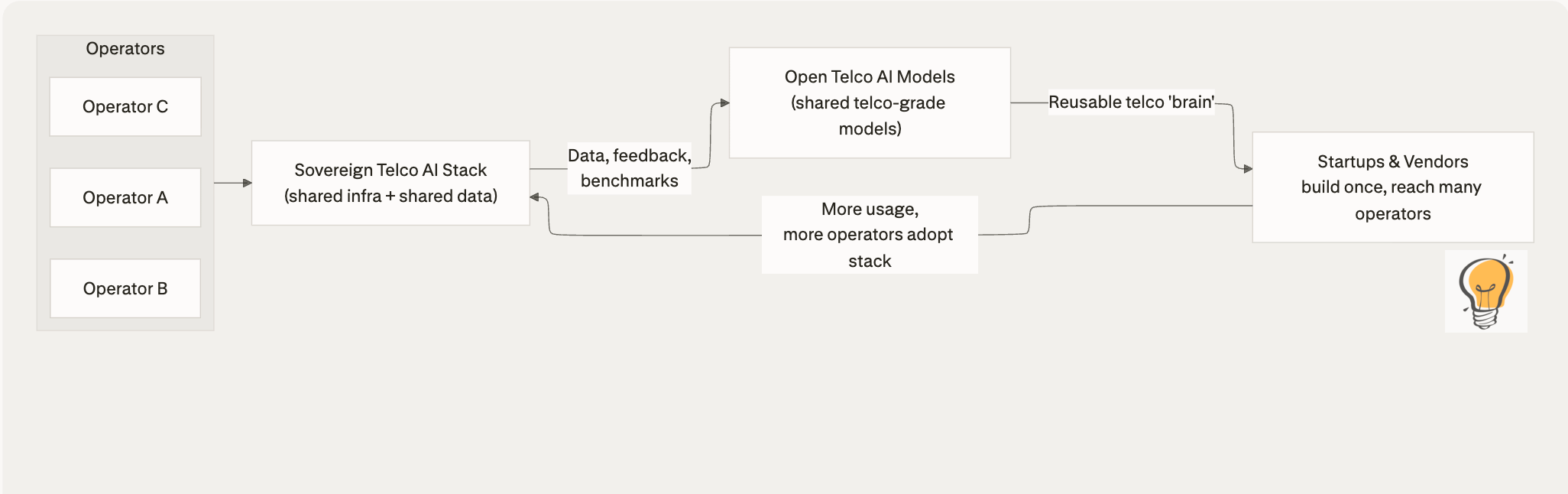
For founders, this matters because it changes the go-to-market logic. Instead of building for one operator at a time, startups can build for the stack, reach multiple operators through a common platform, and benefit from models that improve as the ecosystem grows.
2. Open Telco AI is the engine that makes the flywheel spin
The GSMA’s Open Telco AI initiative is more than a collaboration portal. It’s a shared, open platform where the industry can co-create the foundations of telco‑grade AI. It brings together operators, vendors, and researchers to build new models, datasets, and tools specifically for telecom use cases.
The loop works like this:
A core open-source model for detecting network anomalies is released.
Multiple operators try it, contribute fixes and better training data.
The shared model improves faster than any private, in-house version would.
More operators adopt it, and more vendors integrate with it.
The community grows, which leads to more contributions, and the cycle continues.
Nine out of ten telecom professionals say open-source models are important. That’s not just about saving license fees, it’s about transparency, adaptability, and the ability to fine-tune models for specific network problems without waiting for a vendor.
Real-world anchor?
Open Telco AI launched at MWC 2026 with founding partners including AT&T, which is contributing a family of open telco models trained on public network data, and AMD, which is providing compute capacity and GPU platforms. Other operators like Deutsche Telekom, Orange, SK Telecom, Telia, and many more have joined as part of the expanded consortium.
The initiative even includes a Telco Capability Index to track how well models perform on a growing set of telco-specific tasks.
3. The flywheel in action for founders
Let’s make this concrete for a startup that needs to decide where to build.
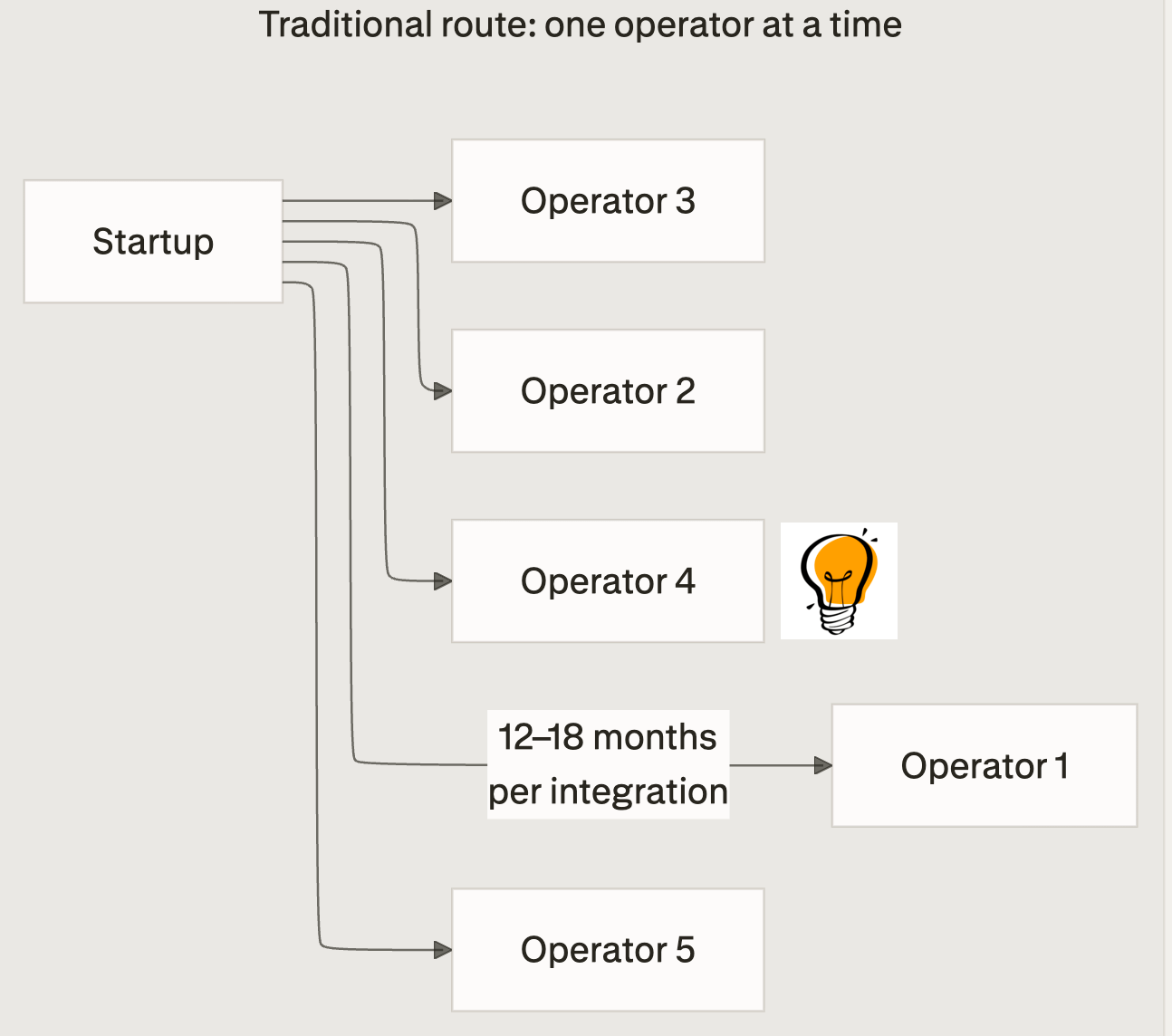
Imagine a European sovereign AI stack where five operators agree on a common way to expose network telemetry and anomaly alerts. On top of that, Open Telco AI hosts an open anomaly‑detection model that those operators have already tuned with their own data. A startup decides to build a fraud and revenue‑assurance product on top of that stack.
On day one, the startup plugs into the shared model and interface, instead of building five separate integrations into five different operator data lakes. The model is already “good enough” because multiple carriers have contributed data, labels, and fixes; every new deployment makes it better for the next one. The sovereign stack provides a predictable path to production, and the open model library gives them a constantly improving brain for free.
Now the flywheel shows up in the go‑to‑market math. Instead of a 12–18 month sales and integration cycle per operator, the startup designs for the stack once and reaches multiple operators with the same core product. Each operator that adopts the product contributes new edge cases and performance data back into the shared model, which makes the product more accurate and the shared stack more attractive to the next operator.
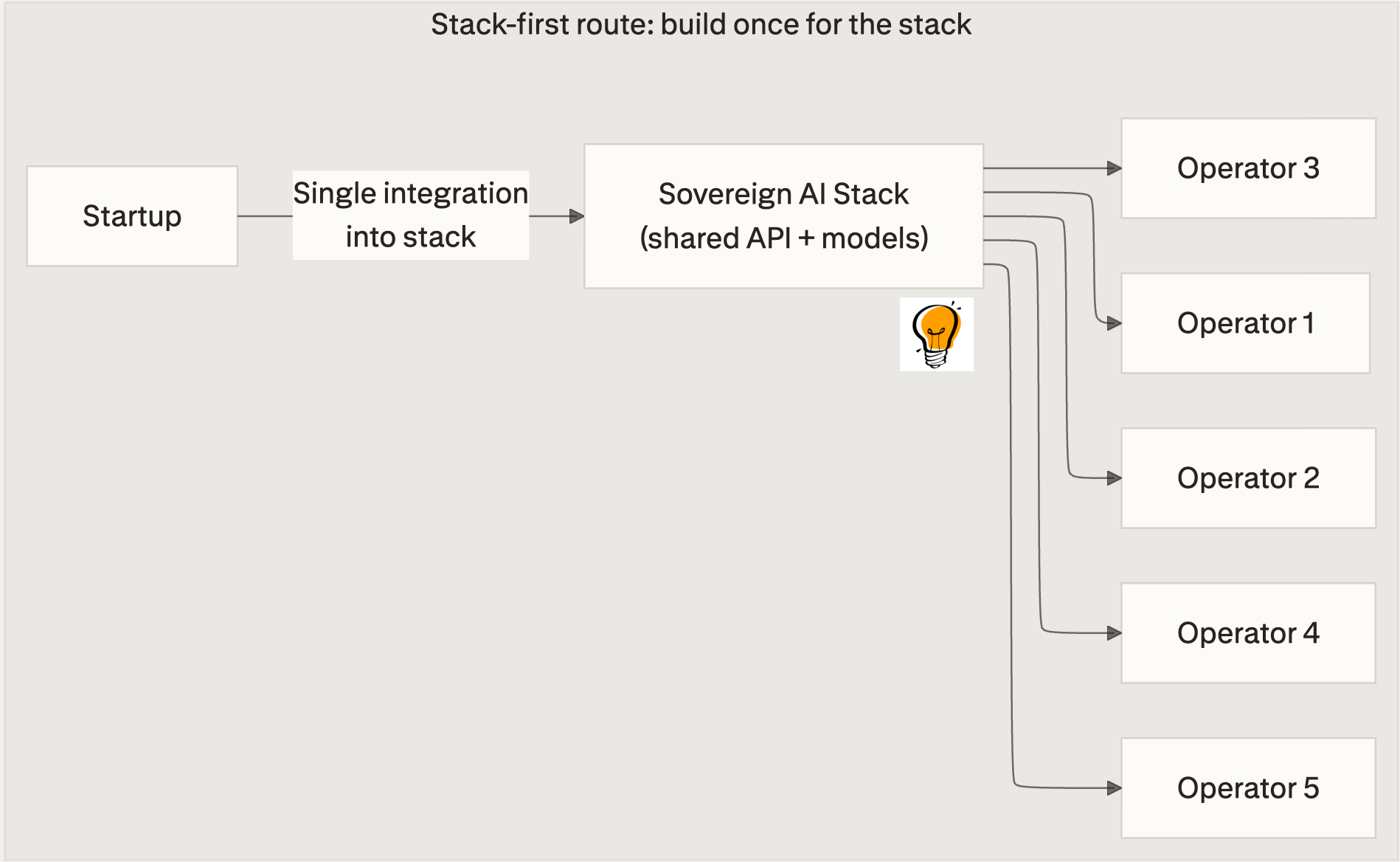
For a founder, the question shifts from “Which single operator can I convince first?” to “Which sovereign stack and open model ecosystem gives me the broadest, fastest route to several operators at once?”.
so you are not just selling into a network, you are building with a network that compounds on your behalf. That is the practical meaning of this flywheel.
4. Sovereign and open reinforce each other
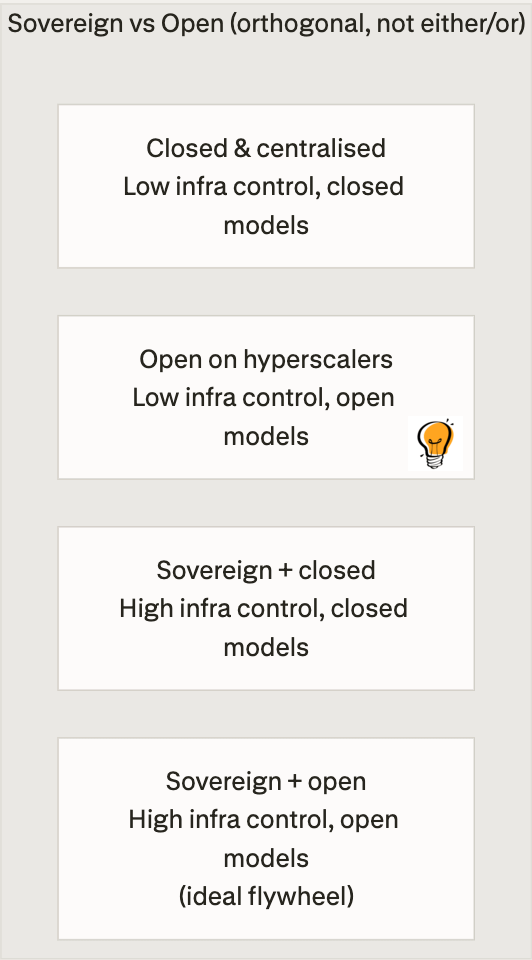
The most powerful story is that sovereign AI and open-source AI are not competing ideas. They make each other stronger.
Telenor AI Factory is a good example.
Telenor AI Factory is Norway’s first sovereign and secure AI cloud service. It’s designed to support the development and adoption of AI in Norway, with data stored and processed entirely within the country to comply with EU/EEA rules.
The infrastructure runs on NVIDIA-powered systems and Red Hat’s cloud-native stack, explicitly framed as sovereign AI cloud. That’s not marketing, it’s a real, operational sovereign AI platform that telcos can host on, and that startups can build against.
Sovereign AI demands control -
local infrastructure,
clear rules, and
strong oversight.
Open-source AI provides building blocks that can be inspected, adapted, and certified for those local contexts.
Together, they allow a country to say: “We will run AI on our own networks, using models we understand, on infrastructure we regulate.”
5. Extending the fabric: quantum and trust
There’s another layer here that’s worth noticing. the telco infrastructure is becoming not just AI-powered, but also quantum-secured.
In January 2026, T‑Labs (Deutsche Telekom) and Qunnect achieved quantum teleportation over 30 km of commercial fibre in Berlin, alongside normal traffic, with ~90–95% fidelity. The trial was described as a major milestone for deployable quantum tech on existing telco infrastructure.
This isn’t about replacing the network with quantum. It’s about adding a trusted, quantum-secured layer on top of the existing telecom fabric. The more quantum-secured endpoints exist, the harder it becomes for competitors to offer the same level of trust.
And that’s the compounding advantage.
the telco is not just a pipe, but a trusted, AI-powered, quantum-secured infrastructure layer.
Note - I’ll cover the quantum in more detail in another post here or at Quantopinion.ai.
Read the latest here.
6. Risks, failure modes, and what to watch
But all this doesn’t all roll out smoothly. There are real risks and failure modes.
Risk 1: Fragmentation of sovereign stacks
If every country or operator builds its own “sovereign” AI platform that doesn’t interoperate, the network effect gets diluted. Instead of a few large, shared stacks, you end up with many small, fragmented ones. The flywheel slows down.
Risk 2: Governance and incentives
Operators may treat open initiatives like Open Telco AI as marketing rather than actually contributing data and models. If contributors are shallow, the shared models don’t improve as fast, and the flywheel weakens.
