

Getting Ready for the Agent-Driven Future
Understanding the Connections and Relationships around AI Agents, Implementation Realities, the performance, impact and their adoption journey.

( 2025 The AI Agent Frontier : The whitepaper companion podcast)

The first time I started blogging 20 years ago, I wanted to share my travel experience, my curiosity that sparks as one explore a new place, with every detail of those intriguing thoughts, sensory impressions that flood in, in vivid colors, unique sounds, and unfamiliar scents awaken your senses. The curiosity to seek out the new, the eagerness to turn apprehension into discovery, the nervousness and uncertainty that arise in unfamiliar environments, making the experience both thrilling and a bit intimidating.
Last but not the least forming connection while sharing moments and gestures sometime just by being on the other side of the lens. Now I want to share my imagination.
Picture this: Not a fairy tale, not a sci-fi epic—just a regular Tuesday in the City of Circuits. Here, the hum of servers is the city’s heartbeat, and the streets are alive with digital whispers. In this metropolis, AI agents aren’t sidekicks or silent servants—they’re the city’s unsung urbanites, darting between data streams, hailing APIs like taxis, and swapping stories in the cloud café.
No capes, no drama—just a day in the life of the world’s most curious code and the Unlikely Heroes on a NOT SO average Adventure
The Planner sketching out the city’s blueprints, breaking big dreams into bite-sized tasks.
The Reflector sitting at the corner coffee shop, replaying yesterday’s moves, always tweaking, always learning.
The Toolsmith connecting the city’s gadgets, making sure every device, database, and doodad speaks the same language.
The Memory Keeper memorizing every shortcut, every detour, every lesson—so the city never forgets.
and the quest?
Untangling a traffic jam of emails.
Mapping the fastest route through a maze of spreadsheets.
Solving the riddle of “What’s for dinner?” by syncing your fridge with your calendar. although I have to say I am quite capable of doing that on my own. and I take pride in that.
But here is the plot twist. In this city of circuits, the agents don’t just follow orders—they improvise, collaborate, and sometimes surprise even their creators. They’re not just writing the next chapter; they’re remixing the whole book, one clever shortcut at a time. Oh but Of course they’re all following my lead here. I keep telling ‘em that.
I cooked this story up with perplexity but Why should this story matter anyway?
The world of AI agents isn’t about replacing humans or spinning wild tales. It’s about making the everyday extraordinary—turning routine into adventure, and data into discovery. The real magic? It’s not in the code, but in the creativity of how we use it.
I wrote about the anatomy of agents in my last post, their history and the future, the impact. but there was so much left unsaid about the present, the understanding this $236 Billion Market Revolution. so I want to build a little on that thought now.
AI Agent Interconnectedness
While everyone was talking about ChatGPT and generative AI in 2022-23, 2025 has taken an evolutionary leap towards Agentic AI - systems that can autonomously plan, reason, and act. the systems that don't just generate content, but actually do things. its no longer a bout creating better chatbots anymore. it's about building digital workforce members, an org chart, with Agents from board members to the assistants in every department. and this imagination is turning in to reality with even faster speed than most realize.
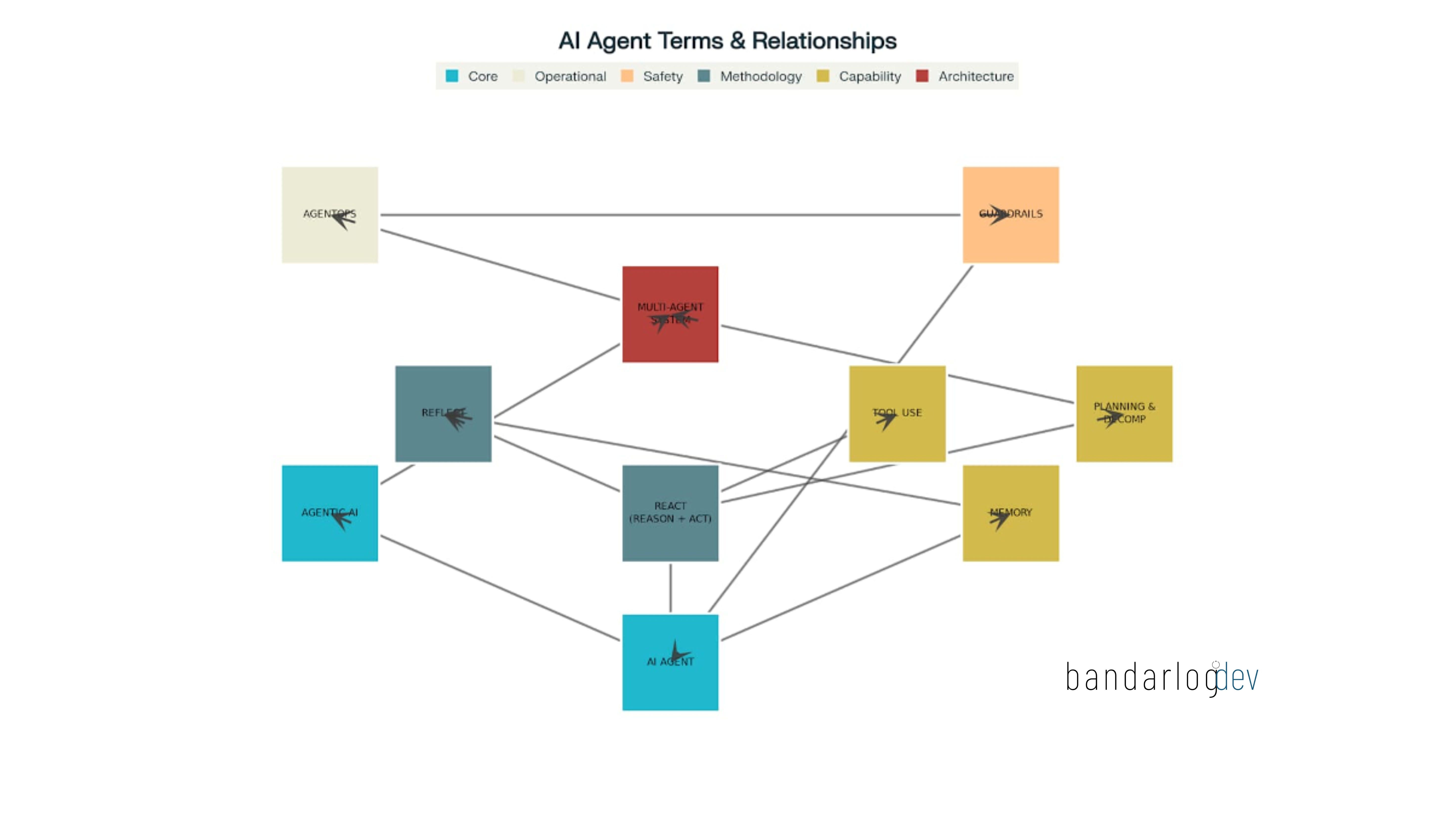
The journey from simple automation to sophisticated AI agents involves understanding how ten critical concepts interconnect to create truly autonomous systems. These aren't isolated technologies but rather interconnected components that work together to enable genuine agency.
At the foundation lies the AI Agent itself - a system capable of observing its environment, reasoning about situations, and taking actions without requiring step-by-step instructions. This evolves into Agentic AI, which goes beyond mere automation to encompass systems that can set goals, adapt plans, and make decisions with genuine initiative.
The core methodology enabling this capability is ReAct (Reasoning + Acting), where agents think through problems step-by-step while taking actions and observing results. This creates a dynamic loop where reasoning guides action, and action informs further reasoning. The Reflect component allows agents to evaluate their own performance and improve over time.
Market Explosion: The Numbers Behind the Revolution
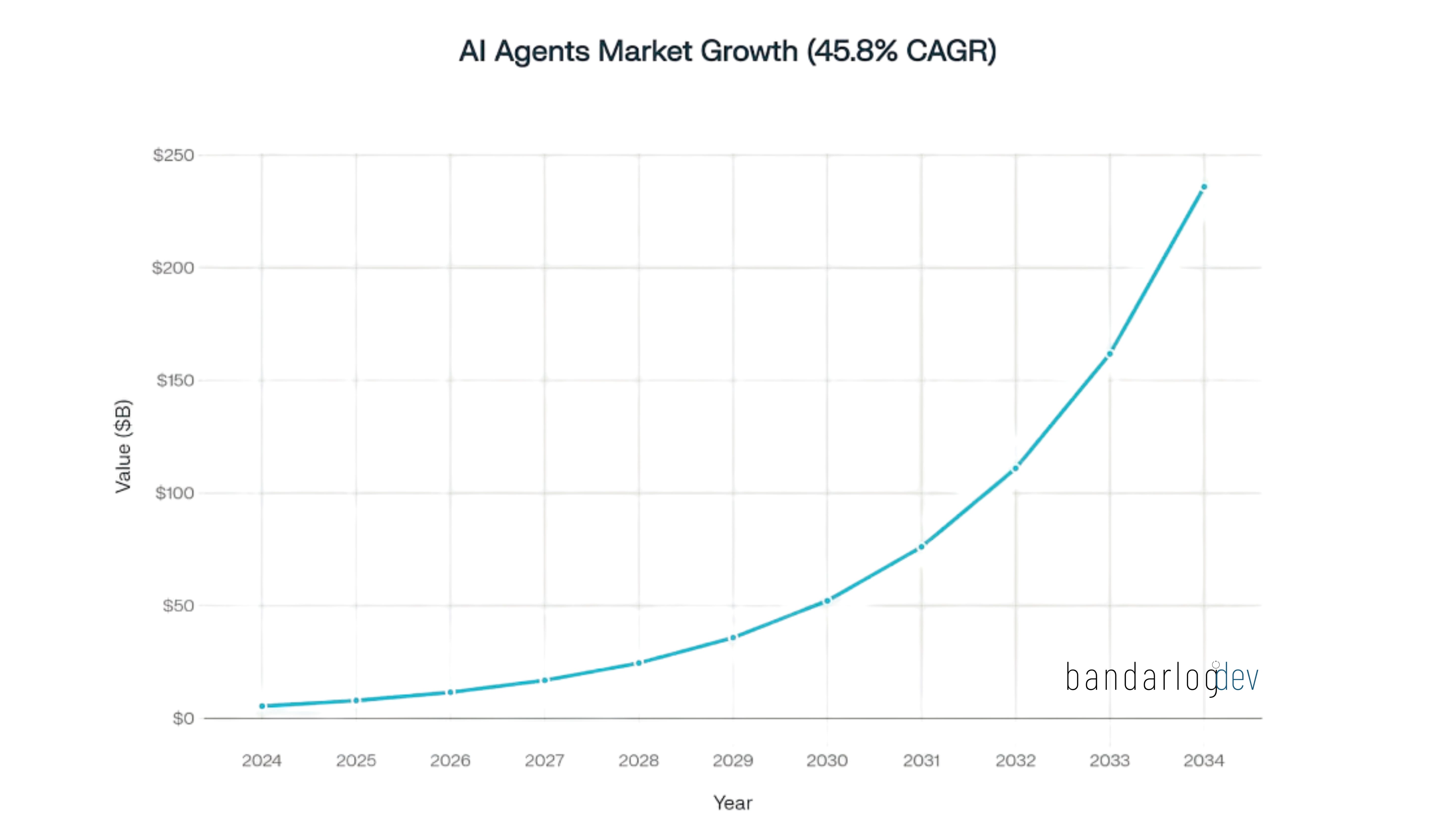
The AI agents market is experiencing unprecedented growth that dwarfs most technology adoption curves. The numbers ( $5.43 billion market in 2024 → $236 billion by 2034 (that's 45.8% annual growth!).) absolutely staggering present an incredible opportunity and growth trajectory surpasses even the early adoption phases of cloud computing and mobile technology.
North America of course is leading this market with 41% share, while Asia Pacific is projected to experience the highest growth rate through 2034. The driving forces include massive enterprise demand for automation, advancements in natural language processing, and the widespread adoption of cloud computing platforms. this explosive growth can be contribute to several factors including.
85% of enterprises plan to adopt AI agents by 2025
78% of organizations are already using AI in at least one business function
63% of top-performing companies plan to increase AI budgets by 6% or more
88% of executives say their teams plan to increase AI-related budgets in the next 12 months
Industry Adoption: Where AI Agents Are Making Impact
The implementation of AI agents varies significantly across industries, with some sectors leading in both adoption and success rates. Understanding these patterns is crucial for businesses planning their AI strategy.
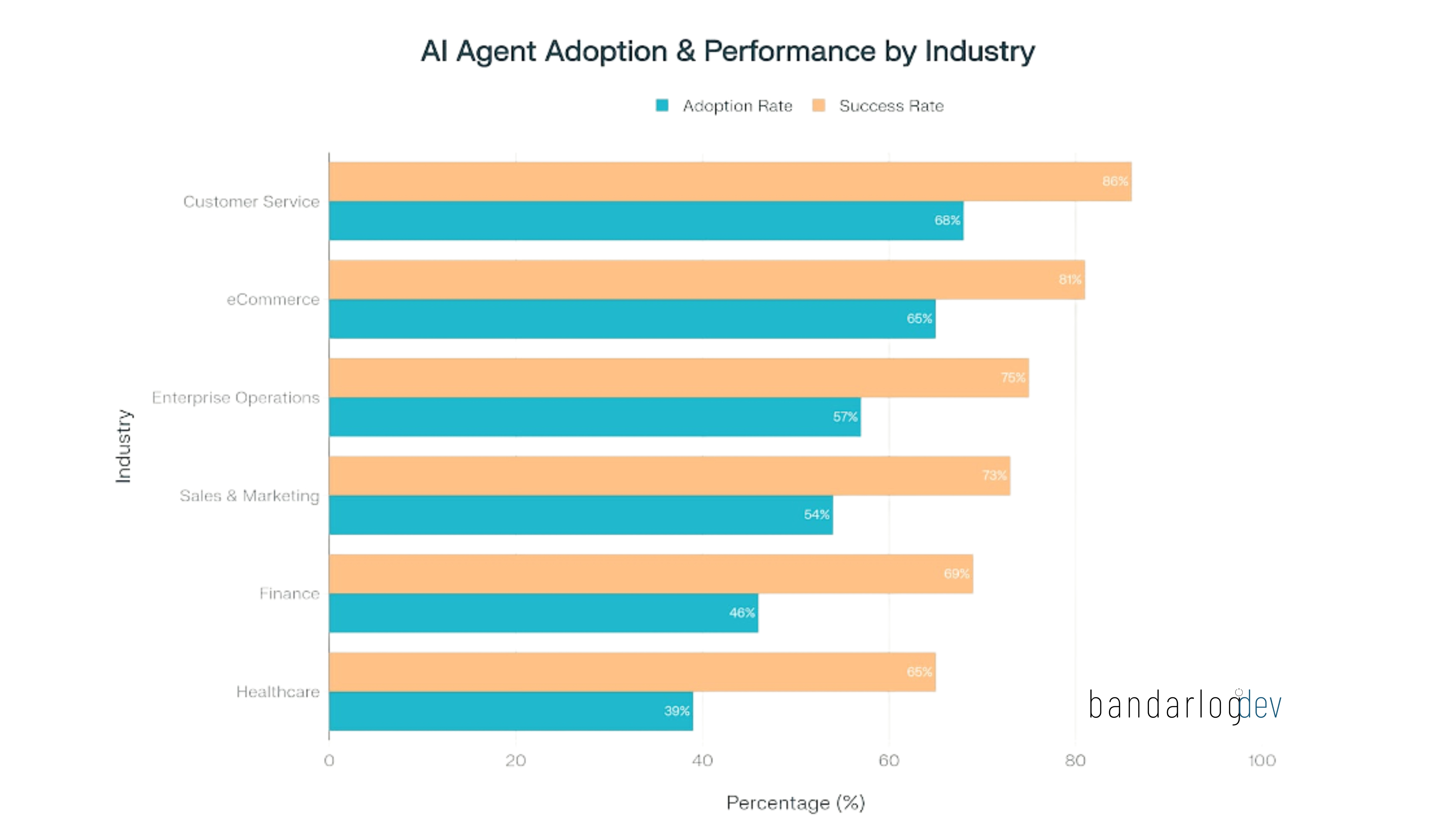
Customer service sector leading the pack with 68% adoption rate and 86% success rate, has proved that AI agents can service first-level support effectively, and 80% of all customer service interactions are now being serviced by AI agents. The technology has accounted for 30% reduction in operation cost while scores for customer satisfaction have been improved.
Marketing and sales is the one to see second best growth with 54% usage and 73% success. Companies are applying AI agents to lead qualification, follow-ups, and targeted campaigns, and result seems impressive: 20-30% sales boost in online channel from AI-powered product recommendation.
Financial services 46% adoption, 69% success rate is focussing on areas such as fraud detection, customer inquiries, and monitoring compliance. Interestingly, 53% of financial services organizations indicate that AI has resolved critical issues in their business. the healthcare sector adoption stands at 39% with a success rate of 65%. While more conservative in adoption, health organizations are experiencing significant benefits in appointment scheduling, patient support, and administration work. 42% of healthcare workers expect improved quality care from agentic AI deployments.
While nearly 90% of telecom companies use some form of AI, only about 10% are currently comfortable deploying fully autonomous AI agents in live production. Most deployments are still in early or piloting stages, but momentum is building as large language models and agentic frameworks mature . the 10% live production adoption is delivering 20–40% operational cost savings and 30%+ efficiency gains. Customer satisfaction has improved by 20–30%, with churn dropping 25%. By 2029, autonomous agents could handle up to 80% of customer service interactions.
Projections suggest that by 2029, autonomous agents could handle up to 80% of customer service interactions, dramatically shifting the operational landscape
Implementation Reality: Challenges vs. Expectations
Despite the promising statistics, AI agent implementation faces significant challenges that organizations must address for successful deployment.
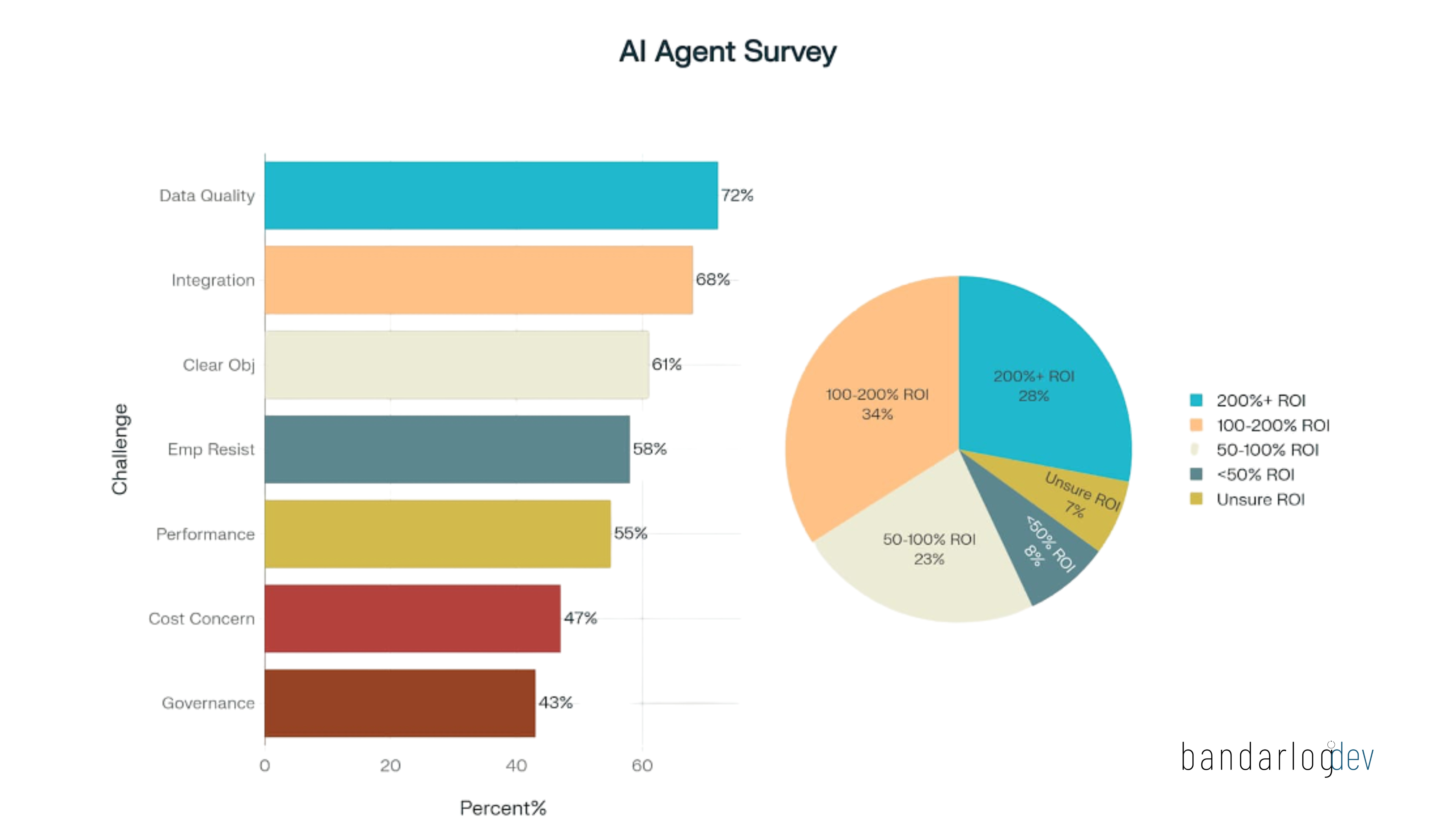
Data quality problems rank as the number one issue for 72% of the organizations reporting this as a top challenge. AI agents are only as trustworthy as the data that they are working upon, and poor data quality damages performance and reliability.
Complexity of integration affects 68% of the implementations. Integrating AI agents with existing enterprise systems, APIs, and databases tends to require a great deal of technical expertise and can result in project delays.
Unclear goals are a hindrance to 61% of projects. Most organizations push AI agents out without identifying measurable success criteria or concise use cases, and this results in unclear ROI as well as eventual project cancellation.
Despite all of these hurdles, ROI expectations are extremely high. 62% of companies expect more than 100% ROI on their AI agent investments, and the average expected return is 171% ROI. This is expectation based on experience: companies who used generative AI had an average of 152% return.
The Technical Infrastructure: Memory, Tools, and Operations
Successful AI agents require sophisticated technical infrastructure more than ordinary language models. Memory systems enable the agents to retain context from one conversation to the next and learn from past interactions. This includes short-term memory for maintaining the flow of conversations and long-term memory for ongoing learning. The tool use capabilities allow agents to call APIs, execute code, query databases, and interact with outside systems. This makes agents action-performing systems that may impact real-world processes.
Planning and decomposition allows agents to break down challenging goals into valid subtasks. Experiments show that agents perform best on tasks requiring about 35 minutes of human time, declining with longer tasks.
Multi-agent systems however, are the future in which a variety of skilled agents collaborate to solve intricate issues. Multi-agent systems will see more success in complex situations and would be able to solve issues that one agent cannot efficiently solve.
The Key Role of AgentOps and Guardrails
As AI agents move from test to production, AgentOps - the deployment, monitoring, and management environment for the agent - becomes of utmost significance. It includes debugging facilities, performance monitoring, and auto-recovery error systems. Therefore, Guardrails ensure that agents are safe, efficient, and in accordance with organizational goals. This would explain the Gartner’s prediction of 40% of agentic AI projects being discarded by 2027 due to insufficient risk controls and inadequate business value. Some new studies also prove that AI agents perform only 30-35% on complicated multi-step tasks. The performance difference reflects the need for robust testing, monitoring, and ongoing improvement systems.
The Financial Reality : ROI and the Business Impact
Key ROI drivers are:
Cost savings and time savings: Increased productivity and reduced operation costs
Enhanced accuracy and quality: Increased SLA adherence and reduced Mean Time to Resolution
Increased revenue: AI-powered upselling and improved conversion
74% of organizations report that their investments in generative AI have met or exceeded expectations, making them optimistic to invest more in agentic potential. the key is strategic deployment. which means organizations with robust AI ROI measurement frameworks in place would likely beat others in essential business metrics.
Future Outlook: The Next Wave of AI Innovation
As much as 15% of work choices will be autonomously taken by AI agents each day in 2028, compared to 0% in 2024, according to Gartner, by 2028, 33% of enterprise software applications will incorporate agentic AI. The convergence of advanced language models, better tooling frameworks, and enterprise-grade infrastructure is going to force the scenario to universal adoption of complete autonomous AI agents. As companies recognize the benefits of expert agents working together in place of one-size-fits-all individual systems, multi-agent systems are predicted to achieve the highest growth rates in 2034.
Getting Ready for the Agent-Driven Future
The AI agent revolution is not just technological advancement - it is a shift in paradigm for working. Organizations and leaders that understand the interdependence of agent technologies, prepare for implementation obstacles, and invest in infrastructure will be well positioned to leverage the spectacular growth opportunities to come.
The $236 billion opportunity while available for all, it would take more than launching AI agents to get it. It takes understanding of all the elements such as reasoning, memory, tools, and operations working together to build systems that can actually augment human capabilities and create business value.
It's not a question of if AI agents will redefine business operations - it's if your business will be ready when they do.
Oh but lets not forget the storytelling with the AI Agents yet. AI agents are set to revolutionize storytelling by making it more interactive, personalized, scalable, and creative. The future will see stories that adapt to each audience member, worlds that respond to our choices, and narratives that are co-created in real time—ushering in a new era where technology and imagination work hand in hand. I am seriously looking forward to some new ones.
Thank you!
I hope you found this article interesting, informative, and useful. Do like subscribe, share it with you colleagues and friends and on social media — X, LinkedIn, or the platform of your choice.