



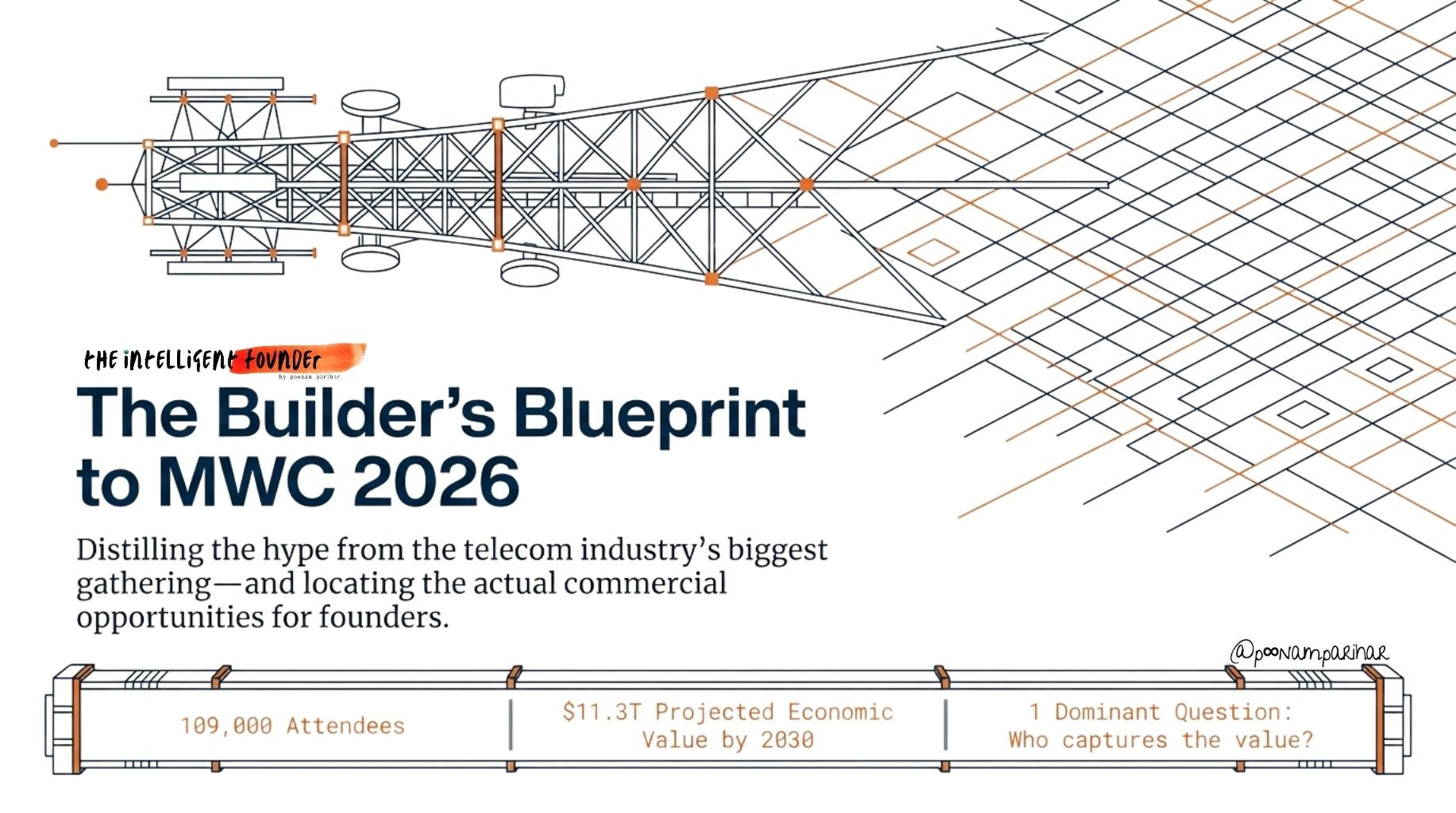
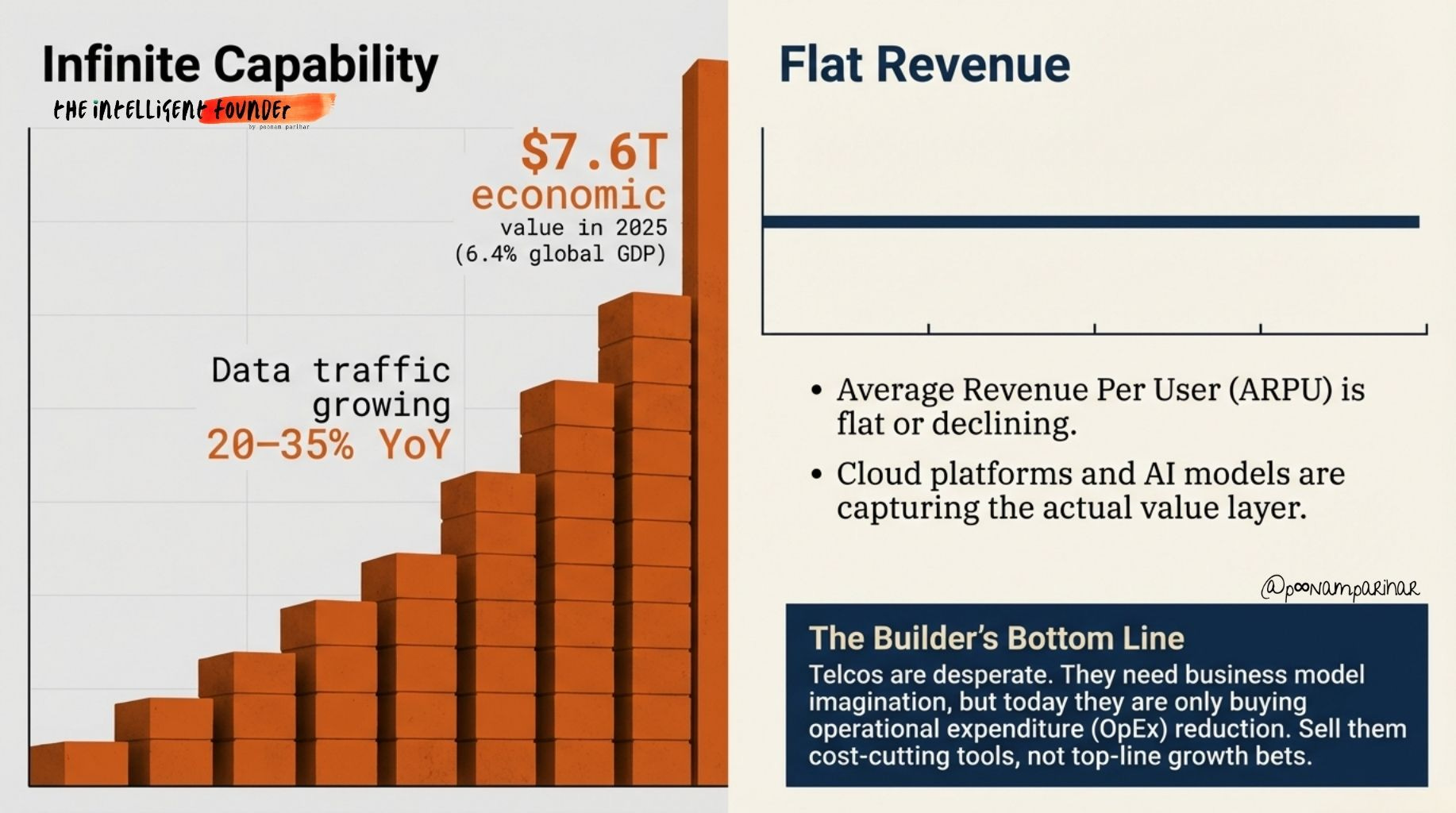
Mobile World Congress 2026 (Barcelona, 2–5 March) was the telecom industry's biggest annual gathering, attracting ~109,000 attendees for its 20th anniversary edition. The theme was "The IQ Era" intelligence everywhere, from radio towers to robots. Mobile technologies and services generated $7.6 trillion of economic value in 2025 (6.4% of global GDP), projected to reach $11.3 trillion by 2030. But beneath the demos and keynotes, and behind the branding, the real story is an industry sitting at a crossroads:
extraordinary technology,
no clear path to new revenue.
If you’ haven’t read the pre-conference MWC article yet, here is the link -
Now post conference, here’s what actually mattered and what it means if you’re building products, not selling phone contracts. ( total 14 points, top 3 elaborated here, and all rest in the podcast. )
1. AI Is Eating the Network, But Nobody Knows Who Pays!
Every major vendor pitched “AI-native” networks. the idea that future mobile infrastructure should be designed around machine learning from the ground up, not bolted on afterwards. Samsung showed multi-agent AI systems that manage networks end-to-end. Qualcomm launched a modem chip built specifically for “agentic AI”, software agents that act autonomously on your behalf.
Deutsche Telekom demoed a system that detects, diagnoses, and fixes network problems across the entire stack using multiple AI agents working together.
Almost all of this AI is about cutting costs (fixing faults faster, optimizing radio signals, automating tickets) rather than generating new revenue.
The ROI gap isn’t about technology/ it’s about business model imagination.
Bain & Company’s post-show report warned that the gap between telco leaders and laggards is widening fast, and any operator that can’t quantify AI business value soon needs to rethink its roadmap.
If you’re building AI-powered products, maintenance platforms, agentic systems, automation tools, telcos are becoming a buyer. But expect long sales cycles and a focus on opex reduction, not top-line growth bets. The real opening may be in building the tools that help telcos prove ROI, not the AI models themselves.

2. NVIDIA Is Becoming the Platform Telcos Build On
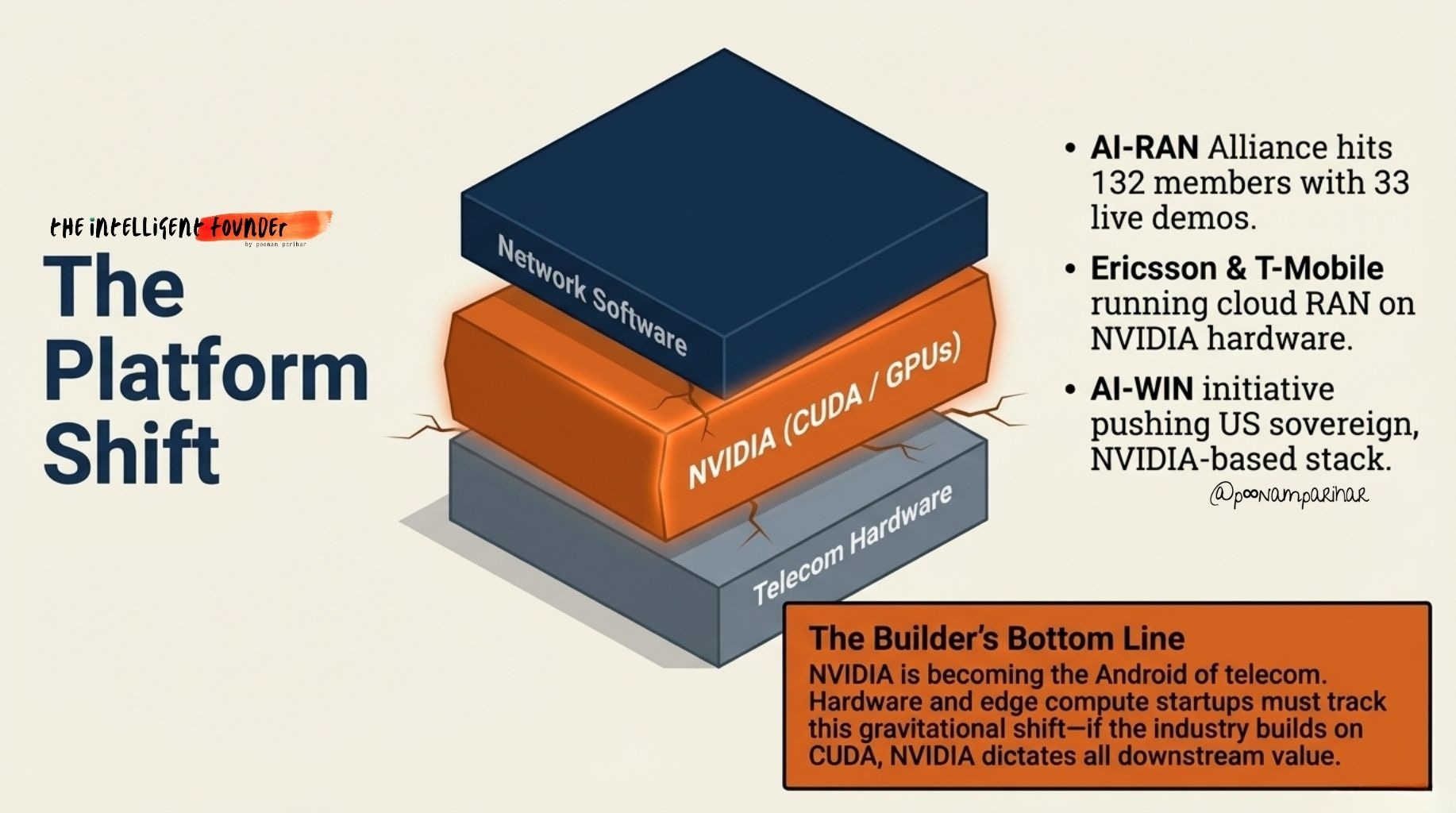
A coalition of major operators and vendors committed at MWC to build future 6G networks on NVIDIA’s AI-native, open platforms. The AI-RAN Alliance, the industry group pushing GPU-accelerated radio networks hit 132 members and showed 33 demos. Ericsson demonstrated its cloud RAN software running on NVIDIA hardware with T-Mobile, proving that radio network software can be portable across different chip platforms.
A separate initiative called AI-WIN (AI-Native Wireless Networks) brings together American companies to create a sovereign, NVIDIA-based AI network stack, a geopolitical as much as a technical play.
What does this means?
What NVIDIA did to AI is what Android did to phones, as it’s becoming the default development platform. If the mobile industry builds on CUDA (NVIDIA’s software framework), it locks in a dependency that shapes everything downstream:
who supplies hardware,
who writes the software,
who captures the value.
For hardware builders and edge compute startups, this is a gravitational shift worth tracking.
3. 6G: Impressive Tech, Zero Paying Customers
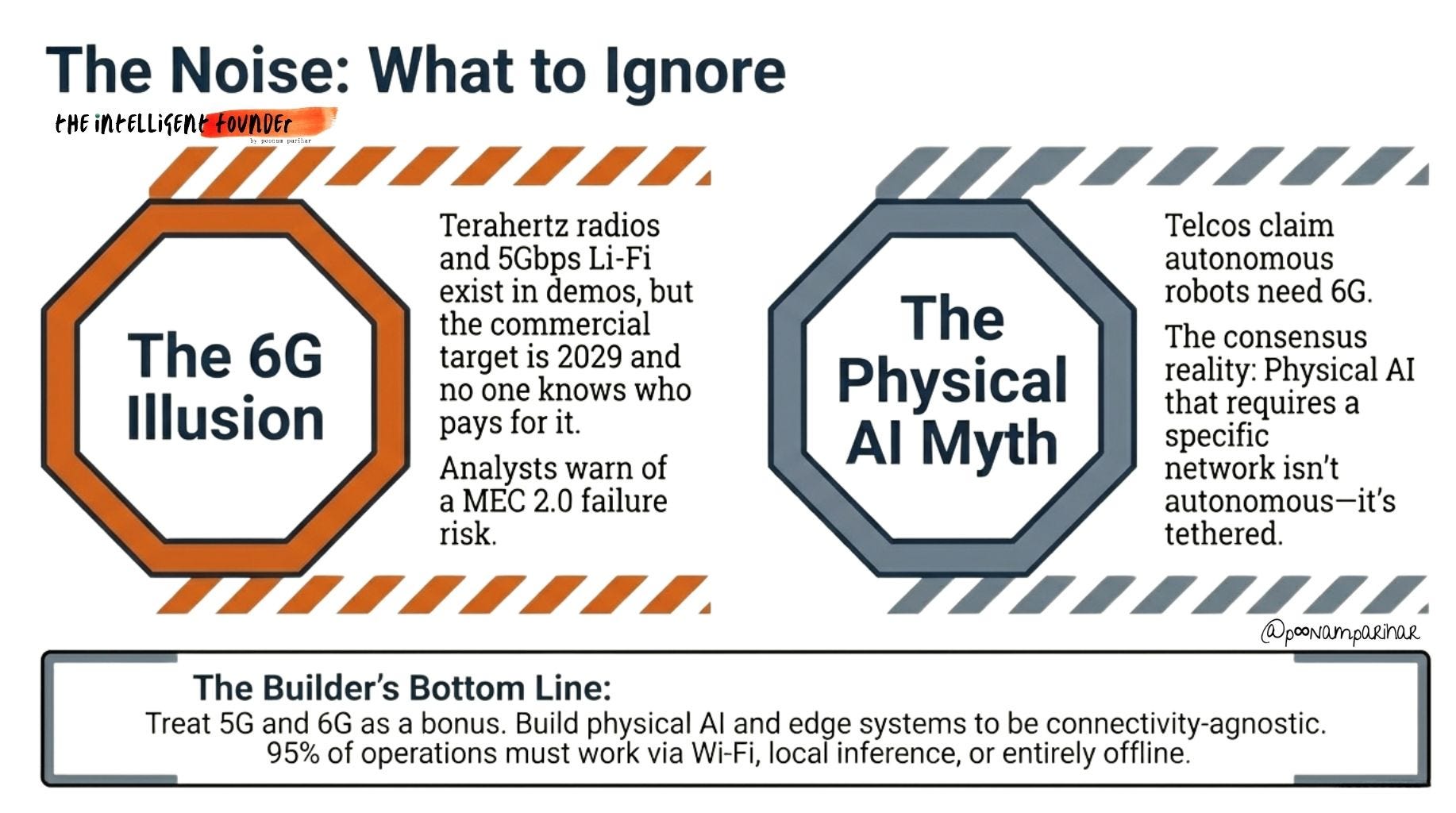
Multiple vendors showed off 6G technology: terahertz radio transmission, AI-native network architectures, even Li-Fi at 5 Gbps. A coalition of major operators targets commercial 6G from 2029. Ericsson claimed the first pre-standard 6G over-the-air session.
The sceptic’s view
is that, until someone answers “who pays for this and why?” the whole 6G story stays academic. and that exactly the view of the independent analysts too. Experienced industry are pushing hard against repeating the mistakes of 5G, which over-promised and under-delivered on new revenue. They have argued for evolving from existing 5G infrastructure rather than starting from scratch with a new, expensive core network.
One analyst likened AI-RAN with GPUs in base stations to “MEC 2.0”, a reference to multi-access edge computing, which failed not on technology but on economics. and the same risk applies here as well.
For founder's and builders?
If your product depends on 6G capabilities (ultra-low latency, massive device density), you have at least 3–5 years before real deployment. Build for what 5G and Wi-Fi can do today, not what 6G promises for 2030.
Here is everything we ‘ve covered in the podcast:-
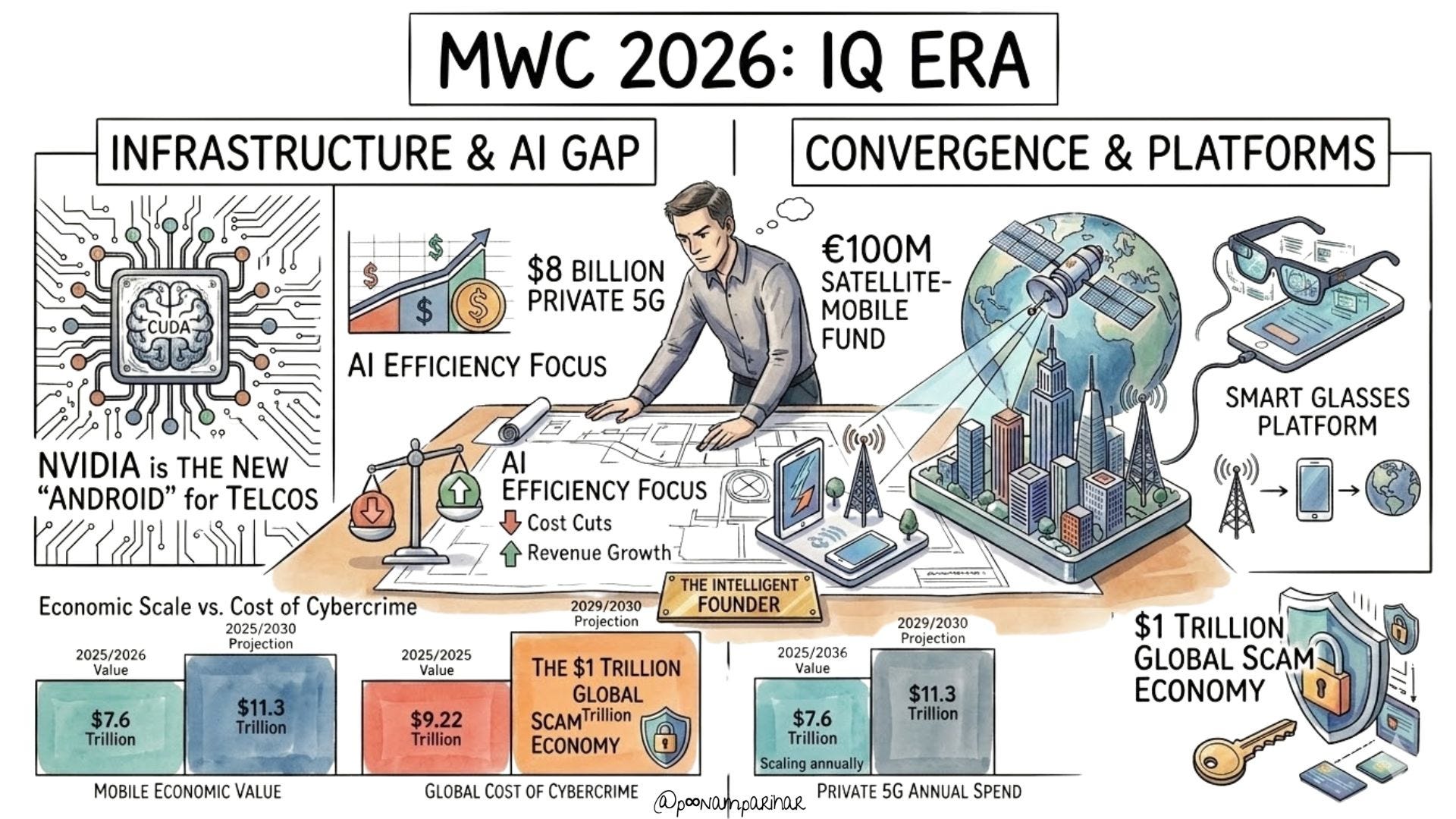
🔹 Satellites going mainstream and disrupting telcos » Starlink Mobile, Europe’s satellite split, and the ESA × GSMA €100M convergence fund
🔹 Smart glasses as the most tangible consumer product » Google Android XR, Samsung Galaxy XR, and the emerging app platform
🔹 The API economy » GSMA Open Gateway’s progress, where it works (fraud), and where it doesn’t yet
🔹 The $1 trillion scam epidemic » GSMA’s anti-scam push and the Scam Signal API
🔹 Private 5G moving from pilots to production » $8B market, airport and port deployments, flying 5G
🔹 Tokens as the new invisible traffic » why telcos can’t see or monetise AI workloads
🔹 Physical AI doesn’t need 5G or 6G » the case for connectivity-agnostic autonomous systems
🔹 Digital sovereignty reshaping European procurement » sovereign clouds, EU funding, and new compliance expectations
🔹 Quantum-safe telecoms being built today » quantum key distribution, post-quantum cryptography, and telcos as buyers
🔹 Energy efficiency and battery-free IoT » 30%+ savings in production and energy-harvesting sensors
🔹 The revenue problem nobody solved » flat ARPU, value capture moving up the stack, and the culture gap holding telcos back
The bottom line from MWC 2026 is simple:
the technology is moving faster than the business models, the culture, and the courage to change.
For founders and builders, that means building for what works today. 5G, Wi-Fi, and increasingly satellite, while keeping a close eye on where real funding and procurement shifts are happening. Don't bet your roadmap on telco promises that are still years from delivery.
Listen to the full episode for the complete breakdown, and follow Intelligent Founder here and on your podcast platform of choice for upcoming deep dives into the signals that matter most , from sovereign AI infrastructure to the satellite power struggle shaping European connectivity.


