

MWC 2026: Separating AI Hype from Deep‑Tech Reality
Inside the €585M Mobile World Congress's spectacle shaping telco budgets for the next 18 months

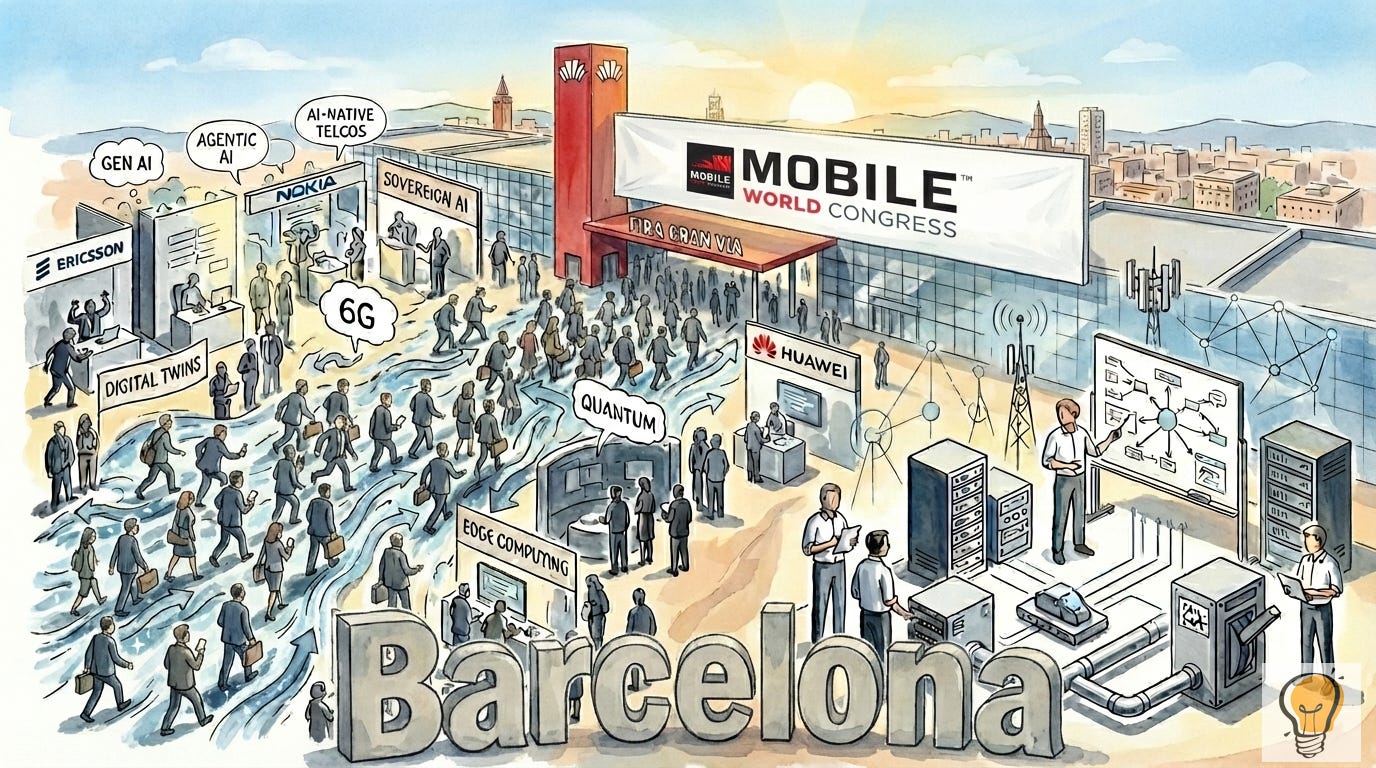
Back in 2024, I spent a full week exhibiting at the UK Pavilion at MWC in Barcelona, having over a hundred conversations at my stand. It was a great deep dive, but it taught me that walking the floor at large trade shows is mostly noise unless you have pre-booked meetings with people you simply cannot reach otherwise.
If you look at MWC over the past few years, it has transformed from a deeply technical telecom exhibition into a massive stage for geopolitical debates and digital economy hype. Lately, it’s felt like a “wildebeest stampede” of buzzwords. In 2024, the talk was still grounded in 5G and network automation, with some early curiosity about AI. But by 2025, Gen AI completely overshadowed the show floor. Suddenly, everyone was an “AI company,” but if you scratched the surface, most of it was just basic LLM wrappers and prompt engineering dressed up as revolutionary products.
This year, for MWC 2026, the herd is just changing its banner.
“Gen AI” is out, and “Agentic AI” is the new magic phrase.
You can expect the floor to be flooded with repackaged automation workflows claiming to be “autonomous agents,” alongside buzzwords like “AI-Native Telcos” and premium “Sovereign AI” stacks. There will also be plenty of early 6G hype and digital twins lacking real production data.
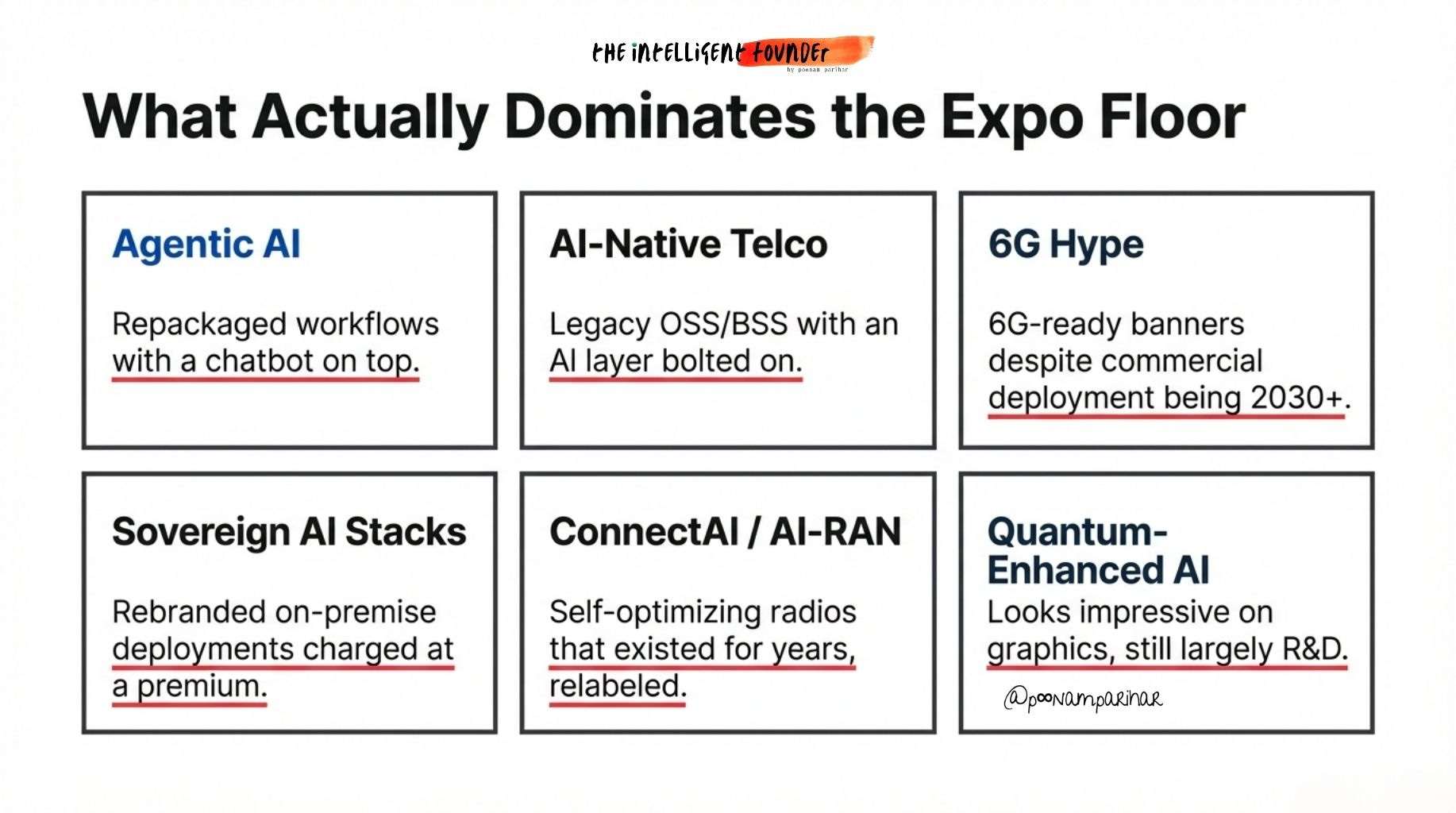
If you are heading to Barcelona this year, your goal should be separating the real builders (the “lions”) from the hype-chasers (the “wildebeest”). Don’t get dazzled by flashy demos. Instead, ask exhibitors the hard questions:
How do you measure performance beyond the demo?
Who owns the data and what does the governance look like? And most importantly,
what happens when your AI agent makes the wrong decision?.
If you’re staying home like me, don’t worry about FOMO, you really aren’t missing much. Almost all the big product reveals, walkthroughs, and impressive demos are launched online weeks before the actual event. Plus, after the first thirty chats on the expo floor, the conversations just repeat themselves anyway. You can easily catch up on the actual substance by simply reading the post-event analyst reports.
So what should you do instead?
Just build. A week of focused product development and R&D compounds much faster than a week of random handshakes. Plus, skipping the event saves you anywhere from £5,000 to £15,000 in travel and exhibition costs money that easily covers a month of engineering runway. This advice is of course for the founders, specially those bootstrapping or early stage, for those getting paid to go, please, by all means, go, and get the experience.
Now that we have out of the window, Lets look in to whats happening this week and if there’s some interesting insights that we can get from the event and all the buzz around it so you are covered.
I found it interesting to look in to a bit of history as well, how this primarily a telco gathering has transformed since. plus MWC in a way sets the tone and budget priorities for the telecom and enterprise infrastructure sectors for the next 12–18 months, and which is why its an important event for the telco community. And my doing this deep dive is not exactly being a a founder complaining about trade show costs here, but to try and cut out the noise and build a forward-looking technology thesis for a deep-tech founder including me, and so to pin-point and make sense where the real value will be captured exactly.
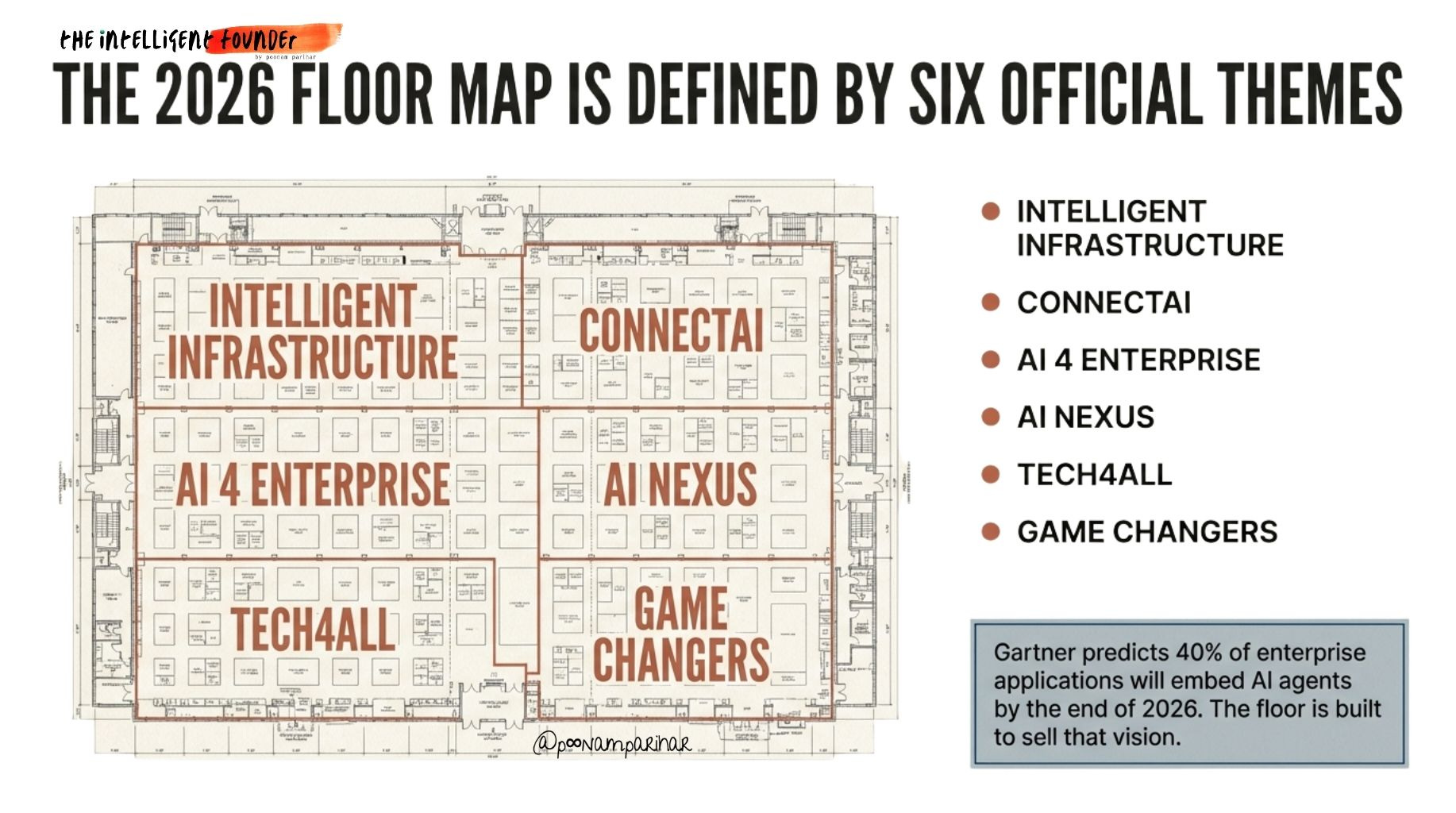
Now If you listen to the keynotes at Mobile World Congress (MWC), you would think the telecom industry solves its hardest structural problems every February. The reality on the show floor is far more complex. MWC is the ultimate mirror for the tech industry. Its a place where long-term infrastructure realities collide head-on with short-term software hype.
As a deep-tech founder building at the intersection of edge computing and network AI, I look at MWC not as a product catalogue, but as a strategic map. If you want to understand where enterprise budgets are actually flowing and where the “tourist traps” lie? you have to look past the banners.
So here is a deep-dive analysis of
how MWC has evolved,
why the AI hype cycle is a dangerous trap for builders, and
where the real technological value is being created in 2026.
1. The Macro Evolution: From Technical Standards to Geopolitical Stage
To understand the current state of MWC, you have to understand its trajectory. The event didn’t start as a selfie wall for folding phones. It started as a closed-door room full of engineers arguing about radio frequencies. Over 35 years, it has morphed from an engineering summit into a high-stakes geopolitical arena.

The Stack of Global Influence
1990 (Rome): The Standards Era
The first real GSM World Congress was held in Rome. The primary focus was GSM coordination. European regulatory coordination created a shared technology platform that replaced fragmented, incompatible national analogue systems. This wasn’t marketing; this was the creation of the global mobile economy.
2006 (Barcelona): The Spectacle Phase
Coinciding with the explosion of the smartphone, MWC became a “device carnival”. The floor was dominated by handset launches. However, underneath the consumer marketing, the real work was operators scrambling to lay the 4G IP-based infrastructure that would make the mobile app ecosystem possible.
Mid-2010s: Infrastructure & The Cloud Invasion
The narrative shifted to 5G, network virtualization (NFV), and the software-defined core. This was the era where hyperscalers (AWS, Azure, Google Cloud) realized telcos owned the ultimate edge real estate.
Telcos were forced to stop thinking of networks as pipes and start thinking of them as programmable edge infrastructure.
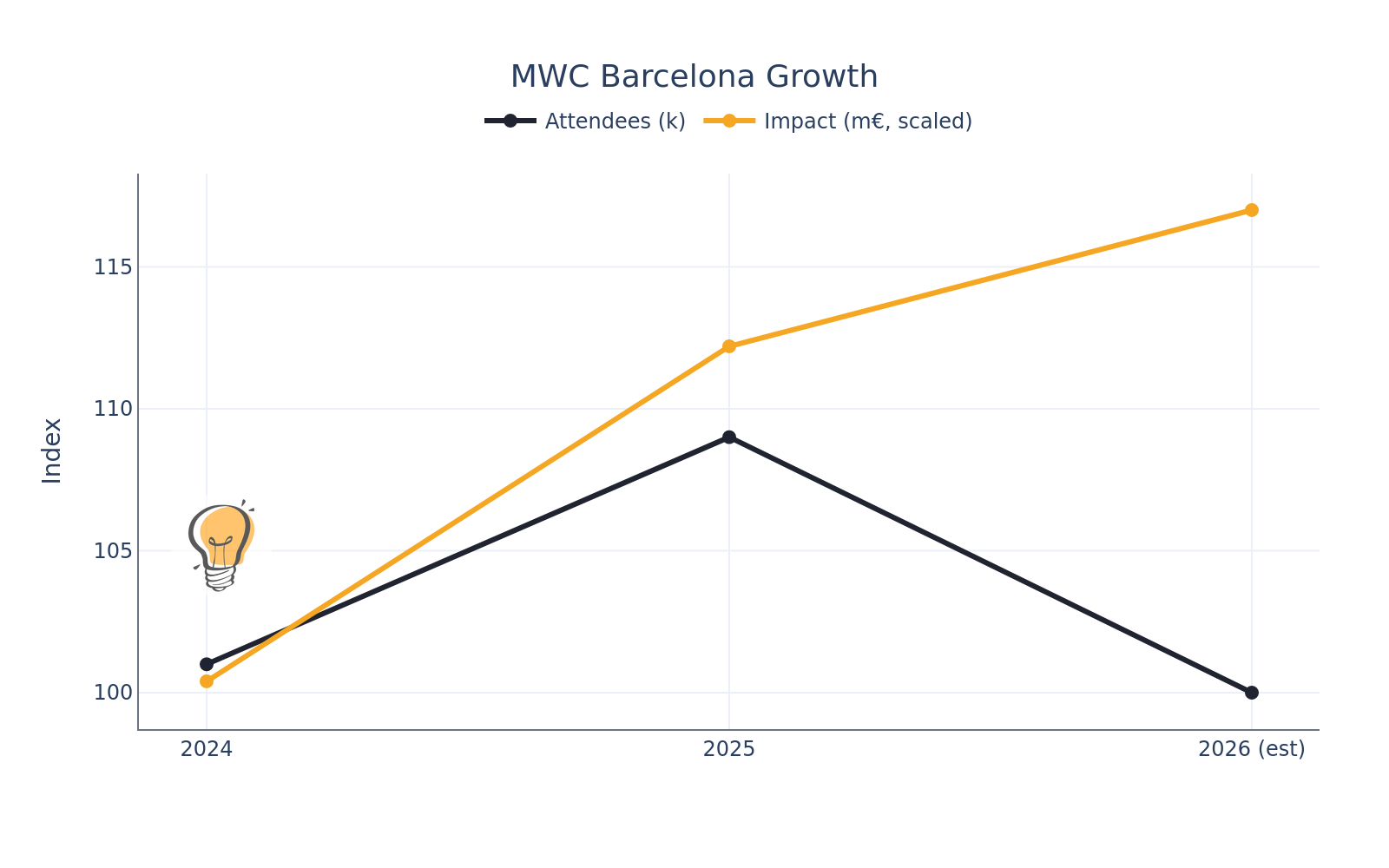
2020s–Present: The Geopolitical Forum
Today, MWC is a stage for debates heavily influenced by Washington, Brussels, and Beijing. The underlying theme of modern MWC is Sovereignty.
🛑 The Counter-Point: Geopolitics Is the Tech Stack
We often treat the “geopolitics of tech” as a bureaucratic annoyance that gets in the way of innovation. In telecom, it is the primary market constraint.
Take the European Huawei rip-and-replace mandates. European operators built their 4G and early 5G networks heavily reliant on cost-effective Huawei RAN (Radio Access Network) and core equipment.
As the EU and local governments moved to ban “high-risk vendors” from core networks by 2026/2027, operators have been forced into multibillion-euro replacement projects.
You can build the greatest AI network optimizer in the world, but if your hardware supply chain violates US export controls on advanced semiconductors, or if your data routing breaches European data sovereignty laws, your tech is commercially dead on arrival.
The geopolitical layer now dictates the hardware layer, which in turn dictates the software layer.
2. The 3-Year AI Hype Cycle (2024–2026)
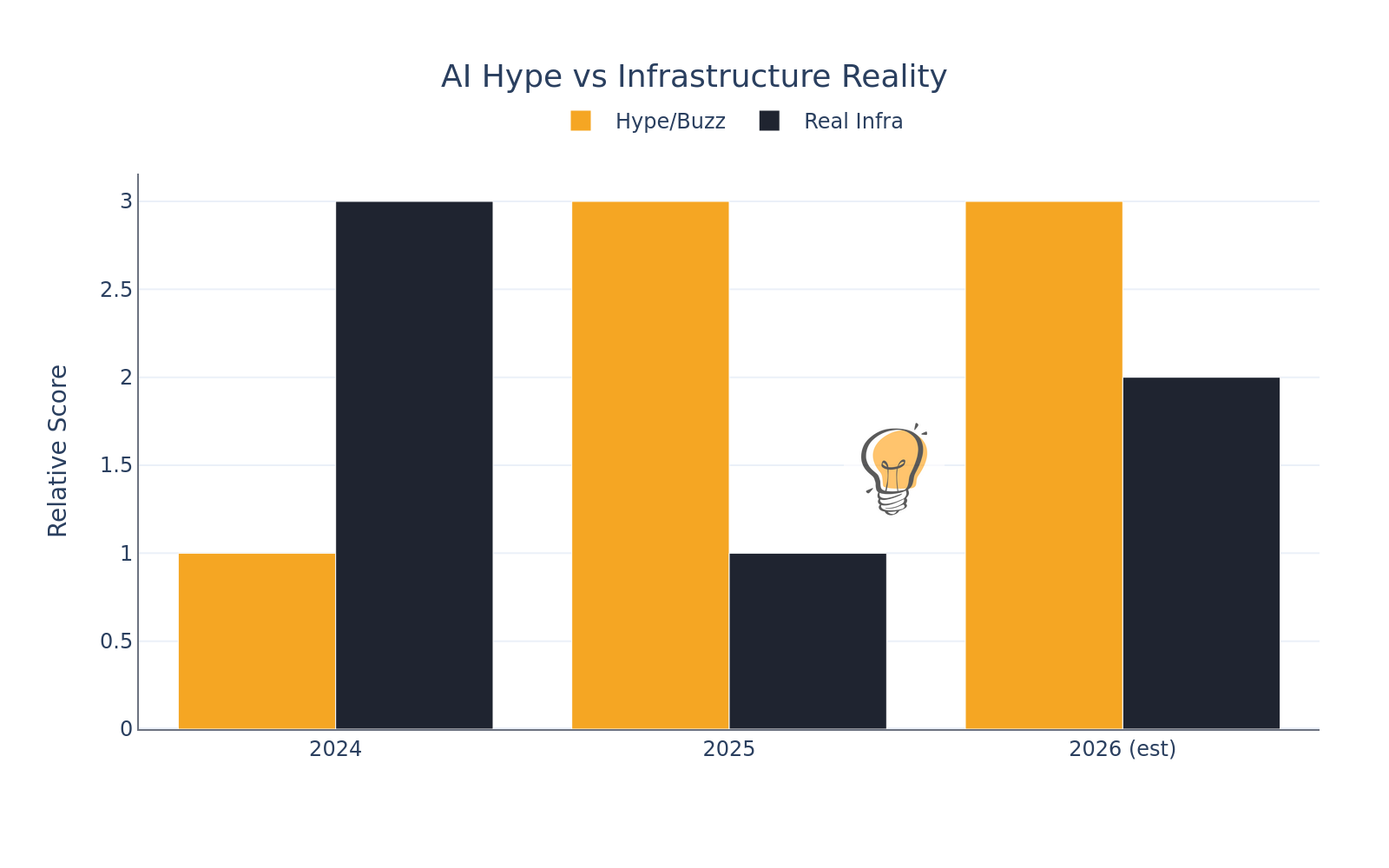
I use the term “Wildebeest Stampede” to describe the telecom industry’s tendency to charge toward new software buzzwords with high velocity but varying levels of direction. The banners change annually, but the underlying technical maturity takes years to catch up.
Let’s look at the last three years of MWC show floors:
2024: Network Automation / 5G
AI hype was building, but implementations remained tentative. A GSMA Intelligence survey during this period showed 81% of telcos were testing GenAI, but very few were deploying it in the core. The real money and engineering focus was still on 5G Standalone (SA) upgrades and basic network automation.
2025: Gen AI / Wrappers
The stampede reached peak volume.
Every booth slapped “GenAI” on their collateral.
Yet, analysts quickly pointed out the reality: most of these services were gimmicky LLM wrappers.
Vendors were taking off-the-shelf OpenAI or Anthropic API keys, wrapping them in a telecom-themed UI, and selling prompt engineering as “network transformation.”
2026: Agentic AI / AI-Native
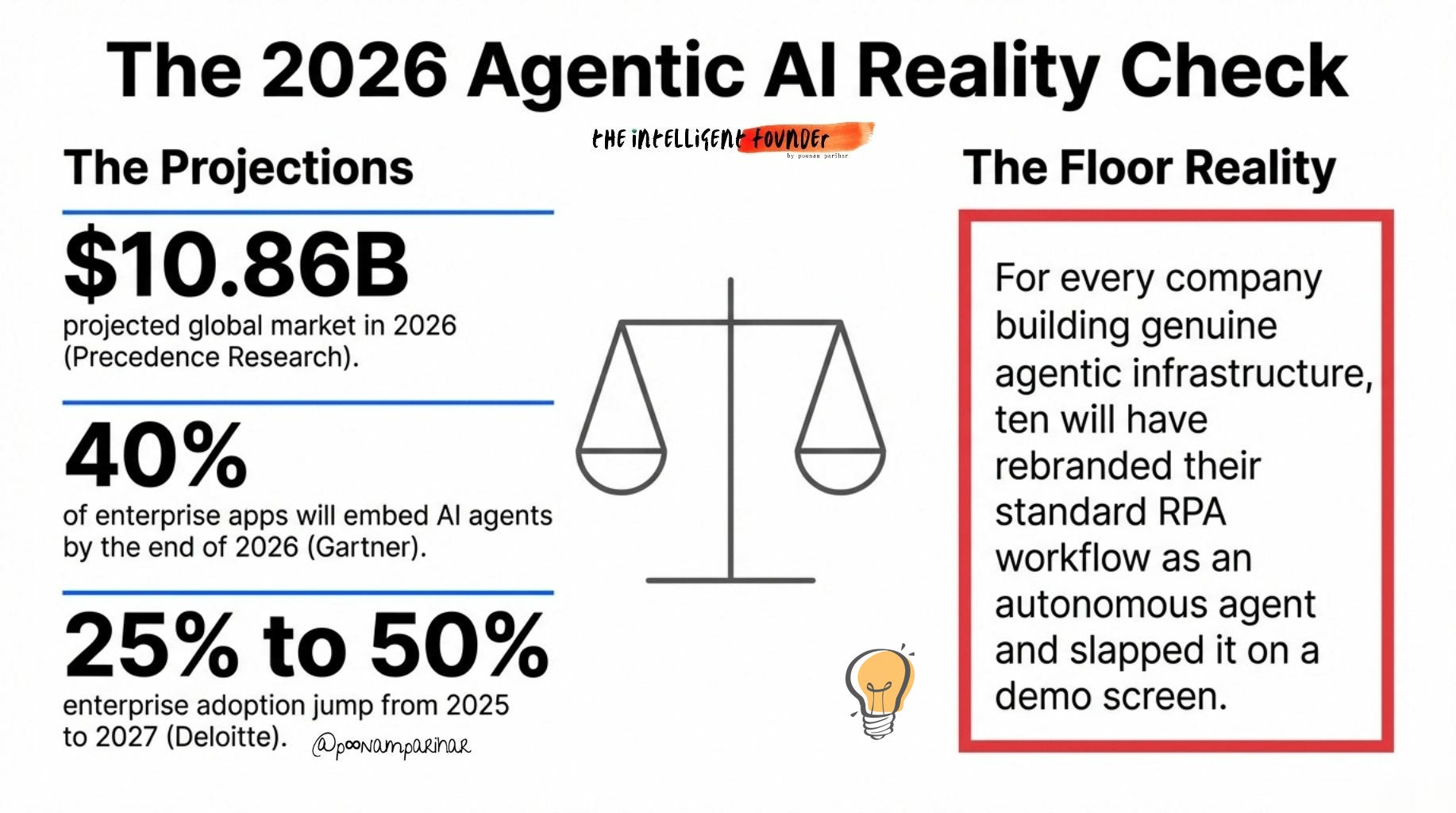
The exact same wrappers have been crossed out and rebranded.
Repackaged RPA (Robotic Process Automation) and deterministic, scripted workflows are now being labelled as “autonomous agents.” Gartner predicts 40% of enterprise apps will embed agents by the end of 2026, creating massive industry FOMO.
🛑 The Counter-Point: The Upgrade Cycle Illusion
The stampede isn’t actually driven by sudden technological breakthroughs; it’s driven by the enterprise software upgrade cycle.
Vendors are forcing “Agentic AI” into product updates to justify subscription price hikes.
For deep-tech founders, chasing these buzzwords is a fatal trap. If you build a product tailored strictly to the 2025 GenAI hype, by the time it achieves production-grade stability in late 2026, the marketing herd will have already moved on to the next banner.
Startups cannot afford to pivot their core architecture every 12 months just to match the MWC keynote schedule.
3. The Technical Litmus Test: Separating Lions from Wildebeests
At MWC, there are two types of companies:
