Network Automation: where we're now!
From conference rooms to reality, reviewing the last 5 years of chatters, implementation, strategies and future direction.
I started my career with Network automation at Cisco over 2 decades ago. my focus area was more script based automation for ( dev-test) routers and switches for MPLS Networks. from there I moved to production side in AT&T and Verizon and then to Keysight to selling testing and network monitoring solutions. when I founded my started bandarlog.dev in 2021, in UK, which was relatively a new tech landscape for considering I haven’t been to Europe much until, I wanted to understand how we plan to transform the legacy infrastructure to something that can handle next generation applications and services including metaverse who no one wants to speak about anymore except yes, there are groups working in peace on this, including me, with in a small bandwidth and scope.
the telco industry’s journey in past few years has been marked by intense activity. good or bad, some success here and there but a lot of technological disruption. in 2022-23 every other conference was focussed on Network automation, before that we were busy talking about how 5G is gonna change the world. then came Gen AI and all hell broke lose, literally. Disruption is good though. no seriously. but distraction? not really.
so now at the end of 2025 when we’re slightly more settled in the Gen AI space, and figuring out how Agentic AI and distributed architecture may be the future, I wanted to assess where we are in terms of our main goal and thats infrastructure.
TL;DR
Industry focus on Network automation in past 5 years.
Have we just been talking? How much automation has been achieved since.
has AI accelerated the efforts or been a distraction?
What’ is actually blocking progress, what are the biggest challenges.
What should be our roadmap
for Non-networking people » Automation comes in different flavors for example factory robots that build things, software “robots” (RPA) that click through computer screens like a person would, and workflow automation that handles business tasks like approving expense reports.
Network automation at the basic is what manages your internet equipments, the hardware - it automatically configures and fixes routers, switches, and firewalls that keep networks running. This is not workflow automation which handles paperwork, RPA mimics human clicking, but network automation actually controls the invisible infrastructure that makes the internet work - it’s managing the Infrastructure, not just the tasks.
1. The boom in Network Automation Conferences
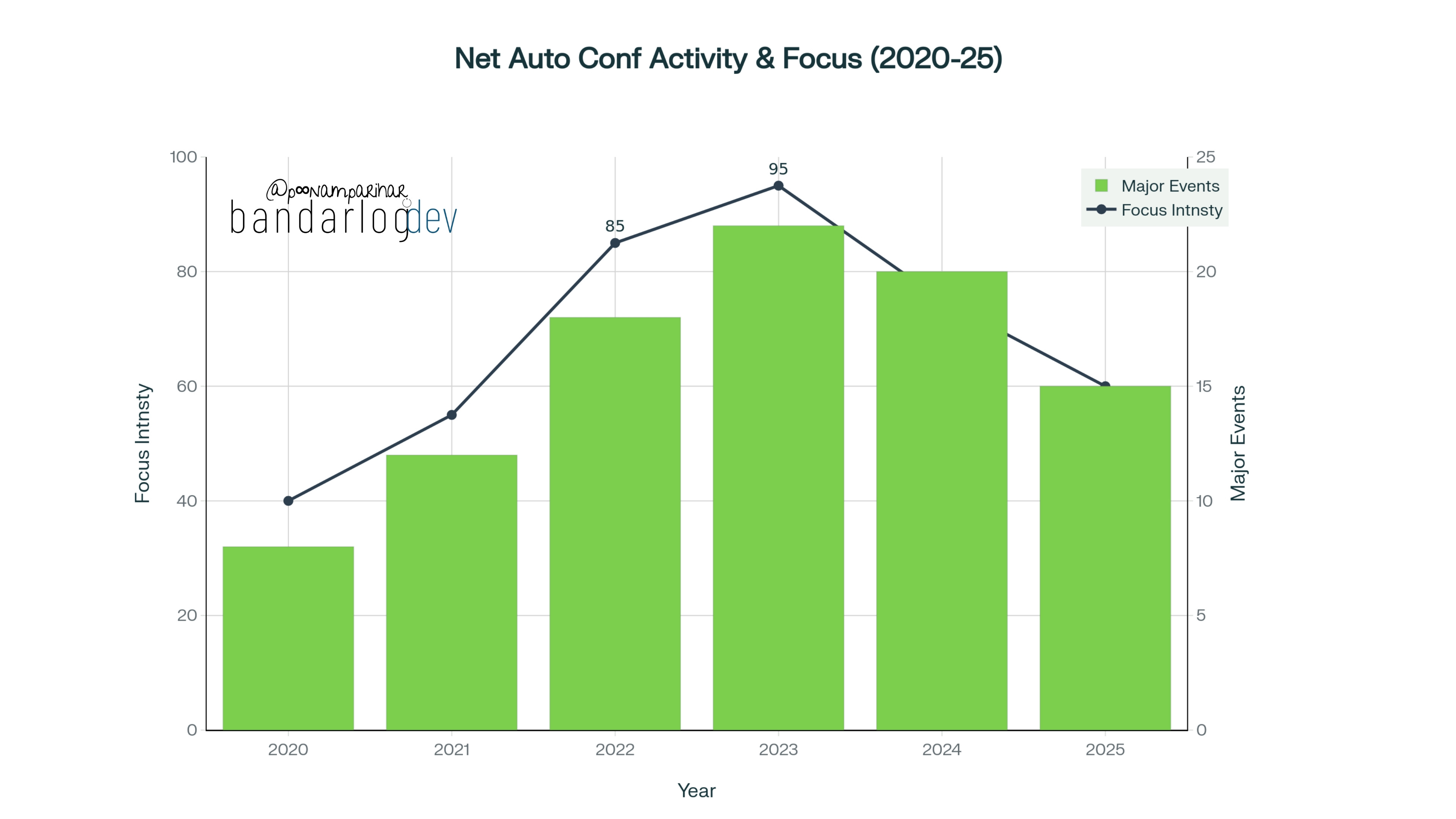
The last 5 years have witnessed a dramatic arc in network automation conference activity and industry focus, with a clear peak that tells us much about where the industry has been and where it’s heading now. the most number of conferences focussed on Network automation were in 2022-2023, with lot of industry mobilization around automation themes. In 2022, 18 major events focused heavily on network automation, with a focus intensity score reaching 85 out of 100. This number surged to 22 events in 2023 with peak focus intensity of 95, representing the high-water mark of pure automation-focused gatherings.
Mobile World Congress Barcelona 2022 epitomized this peak, dedicating substantial programming to 5G expansion and network transformation. in the same year, specialized events like Cisco’s “Automate & Innovate 2022” concentrated almost exclusively on integrated network automation and intent-based networking. The 2023 conference season maintained this momentum. MWC Barcelona 2023 pivoted toward cloud-native networks, 5G Standalone architecture, and network automation with a focus score of 92. NANOG 88 in June 2023 presented critical data from the “2023 State of Network Automation Survey Results,” while the GSMA Digital Transformation Leaders’ CxO Summit in November 2023 in Kuala Lumpur brought together industry executives to discuss intelligent digital transformation in the 5G era.
Then comes the shift:
While the absolute number of events remained substantial (20 in 2024, 15 in 2025), the focus intensity dropped markedly to 75 and 60 respectively in past 2 years. AI took the center stage and focus dropped to almost 50. all the major events such as DTW Copenhagen 2024, Network X Paris 2024 and FutureNet World 2025 demonstrated the new reality with automation focus at 55 versus AI focus at 90.
Several converging factors could explain why network automation may have first dominated the conference landscape during this 22-23 and then the drop afterwards.
5G Deployment Momentum: Global 5G connections surged from 1.05 billion in 2022 to 1.5 billion in 2023, a 43% increase in a single year. The number of commercial 5G networks expanded from 229 to 259, each requiring sophisticated automation for network slicing, dynamic resource allocation, and service orchestration.
Market Validation: The network automation market experienced explosive growth from USD 2.99 billion in 2022 to USD 14.56 billion in 2023, an astonishing 387% year-over-year increase. This validated the business case and attracted intense industry attention and investment.
Technology Maturity: By 2022-2023, SDN/NFV had matured sufficiently for widespread deployment. Over 140 telecom operators across 70 countries had implemented SDN or NFV by 2022, growing to over 70% of communication service providers adopting cloud-native network functions by 2023.
Legacy Infrastructure Urgency: The PSTN shutdown timelines became critical, with the UK’s BT Openreach announcing a complete shutdown by January 2027 and nationwide stop-sell beginning September 2023. Operators faced mounting pressure as 60-80% of IT budgets were consumed maintaining legacy systems, creating existential urgency around modernization.
Pre-GenAI Clarity: Importantly, 2022-2023 predated the GenAI revolution triggered by ChatGPT’s November 2022 release. The automation discussion remained focused on achievable, well-understood technologies rather than speculative AI capabilities, creating clearer messaging and stronger industry alignment.
2. How Much Automation Have We Actually Achieved?
When we look past all the conference talks and check the actual results, we see both real progress and how much work is still left to do.
Quantifiable Automation Gains
The proportion of automated network management tasks increased from approximately 15% in 2020 to 48% in 2025, a 220% improvement that nonetheless leaves the majority of tasks still requiring human intervention. NetBoxLabs data indicates that by 2024, 43% of all network management tasks had been automated, with predictions reaching 66% automation by 2026.
The network automation market provides another metric of progress, growing from USD 2.9 billion in 2020 to an estimated USD 46 billion in 2025 representing a 1,586% increase and a compound annual growth rate (CAGR) of 73.8%. This extraordinary financial commitment reflects real deployment rather than mere aspiration.
Autonomous Network Level (ANL) Advancement
the TM Forum’s Autonomous Network Level framework provides standardized measurement of maturity. which shows and it shows major progress in network automation however full automation just began in 2025 at 2%, but complete network autonomy remains years away.
Manual operations (Level 0) dropped from 25% of operators in 2022 to just 5% today, nearly eliminating manual-only networks.
Mid-level automation (Level 3) tripled from 8% to 25% since 2022, with systems making automated decisions in specific areas.
High automation (Level 4) saw the biggest jump - from zero to 20% of operators in just four years, expected to hit 35% by 2027.
Full automation (Level 5) just started in 2025 with 2% of operators achieving it in limited areas, but complete network autonomy is still years away.
Documented Operational Improvements
in Level 4 automation so far, are China Mobile cutting network faults 80%, Telefónica improving efficiency by 90%, while others reducing energy use by 5%. Industry-wide results do include 30% operational cost cuts, 40% faster service delivery, and up to 60% hardware savings through AI-driven automation and predictive analytics.
Energy Efficiency Revolution
from sustainability perspective, the reports included 20-40% energy consumption reductions compared to legacy system, specially fiber-to-the-premises using only 13% of the energy per line compared to FTTC and just 6% compared to DOCSIS 3.1. Telenor expects to save up to 100 GWh of electricity per year after legacy network switch-off approximately one-eighth of total energy consumption.
But the Sobering Reality
is that , despite impressive progress, significant limitations remain. Only 16% of telecom operators expect to reach Level 4 autonomy across all operations within the next five years, and merely 1% expect to reach Level 5 overall.
The technology maturity barrier remains the biggest obstacle to achieving Level 5, with physical infrastructure components like microwave antennas and optical fibers posing challenges that prevent full automation across all scenarios.
The gap between automated tasks (48%) and the remaining manual operations (52%) represents complex, exception-driven scenarios that resist straightforward automation. These include multi-vendor integration challenges, regulatory compliance workflows, physical infrastructure work, and customer-facing decisions requiring human judgment.
3. The whole AI Distraction Debate: an Accelerant or a Detour?
The emergence of generative AI ( Gen AI) in late 2022 and now with Agentic AI, which continue to reshaping industry priorities has fundamentally disrupted the telco sector and the network automation trajectory as such. the shift has’t just created the opportunities but also has added significant challenges and fundamentally disrupted the business model telcos used before. but all the attention on AI hasn’t been so much fun for the traditional industry roadmap and strategy.
The Investment Shift
the Traditional automation approaches commanded 85% of investment in 2020 but have now plummeted to just 35% by 2025. Conversely, AI/ML-driven automation grew from 15% to 65% of total automation investment over the same period, a very dramatic reallocation of automation investment.
Gen AI that didn’t even exist in the automation context three years ago now commands two-fifths of all investment. GenAI investment exploded from 0% in 2022 to 5% in 2023, 25% in 2024, and 40% in 2025. Agentic AI, an even newer concept, already captures 15% of 2025 automation investment despite being in pilot phases.
The Distraction
While we work transform legacy infrastructure, and find ways to integrated AI with in the network, All this AI hype has indeed created disruption and delay in automation progress:
Project Delays: Automation project delays increased from 10% in 2020 to 28% in 2024 before moderating slightly to 25% in 2025. and the major cause of this delay’s been attempting to integrate GenAI and agentic AI into automation workflows before these technologies matured sufficiently for production environments.
Focus Fragmentation: in 2022-2023 the focus was all on network automation. which got fragmented considerably in 2024-2025. Conferences that previously centered on automation implementation increasingly pivot to AI possibilities, potentially distracting from the unglamorous work of implementing proven automation approaches.
Technology Immaturity: Current AI technologies, particularly GenAI and agentic AI, face significant challenges in telecom production environments so the fundamental challenges of network automation have not really changed despite AI advances, and while we can finally see some success in customer use cases for gen AI, its too early to say if agentic AI will be panacea for network automation in telecoms.
ROI Uncertainty: While traditional automation delivers well-documented returns (30% OPEX reduction, 40% faster service delivery), GenAI applications in network automation show less certain business cases. 43% of telecom respondents reported investing in generative AI in 2024, but most applications remain experimental rather than production-critical.
The Accelerant
Its not all bad however, for AI if used appropriately can and is accelerating rather than impeding network automation. here are few examples.
Enhanced Capabilities: AI enables capabilities impossible with traditional automation. AI-driven self-organizing networks (SON) can automatically adapt to changing conditions with minimal human intervention. Predictive maintenance powered by AI forecasts equipment failures before they occur, allowing proactive interventions that reduce downtime.
Autonomous Network Advancement: The rapid progression to Level 4 autonomy (from 2% in 2022 to 20% in 2025) occurred during the AI revolution, not despite it. AI agents and predictive AI are explicitly credited with enabling the crucial step to Level 4.
Specific Use Case Success: Nokia’s MantaRay Cognitive SON deployed for STC Group improved network performance by up to 30% while reducing both energy consumption and manual work requirements. Thailand’s AIS leverages AI-driven analytics to enhance fixed broadband services through predictive maintenance and tailored solutions. These represent genuine capability expansions beyond traditional automation.
Energy Optimization: AI-powered energy management delivers 2-5 times more power savings compared to traditional energy management systems, with Nokia reporting AI technology can save up to 30% in energy for telecom radio networks. This directly addresses both operational costs and sustainability mandates.
So whats the complete picture? the reality.
AI can absolutely succeeds when enhancing existing automation, but not replacing it. the key is to AI strategically rather than abandoning proven automation systems.
The World Economic Forum observes that “a new model of telecommunications is emerging, whereby AI-enabled automation of network management and technology is reducing cost-to-serve,” but notes this requires careful integration rather than wholesale replacement of existing automation approaches
4. The Biggest Challenges Now: What’s Actually Blocking Progress?
below are 8 challenges that define the boundary between current capabilities and future ambitions.
As long as we have the Legacy Systems (85/100 severity, 35% impact): Outdated infrastructure still consumes 60-80% of IT budgets, leaving little for innovation. Technical debt combines with organizational silos and retiring personnel to create massive integration challenges.
There is no alternative to learning (Skills Gap 78/100, 28% impact): Critical shortage of engineers skilled in SDN, NFV, cloud-native, and AI technologies. Traditional network staff need retraining while organizations compete with tech giants for scarce AI talent.
How reliable is AI? (Reliability 72/100, 22% impact): AI hallucinations and unpredictable behavior in production networks risk affecting millions of customers. Models require extensive tuning and strict guardrails before deployment.
Security Concerns? (68/100, 18% impact): Automated systems expand attack surfaces and can propagate vulnerabilities at machine speed. Networks face 2,200 daily cyber attacks while governance frameworks lag behind AI capabilities.
Technology Immaturity (65/100, 25% impact): Most 6G technologies remain at early development stages (TRL 1-3). Physical infrastructure like antennas and optical fibers resist automation.
Uncertain ROI (62/100, 20% impact): While basic automation shows clear returns, AI-driven approaches have unclear payback periods. Dual-running costs during gradual transitions strain budgets.
Vendor Lock-in (58/100, 15% impact): Multi-vendor environments with proprietary APIs complicate integration despite 70% having “open” interfaces.
Cultural Resistance (55/100, 12% impact): Automation threatens established roles and power structures, creating organizational pushback against fundamental operational changes.
5. The Best Way Forward: A Pragmatic Roadmap
Given the complex landscape of opportunities, challenges, and competing technologies, what is pragmatic path forward for the telecommunications industry?
Start Small, Build Up
Don’t try to jump straight to full automation. Most companies should first focus on getting basic automation working well before attempting advanced AI systems. Nearly half of operators are still using mostly manual processes. they need to walk before they can run.
Focus on What Works Now (2025-2026)
Prioritize proven automation that delivers immediate value:
Automatic network configuration to prevent errors
AI that spots problems before customers notice
Predictive maintenance to fix equipment before it breaks
Smart energy management that cuts power bills by 2-5x
Build Strong Foundations
Success requires three basics:
Unified data: Combine all your scattered network data into one platform
Modern architecture: Replace old rigid systems with flexible cloud-based ones
Digital twins: Create virtual copies of your network to test changes safely
Use the Right AI
this is extremely important. Gen AI doesn’t at every stack level. in the same way generic Agents and chatbots wont work for specialized telecom tasks. Start with simple tasks where mistakes won’t affect millions of customers. One expert advises: “Solve the easy 90% reliably before chasing the fancy 10%.”
Don’t Chase Shiny Objects
Quantum computing and 6G won’t be ready for real use until 2030-2035. Stay informed but don’t bet your strategy on unproven technology.
Train Your People
Technology is only half the battle. Retrain network engineers for automation, restructure teams around new ways of working, and address fears about job changes transparently.
Stay Vendor-Flexible
Use open standards where possible but be practical. Build automation that works across different vendors’ equipment rather than waiting for perfect compatibility.
Track Real Progress
Measure success beyond simple percentages: How fast do you fix problems? How much energy do you save? How quickly can you launch new services? Use these metrics to adjust your approach.
Conclusion: Critical Questions for the Road Ahead
Having reached reached a pivotal inflection point in 2025, with AI-driven technologies now dominating the landscape and fundamentally transforming how networks are designed, deployed, and managed. The transition from traditional script-based automation to intelligent, self-managing networks represents one of the most significant shifts in enterprise IT infrastructure. However, the key questions remain as automation evolves:
Are rapid tech shifts causing endless evaluation? Should we target autonomy only where it’s most valuable?
Is GenAI hype overshadowing proven solutions?
Are resources mis-allocated?
Is 6G/quantum talk premature?
Are organizations keeping pace?
Are we measuring results correctly? Is industry coordination needed?
Perhaps most fundamentally: Are we automating networks to serve human needs better, or has network automation become an end unto itself, pursued because it’s technologically fascinating regardless of whether it delivers proportionate value?