


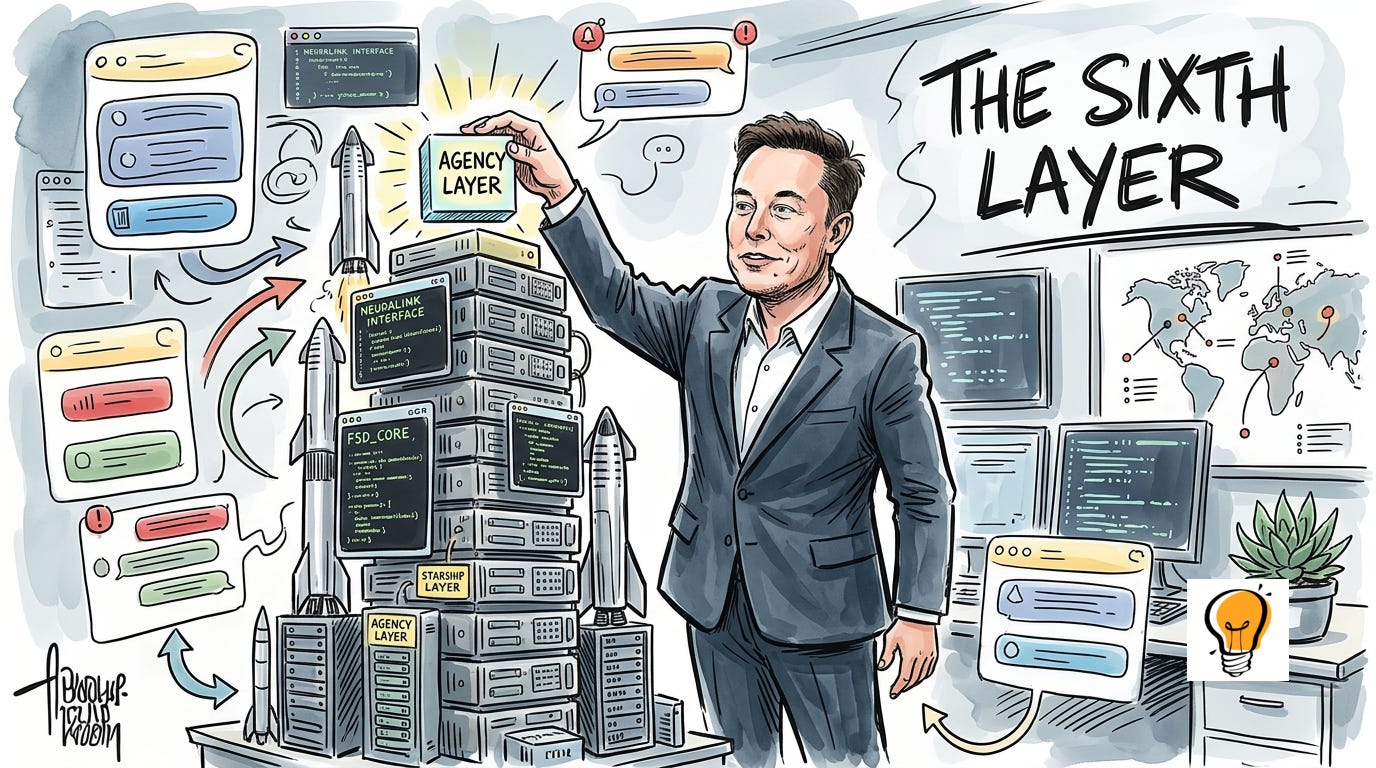
It looked like a meme. Elon Musk is seen “vibe coding” with an AI model, the internet does its usual thing, and then almost immediately SpaceX moves to buy Cursor in a $60 billion all-stock deal. If that is all you saw, the obvious interpretation is that Musk discovered a new toy, got excited, and did what Musk does best: turned fascination into acquisition. but no deals happen overnight. so,
I’d say its a good clever PR. 👍
The Cursor move makes far more sense, when I view it as a follow-up to SpaceX’s xAI acquisition I wrote about here a few of months ago.
SpaceX had already merged with xAI in a record-setting transaction that combined compute ambition, frontier models, physical infrastructure, and the global distribution under one roof. Cursor is not some random add-on to that stack.
It is the interface layer where the stack becomes operational.
This is why this story matters. Not because “vibe coding” suddenly became cool, but because it reveals where the next strategic control point sits.
The first wave of AI competition was about who owned the model.
The next wave is about who owns the environment where models actually do useful work.
A quick recap to what i wrote in feb about : The Five-Layer Cake
In tthe last post my argument was straightforward: Musk was not actually building a chatbot company, but he was assembling a vertically integrated AI empire. The five-layer cake looked something like this:
Energy and logistics
Chips and manufacturing
Compute and data centres
Models and AI platforms (xAI, Grok)
Distribution: rockets, satellites, robots, social, government contracts
The point of that framework was never just that Musk owned a lot of impressive assets. The point was that these layers reinforced each other.
Energy powers compute.
Compute trains models.
Models gain leverage through distribution.
Distribution feeds back data, contracts, and cash flows into the rest of the machine.
That is how a stack stops being a collection of businesses and starts acting like a strategic system.
That earlier thesis also came with a warning for founders, that the middle is very likely getting squeezed. Generic AI wrappers and broad horizontal tools would find themselves trapped between giant integrated stacks above them and high-trust, domain-specific players below them. That was true when the conversation was mostly about models. It is even more true now that the control surface is shifting higher up the stack.
What makes the Cursor development so interesting is that it does not break the five-layer thesis. It extends it.
The original cake was about owning the ingredients, the kitchen, and the distribution chain. Cursor adds the person standing at the stove.
Table of Content:
The Sixth Layer: The Agency IDE
Was This About New Love for Vibe Coding?
From Full Stack to Agent Stack
Governance, Pentagon, and Agents With Root
The Squeeze Stack, Updated
What This Means for Your Startup
The Sixth Layer: The Agency IDE
Cursor is not just another AI coding assistant. Cursor describes itself as an AI coding agent, and both product positioning and outside analysis increasingly frame it as a system that can understand a codebase, plan changes, execute tasks, and behave more like an operator than a passive autocomplete tool.c That distinction matters because once the tool moves from suggestion to execution, it stops being a convenience feature and starts becoming a strategic interface.
If the original five-layer cake ended at distribution, then Cursor adds a sixth layer above it all: The Agency IDE
and what is The Agency IDE ?
the environment where humans, models, and tools co-create software and, by extension, the systems that run companies, infrastructure, and economies.
In old language, this is the IDE. In 2026 language, it is closer to an operating system for agents. It is the place where:
Global context lives - repo history, infra scripts, tests, configs, habits.
Natural language intent gets translated into real software work.
Agents can plan, edit, verify, and increasingly ship multi-step changes.
That is a much bigger deal than most commentary suggests.
For the past two years, most of the AI debate has focused on the model layer:
who has the smartest frontier model,
who is ahead on benchmarks,
who can train at scale.
But once agents become competent enough to actually perform economically valuable work, the real chokepoint is no longer just the model. It is the environment where the model gets context, receives instructions, and takes action.
This is why Cursor belongs in the same sentence as xAI and SpaceX. If Musk is serious about building an AI-infrastructure empire, then owning the agency layer is obvious. You do not just want the smartest model in the world. You want the surface where that model becomes work product.
Was This About New Love for Vibe Coding?
Vibe coding is a useful meme because it captures a real behavioral shift. Instead of writing every line yourself, you describe what you want, review what comes back, tighten the constraints, and let the system do more of the implementation. Cursor became one of the clearest product expressions of that shift because it moved beyond autocomplete into a more agentic workflow where users can delegate real tasks instead of merely accepting suggestions.
So yes, the headline slash campaign works. One day Musk is vibe coding. Next day he buys Cursor. It sounds impulsive, intuitive, almost funny. But as with most Musk narratives, the public meme is usually the last visible layer of a much older strategic pattern.
Look at the sequence. SpaceX and xAI were already merged months earlier into a corporate structure that combined compute ambition, AI models, physical infrastructure, and broad distribution. Cursor had already been shifting toward agentic execution. Reuters then reported that SpaceX secured an option structure that let it either acquire Cursor for $60 billion later in the year or pay $10 billion for the partnership if it chose not to proceed. That is not the move of someone reacting to an internet trend. That is the move of someone identifying and securing a strategic control point.
This is the crucial distinction founders should pay attention to.
Vibe coding is the consumer-facing story.
Cursor is the infrastructure move.
The meme says coding is getting easier. The deal says control of the software production environment is now strategically important enough to justify tens of billions in stock.
From Full Stack to Agent Stack
The most useful way to update my 5 months old xAI thesis is that, the full stack was the first act; and the agent stack is the second.
A full stack strategy is about owning the enabling layers of production. An agent stack strategy is about owning the environment where those enabling layers are converted into action.
That revised stack now looks something like this:
Hardware and orbits - rockets, satellites, vehicles, robotics, and potentially orbital or tightly integrated compute infrastructure
Compute and models - xAI, Grok, large-scale clusters, and the systems needed to train and serve them
Agent environment - Cursor as the interface where software work is delegated, inspected, and iterated.
Applications and distribution - the businesses, channels, and contracts that convert technical capability into economic
The reason this matters is simple.
The best model in the world still needs a place to work.
It needs context. It needs permission boundaries. It needs an interface where humans express objectives and where systems can translate those objectives into code, workflows, and outcomes. That is what the agency IDE becomes.
Seen this way, Cursor is not exactly “a dev-tool acquisition”. Its actually a move to own the cognitive edge of the stack. The point is not just to generate better code. The point is to control the environment in which economically meaningful software decisions get made.
That is also why this should matter to founders outside pure software.
If AI agents become normal inside engineering, operations, research, and infrastructure companies, then the platform where those agents live becomes as important as the ERP, the cloud account, or the operating system once was. Ignore that at your own risk.
Governance, Pentagon, and Agents With Root
The first xAI deep dive highlighted an uncomfortable tension. On one hand, xAI and Grok were associated with a looser attitude toward guardrails and public controversy. On the other, the broader Musk ecosystem was increasingly tied to government-facing infrastructure, strategic communications, and defence-adjacent relevance. That tension already mattered when the conversation was about models and media. It matters even more when the conversation shifts to coding agents.
An AI coding agent with deep repo access is not just a writing aid. It can touch infrastructure-as-code, deployment scripts, authentication logic, testing pipelines, and system configuration.
In a startup building an internal analytics app, that may be mostly a productivity question.
In aerospace, rail, energy, telecoms, or government systems, it becomes a governance question very quickly.
This is where a lot of founder commentary still feels behind the curve. Teams talk about agentic coding mainly in terms of speed:
more features,
fewer engineers,
faster sprints.
Those benefits are real. But once an agent sits close to the operational surface, speed is only half the story. The other half is trust architecture.
What approvals are required?
What can the agent touch directly?
How are changes traced, rolled back, or quarantined?
How do you separate low-risk automation from high-consequence systems? T
all these are not boring compliance details. They are the design constraints that will decide which agent-native companies can sell into serious markets and which remain toys for low-risk workflows.
So when SpaceX moves deeper into the coding-agent layer, it does not just signal ambition. It also raises the stakes on governance too.
The same ecosystem that wants to own the stack now has stronger incentives to own the operational interface to that stack. For founders, the implication is clear:
AI tooling is no longer neutral.
The Squeeze Stack, Updated
The original “squeeze the middle” thesis feels much more stronger now than it did when it was first written. The market is increasingly sorting itself into two poles.
