

Out of theory, into Infrastructure: what Hannover Messe 2026 said about industrial AI

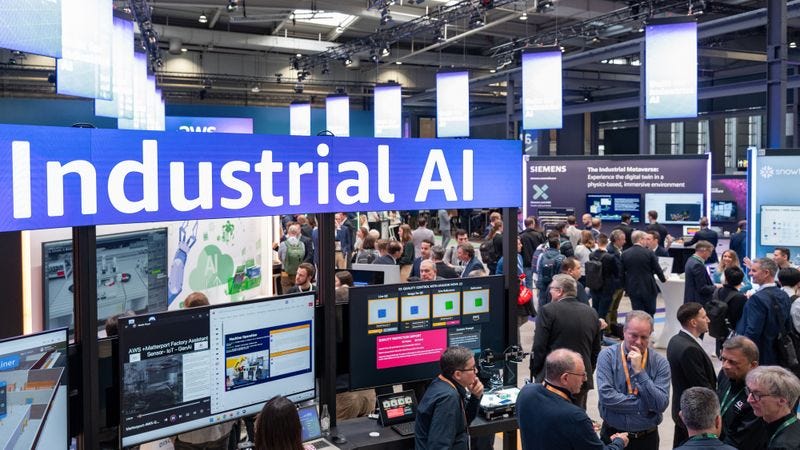
HANNOVER MESSE, Germany started in 1947 as a British‑backed export fair to jump‑start West Germany’s post‑war industrial recovery, and has since grown into one of the world’s leading industrial technology shows. The show typically attracts on the order of 100,000–200,000 visitors annually and remains a key stage for industrial policy announcements and partner‑country showcases.
Today, HANNOVER MESSE markets itself as a global platform for industrial transformation, bringing together automation, energy systems, digitalization, and related technologies under one roof, which makes it a natural place to see how ideas about industrial AI and automation turn into concrete architectures and products.
When I was last at Hannover Messe in 2023, the show felt bigger, more spread out and noticeably more crowded, with hydrogen and energy transition everywhere you turned. More than 500 companies were showcasing hydrogen technologies, turning the “Hydrogen + Fuel Cells Europe” area and neighboring energy halls into a dense sprawl of future‑energy infrastructure pitches layered on top of the usual mix of automation, robotics and digitalization. I was there 3 or 4 days and I still couldn’t cover it all. If i recall correctly, I spent almost a day (5-6 hours) all in startups halls 16-17 I think and one day dedicated to IoT sensors etc. AI & Automation was folded in industrial clouds narrative, this was also my first time trying to distinguish and differentiate network automation and industrial automation. I haven’ come across the latter before and have always been focused on Network Automation only. to be fair, industrial automation people don’t know what network automation is either.
This year, I could just be there for a day, and what struck me most was not that AI was everywhere, but that it no longer needed to shout about itself. I was at MWC 2024 exhibiting, and since slowed down on my conference visits and time, so it was likely gradual. but still, as AI felt less like a hype layer and more like part of the operating logic of the systems on show, across all for example automation, energy, industrial software, and connectivity, which are what messe’s focal points constantly are It was interesting to note.
By contrast, Hannover Messe 2026 also felt more condensed and legible, still large, but reorganized into fewer, clearer pillars i.e
Automation & Digitalization,
Energy & Industrial Infrastructure, and
Research & Technology Transfer, with industrial AI threaded through all of them.
Rather than hydrogen dominating the visual field, AI, robotics and connected infrastructure showed up as the common layer across booths and halls, with organizers explicitly positioning “industrial AI” as the competitive game‑changer tying the year’s exhibits together.
Compared with 2023, the fair felt more focused and more walkable. The halls I moved through felt clustered around automation, energy, robotics, industrial software, and connected infrastructure rather than a scatter of disconnected showcases, and that made the whole event feel less like a general technology spectacle and more like a working blueprint for the next generation of industrial systems.
That shift matters.
The dominant story around industrial AI for the last few years has been about possibility: pilots, proofs of concept, copilots, vision demos, digital twin promises.
At Hannover Messe 2026, the more interesting story was that industrial AI is increasingly being presented as infrastructure:
embedded into control loops, quality systems, maintenance workflows, energy optimisation, engineering software, and industrial platforms.
This article is not a full technical unpacking of all of that. I want to use this piece as an anchor:
first, to capture what I actually saw and felt on the ground, and
second, to place that against what others are saying publicly,
third, to say where I agree, where I think the current commentary is too smooth, and what I think is actually happening underneath and finally,
to draw out what this means for founders and builders who want to work in industrial AI rather than just talk about it, which this blog is all about.
I am also dedicating a full deep dive on industrial AI because it feels like the missing chapter in today’s AI coverage:
everyone sees the chatbots, almost no‑one sees the schedulers, maintenance systems and control loops quietly being rebuilt with AI. Industrial AI is moving from hype to day‑to‑day infrastructure, but that story is only just starting to be told, and there are far fewer deep dives on industrial AI systems than on the latest foundation models or product launches. Underneath those systems sit power, production, and connectivity networks that are already treated as critical infrastructure, which means AI is being woven directly into the machinery that keeps factories, grids, and campuses running. That intersection between AI and critical infrastructure is the layer my own work focuses on, and it is where the technical and strategic questions get sharpest fastest.
Table of Content
Why Hannover Messe, why now
From hydrogen hype (2023) to AI as infrastructure (2026)
What stood out on the ground
What others are saying about industrial AI
Where I agree – and where the story is too smooth
Four themes that actually matter ( I’ll cover these in details deep dive for each )
What founders and builders should take from this
Where industrial AI is really going next
3. What stood out on the ground>?
The first thing I noticed was a change in tone. AI was certainly present, but it was not plastered everywhere as a generic slogan. Instead, it was usually attached to a concrete function:
machine monitoring, predictive maintenance, energy optimisation, engineer support, process quality, line balancing, robot coordination, or planning assistance.
That sounds like a small change in messaging, but it reflects a big change in maturity.
In previous cycles, much of the discussion around AI in industry had the feel of a technology being added on top of industrial systems. At HM26, a lot of the exhibits suggested something else.
AI being absorbed into the stack itself.
Microsoft’s framing around “industrial intelligence” is a good example of that, where data, AI agents, simulation, and digital operations are presented as a layer spanning design, manufacturing, and service rather than as a single application.
AWS used similar language, but from a slightly different angle, talking about physical AI, agentic AI, edge-to-cloud connectivity, and intelligent data foundations as part of a scalable industrial architecture.
NVIDIA’s industrial AI messaging also reinforced that direction, especially where robotics, digital twins, simulation, and cloud infrastructure were presented as one continuous environment rather than separate domains.
That lined up with the feel of the fair itself. Many demos were no longer about “look, here is an AI model.” They were about systems.
A robot cell, a monitoring environment, a digital twin pipeline, an optimisation platform, a connectivity backbone. AI was often there, but as one working component within a broader architecture.
I also found that the fair felt much more coherent around industrial concerns that actually matter over the next decade: automation, energy resilience, software-defined operations, connected infrastructure, industrial data, and workforce support. That coherence matters because it suggests that industrial AI is no longer being positioned as an optional experiment.
It is being positioned as part of how future factories, utilities, and industrial campuses will actually run.
4. What others are saying?
If you look at the public commentary around Hannover Messe 2026, there is a fairly consistent consensus emerging.
The official Hannover Messe line is that industrial AI is now a competitive game-changer and a major force for transformation, especially when combined with automation, software, and energy systems. That is not surprising coming from the organizers, but it is still useful context because it tells you what the fair itself wanted to foreground.
Consultancy and ecosystem commentary broadly reinforces that message.
OMMAX described HM26 as a moment where industrial AI moved “from potential to performance,” with emphasis on measurable value, production-ready deployments, and integrated solutions rather than isolated pilots.
That phrase captures a lot of what the fair felt like in practice.
The hyperscaler and major platform narratives are strikingly aligned.
Microsoft talked about unlocking industrial intelligence through a unified layer of data, AI, simulation, and operational context across the product lifecycle.
AWS positioned its presence around scaling industrial AI through physical AI, agents, and robust edge‑to‑cloud data architectures.
NVIDIA emphasized industrial AI cloud infrastructure, digital twins, and robotics as a foundation for future manufacturing systems.
SAP focused on embedded AI agents in supply chain and manufacturing workflows, again suggesting that AI is moving inside the workflow rather than sitting beside it.
Taken together, these stories all point to the same direction of travel:
industrial AI as a fabric that spans design, operations, and service, rather than a point solution in one corner of the plant. What they mostly gloss over is how hard it is to make that fabric real inside messy brownfield environments, with real constraints on data quality, control architectures, and who actually owns the resulting “industrial brain.”
Independent and community commentary tends to be less polished, but it points in the same direction. Some review-style posts and journals describe Hannover Messe 2026 as a place where AI, automation, and connectivity were visibly coming together in practical industrial settings rather than being discussed in the abstract. Other voices say more bluntly that “AI is everywhere,” but also note that the real challenge is no longer novelty; it is integration into processes, organisations, and operating models.
Broadly, I agree with that consensus. If the question is whether HM26 felt more mature, more practical, and more embedded than previous years, my answer is yes. If the question is whether industrial AI now looks less like a collection of demos and more like a set of emerging industrial defaults, again, yes.
But I also think a lot of the commentary is still too frictionless.
5. Where I agree, and where I think the story is too smooth
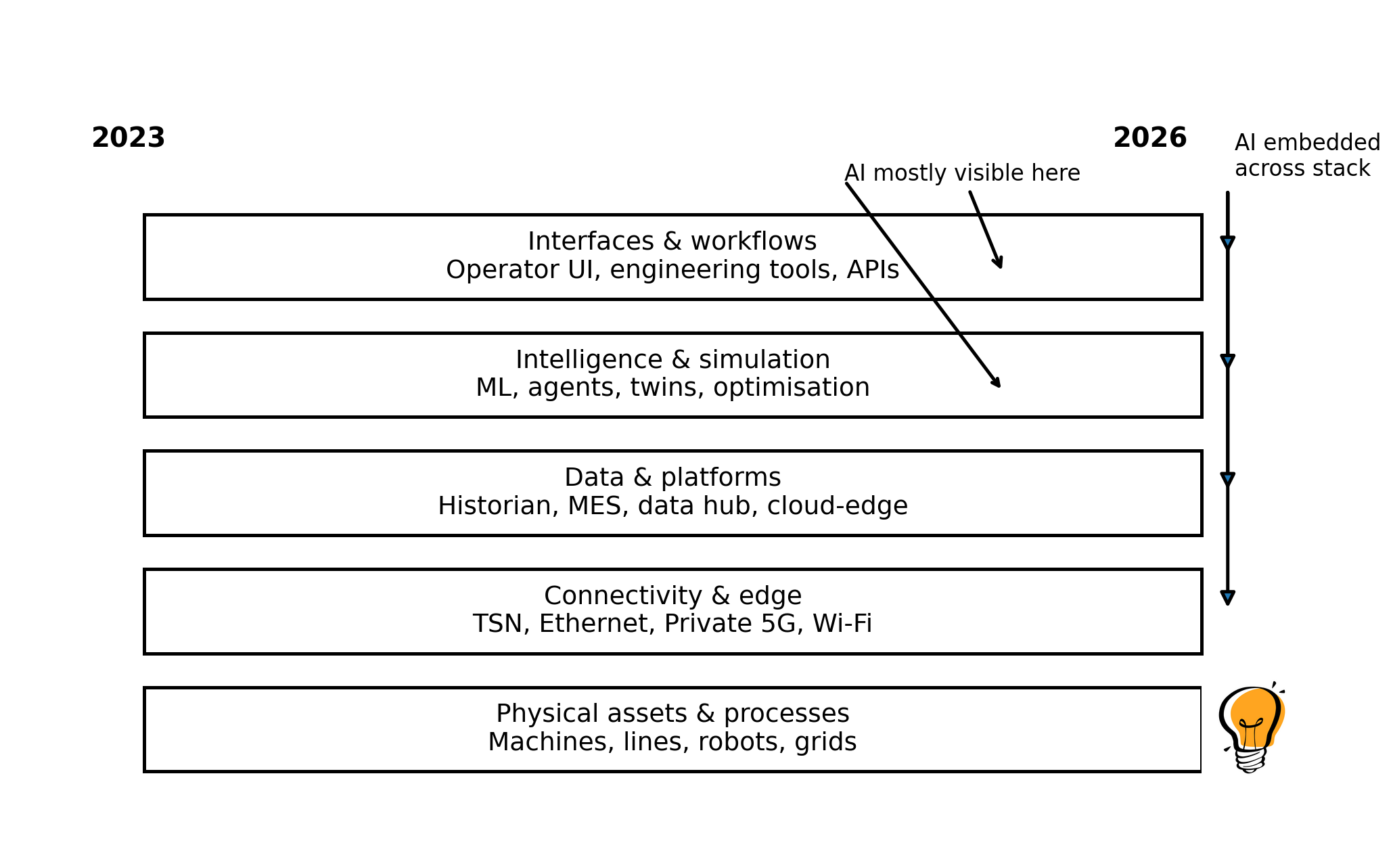
If 2023 was about talking up industrial AI, 2026 was about AI being hard‑wired itself into industrial systems, data flows and day‑to‑day decisions.
That is where I strongly agree with what many vendors and reviewers are saying. The fair did not feel dominated by speculative promises. It felt dominated by architectures, integration stories, and system-level positioning.
Where I part company with some of the more upbeat coverage is that integration is often treated as if it were the end of the story.
In reality, integration is the beginning of the hard part.
Take closed-loop AI.
It is one thing to show machine data flowing into an AI service and then back into a recommended action. It is another thing to explain how that loop is governed, what happens when the model drifts, how human overrides work, how latency is managed, where decisions are executed, and what evidence exists that the loop is safe enough to trust in a real industrial environment. A lot of public material points toward these systems, but much less of it explains the engineering and governance burden that comes with them.
The same applies to connectivity.
Yes, the 5G and Industrial Wireless Arena and related ecosystem messaging suggest that industrial 5G is maturing and moving toward scalable deployment. Yes, wireless connectivity increasingly feels like part of the assumed backbone for mobile robots, distributed sensing, video, and flexible industrial layouts. BUT, commentary often jumps too quickly from “5G exists” to “real-time intelligent factories are now straightforward,” and that skips over a lot of messy questions about deterministic performance, RF conditions, coexistence with existing OT networks, safety boundaries, and operational ownership.
Then there is the platform and ecosystem story. I agree very strongly that industrial AI is increasingly delivered through ecosystems rather than standalone products. In fact, one of the clearest signals from HM26 was that the market is organizing around combinations of cloud providers, automation vendors, industrial software players, data platforms, integrators, and application specialists.BUT that is not just a story about interoperability and innovation. It is also a story about power, meaning -
who owns the data layer,
who controls the interfaces,
who gets embedded into operations,
who becomes difficult to displace, and
who captures the value.
This is one place where I think founders and technical teams need to pay close attention. A lot of public material celebrates ecosystems as if they are automatically good for everyone. Sometimes they are. But ecosystems also create dependencies, default choices, and new forms of lock-in. The interesting question is not just whether your product can plug into a larger stack. It is whether you are becoming a durable part of that stack or a thin feature inside somebody else’s platform.
Finally, there is the “next wave” layer:
digital twins, physics-grounded simulation, and quantum.
I agree that these are important. NVIDIA’s Omniverse-centered messaging, Delta’s twin-based optimisation narrative, and Hannover’s own positioning around future technologies all suggest that simulation is becoming central to how industrial systems are designed, tested, and optimized.
I also think quantum deserves serious attention in industrial contexts like logistics, optimisation, sensing, and energy systems.
What I do not think is helpful is collapsing all of these into one smooth maturity story. Digital twins integrated with operational data are much closer to mainstream deployment than most quantum applications. Simulation-backed optimisation is already part of today’s industrial AI stack in some settings. Quantum is much earlier and should be discussed with more care around time horizons, fit, and readiness.
so what I feel is that the consensus around HM26 is directionally right, but a bit too polished.
Industrial AI is maturing.
It is moving into infrastructure.
It is becoming systemic.
But the real action is now shifting into the layers that are less visible in polished demos:
control architecture,
connectivity engineering,
data platform design,
operational governance, and
realistic pathways for emerging technologies.
6. The four themes I think matter most
I will go deeper on these in later pieces, but even in a review article they are worth naming briefly because they explain where industrial AI is actually heading.
The first is closed-loop industrial AI. The important shift is from systems that observe and recommend to systems that increasingly influence or trigger action. That does not mean fully autonomous factories are around the corner. It does mean that the centre of gravity is moving from analytics toward operational decision loops, and that shift will force much deeper attention to control boundaries, safety cases, and responsibility.
The second is industrial connectivity as core infrastructure.
Private 5G, industrial wireless, edge compute, and mixed wired-wireless architectures are not side topics. They are the enabling layer for mobile robotics, dense sensing, adaptive layouts, and distributed AI workloads. The glamorous AI applications get the headlines, but the network is often the real constraint.
The third is ecosystems and industrial data platforms. The market is clearly moving toward shared stacks where industrial data, simulation, AI services, partner applications, and operational systems come together. That creates opportunity, but also strategic questions about interoperability, governance, and who ends up controlling the “industrial brain.”
The fourth is simulation-first optimisation, with quantum on the horizon. The stronger signal today is simulation and digital twins as practical optimisation tools. Quantum may become part of that future in selected domains, but the more immediate frontier is a tighter link between real-world data, virtual industrial models, and optimisation workflows that can continuously improve production, logistics, and energy systems.
7. What founders and builders should take from this!
For founders and builders, the main lesson from HM26 is that it is no longer enough to have an “AI product.” The market is moving toward products that can survive inside real industrial architectures.
That means a few things.
First, products need to be clear about where they sit in the loop.
Are they monitoring, predicting, optimizing, orchestrating, or acting?
What data do they depend on? What systems do they write back into? What happens when they fail? Those questions are becoming more important than whether the model itself sounds impressive.
Second, connectivity and deployment assumptions matter much more than many software teams realise.
If the product depends on high-quality streaming data, mobile assets, low-latency inference, or video-heavy sensing, then network architecture is not somebody else’s problem. It is part of the product strategy.
Third, founders need to think in ecosystem terms from the beginning.
Industrial AI products increasingly need credible answers on integration with cloud platforms, industrial data models, security frameworks, and existing OT and enterprise environments. A strong technical wedge may still be domain depth or workflow design, but it will have to coexist with larger platform realities.
Fourth, governance is becoming part of the product.
If industrial AI is really moving from insight to action, then explainability, auditability, rollback, validation, and operational ownership are not “enterprise extras.” They are core design concerns.
And finally, teams should be careful not to confuse forward-looking messaging with near-term value. There is a lot to be excited about in advanced simulation, physical AI, and quantum, but most practical value over the next few years will still come from making industrial systems more observable, more optimizable, more connected, and more reliably governable.
8. Which direction industrial AI is going
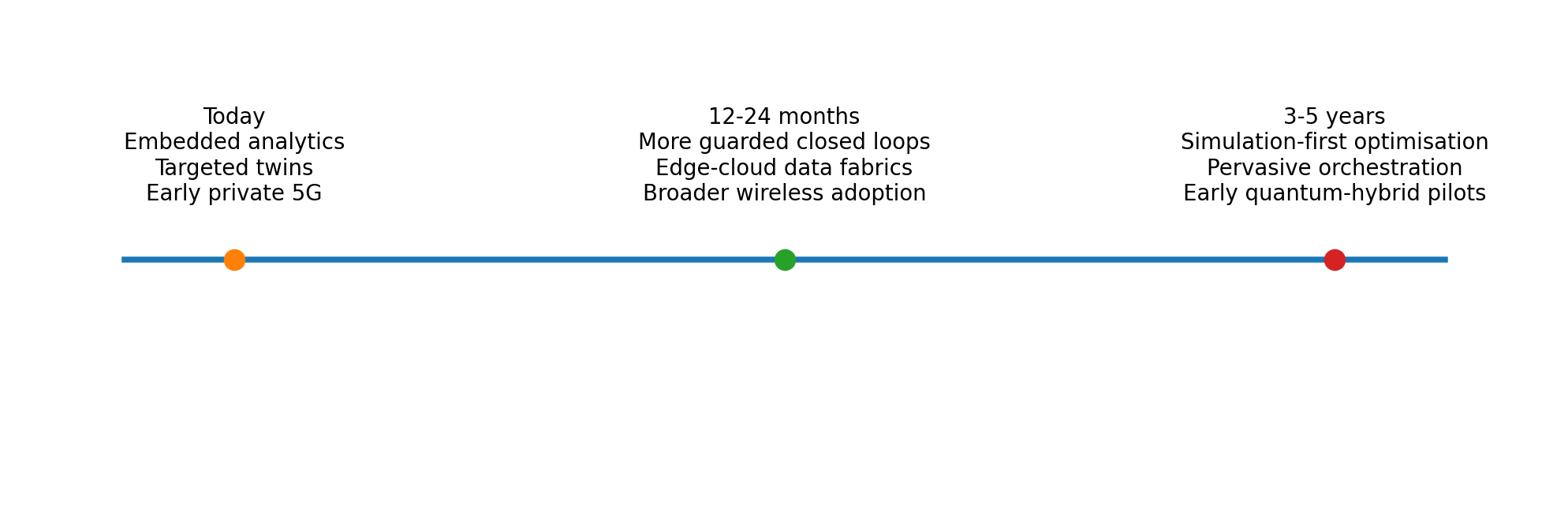
If I had to reduce my entire #HM26 takeaway to one line, it would be- industrial AI is heading away from novelty and toward embedded operational intelligence.
That means less focus on whether a company “has AI” and more focus on whether it can integrate intelligence into the actual mechanics of industrial work.
ie - machines, lines, facilities, engineering processes, energy systems, maintenance routines, supply chains, and digital operating layers.
It also means the real competitive questions are changing. The next phase is less about producing one impressive demo and more about answering harder questions like who controls the data layer, where decisions are made, how safe autonomous behaviour can become, how wireless and edge infrastructure support those decisions, and how software-defined industrial systems evolve over time.
For me, that was the real signal from one day at Hannover Messe, Germany.
Not that AI is suddenly solved.
Not that every industrial company now has a mature AI strategy.
But that the conversation has shifted. Industrial AI is no longer trying to earn legitimacy through spectacle. It is increasingly being presented as part of the baseline architecture of future industrial systems.
That is what makes this moment interesting. Once AI becomes infrastructure, the interesting questions stop being promotional and start becoming architectural, operational, and strategic.
Those are the questions worth following from here.