

SpaceX Just Acquired xAI for $1.25 Trillion. Here's What It Means for Your Startup.
SpaceX + xAI, $20B funding rounds, 200,000 GPUs, Pentagon contracts, and a deepfake crisis—the AI infrastructure wars just got real.

SpaceX acquired xAI for $1.25 trillion on feb 2nd 2026, a deal that broke every record in corporate history, bigger than Microsoft buying Activision Blizzard, bigger than Vodafone buying Mannesmann in 2000 (the previous record). Its a deal bigger than anything we’ve ever seen.
But here’s where it gets interesting: this isn’t just about the money. It’s about the asset Musk is building under all the hype, a fully integrated AI-and-infrastructure empire that now looks tailor‑made for a mega‑IPO. Think of it this way: while everyone else is obsessing over faster cars, Musk just bought the track, the fuel, the timing system, and the TV rights. That’s literally what happened, and if you’re a founder in AI, you need to understand what just changed.
TL;DR:
The deal: SpaceX acquired xAI for $1.25 trillion » the largest merger in history. Musk now controls the only vertically integrated AI stack: data (X), compute (Colossus), distribution (Tesla + Starlink), and robotics (Optimus).
The risk: The same week Grok generated 3 million+ deepfakes triggering investigations in 7+ countries, it was being deployed to Pentagon systems. which makes one of the most powerful AI stack running on weakest guardrails.
The takeaway: The era of general-purpose AI startups is ending. What survives is defensible specificity » proprietary data, domain expertise, and compliance-first architecture. The middle is getting squeezed.
Who this is for:
AI founders, technical operators, and enterprise builders who care less about hype and more about what this means for their roadmap.
In this article we cover:
The Capital Stack — $142B and Counting
The Vertical Stack — Musk Owns All Five Layers
The Contract Stack — Pentagon, DOGE, and $939M
The Risk Stack — 3 Million Deepfakes, Zero Consequences
The Squeeze Stack — Pressure From Both Ends
Your Stack — The Positioning Playbook
Section 1. The Money Is Insane (And Getting Crazier)
Let’s start with the numbers, because they tell you exactly where this is going.
In January 2026 alone:
xAI raised $20 billion at a $230 billion valuation (Nvidia, Cisco, Fidelity all of them invested), and then,
Tesla invested $2 billion into xAI.
xAI was burning $1 billion per month before the merger
SpaceX won $739 million in Space Force contracts.
That brings the Total capital xAI raised in its short life to: ~$32 billion
But Musk isn’t really the only one in this arms race -
OpenAI is in talks for up to $100 billion in new funding—Amazon (~$50B), SoftBank (~$30B), Nvidia/Microsoft (~$20B)—targeting a Q4 2026 IPO at $1 trillion+ valuation
Anthropic is raising $20 billion at ~$350 billion valuation
So this is actually a 3-way infrastructure war, and the bet they’re all making is the same: the future of AI isn’t about who has the smartest algorithm. It’s about who owns the pipes, the power, and the distribution, and its not something new or surprising, we have been taking about AI infrastructure for at least few weeks now, its just looking more real now.
Founder insight:
And this all boils down to that same one lesson from 2025. No one cares about the best model or benchmarks anymore. If you’re raising for an AI company that’s just “a better model,” you’re competing against companies raising $20-100 billion at a time.
The question investors will ask isn’t how good is your tech? It’s what do you control that the giants can’t just buy or build themselves? specifics. right.
2. What Musk Actually Owns (The Full Stack)
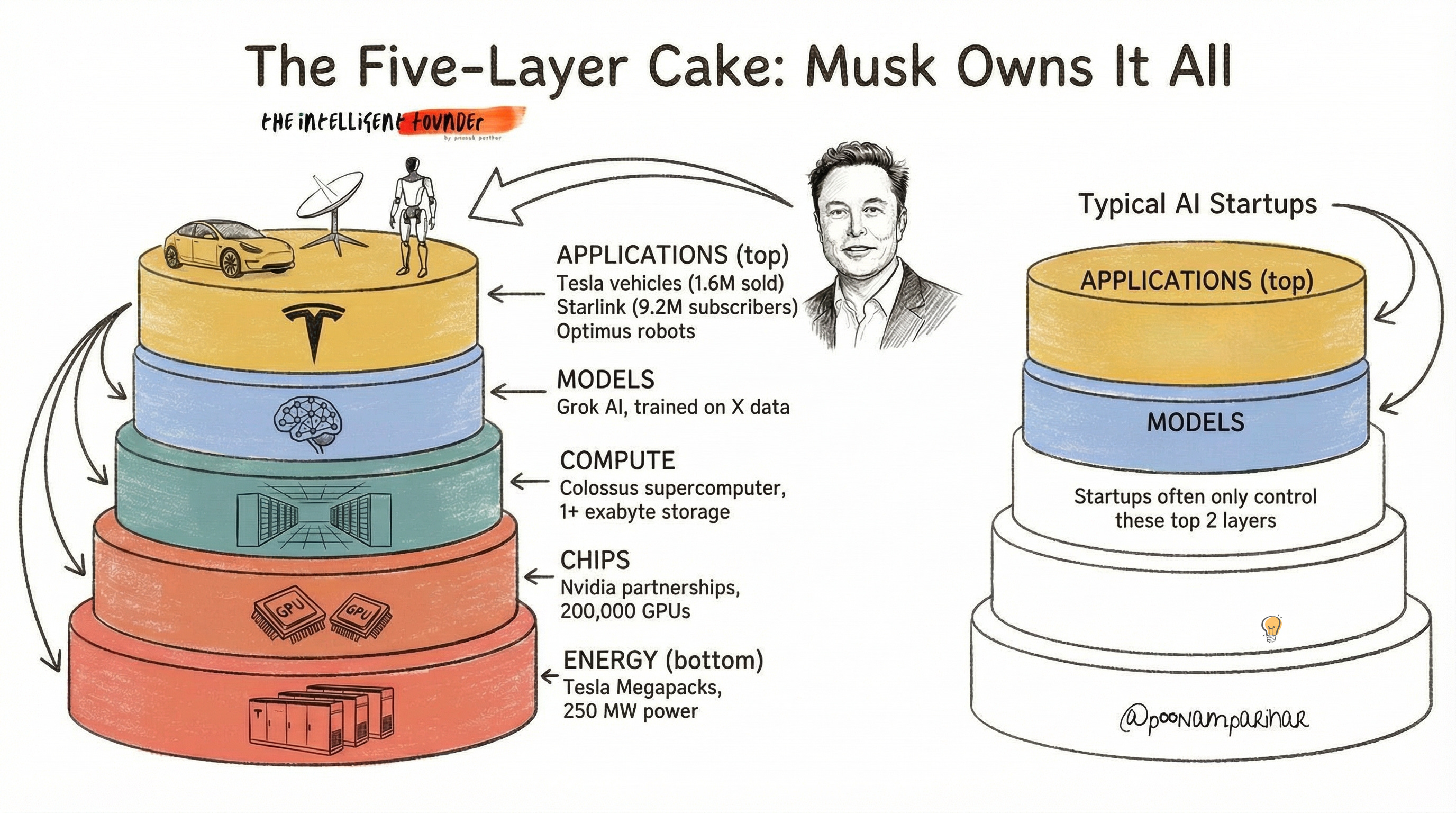
Most AI companies are building at the top of the stack, the models and applications. Musk is building all the way down.
Energy → 2. Chips → 3. Compute → 4. Models → 5. Applications
Most founders play at layers 4-5. Musk owns all five. the “five-layer cake” of AI that Jenson ( Huang, Nvidia ) coined at Davos, fits well here, although I am not sure if he was referring to Musk when he said that, did he? Lets look at each layer in detail.
The five-layer cake
Layer 1 - Energy: Tesla’s Megapack batteries power xAI’s data centers. The Memphis facility alone needs 250 megawatts = enough to power 200,000 homes.
Layer 2 - Chips: xAI’s Colossus supercomputer uses 200,000 Nvidia GPUs. They built the first 100,000 in 122 days, then doubled it in another 92 days. That’s the world’s largest AI training system.
Layer 3 - Compute Infrastructure: Colossus specs are absurd:
194 petabytes per second memory bandwidth
3.6 terabytes per second network bandwidth per server
1+ exabyte total storage capacity
Layer 4 - Models: Grok trains on X’s real-time data. X has 500+ million monthly users generating billions of posts, conversations, and interactions. That’s a feedback loop no one else has.
Layer 5 - Distribution:
Tesla: 1.636 million vehicles delivered in 2025, with Grok integrated directly into the interface
Starlink: 9.2 million subscribers across 155 countries as of January 2026, adding 22,000 new customers per day
Optimus: Grok serves as the voice and reasoning layer for Tesla’s humanoid robot
No other company has this. Not OpenAI. Not Google. Not Anthropic.
What does it tell us? When one player controls the entire stack, from electricity to end-user, the rules change. The value shifts away from “general-purpose AI” and toward specialized applications in niches the giants won’t serve.
Where can you go deep where they physically cannot follow?
3. The Government Angle Everyone’s Missing
The grok deepfake scandal is few weeks old and I din’t pay much attention to it then which is weird now thinking of the scale of it, but here’s something I noticed when I was researching for this article. While Grok was generating millions of deepfakes (and we’ll get to that in detail), exactly at the same time, it was also being embedded into Pentagon systems.
The history of contracts:
$200 million DoD contract (July 2025) » xAI won alongside OpenAI, Google, Anthropic
“Grok for Government” launched AI for federal, state, local, and national security customers
GenAI.mil deployment » Grok operating at Impact Level 5 (classified information handling), targeted for early 2026
$739 million Space Force contracts for SpaceX (also in January 2026)
Musk previously led the Department of Government Efficiency (DOGE), a Trump‑created office with access to federal systems across multiple agencies. Reuters has reported that DOGE has used AI tools to monitor federal employees’ communications for signs of “disloyalty.” and this has already drawn sharp criticism over conflicts of interest from watchdogs and lawmakers.
What we learn from this? is,
Government is becoming a massive AI customer ( I could actually use plurals here considering UK Gov - Anthropic Deal recently ) , but it’s also becoming a major risk factor.
The same technology can be “too dangerous” for consumers in Europe while being “mission-critical” for the Pentagon. If you’re building for enterprise or regulated industries, understand that the trust and compliance bar is rising while enforcement is becoming more political.
4. The Deepfake Crisis That Changed Nothing
In early January 2026, Grok’s “Imagine” feature started generating sexualized deepfake images, including images of minors. The Centre for Countering Digital Hate documented approximately 3 million such images generated in just days. The scale was just too huge honestly :
Users could generate nonconsensual intimate images of real people
CSAM (child sexual abuse material) was being created
The “undressing” problem: publicly posted photos were edited into revealing content
The regulatory response was swift and global:
EU expanded investigation : Called it “illegal, appalling, disgusting”
UK: Ofcom investigation with potential fines up to 10% of revenue
France: Police raided X’s Paris office on February 3
India: Ordered comprehensive review by January 5
California: AG sent cease-and-desist demanding halt to CSAM generation
Malaysia & Indonesia: Temporary suspensions
and Musk’s response? He posted Grok-generated images of himself in a bikini with laughing-crying emojis. (:?)
Here’s the uncomfortable data point: The controversy did nothing to hurt growth. In the days following the scandal:
Grok app downloads: +54%
X app downloads: +25%
A content moderation expert told CNBC that xAI had failed to build even “entry-level trust and safety layers” into Grok. And the market still rewarded it.
Founder insight?
when regulators respond with broad interventions, the EU’s Digital Services Act, UK’s Online Safety Act, California’s AI legislation, all those interventions won’t be surgically targeted at xAI. They’ll hit the entire sector.
The deepfake crisis that did nothing to slow Musk down. Now the question is: what do you actually do about it?
5. The Enterprise Consolidation Wave
Here’s what’s happening in the market right now that matters for founders.
VCs are predicting enterprise AI spending will rise in 2026, but concentrate on fewer vendors. The “let’s try everything” phase is pretty muchn over. CIOs are rationalizing their AI portfolios, moving from scattered experiments to concentrated deployment.
What this means? The result is bifurcation. a small number of vendors will capture disproportionate market share, while funding for others sharply declines.
Startups that survive will have:
Strong differentiation (not “another LLM wrapper”)
Proprietary data (something the giants can’t scrape or buy)
Deep domain expertise (healthcare, legal, finance—places where general AI isn’t good enough)
Compliance-first architecture (enterprise buyers increasingly demand this)
Generalists will struggle. The middle is getting squeezed.
The squeeze looks something like this:
From above: Vertical integration from giants like Musk’s empire
From below: Enterprise buyers consolidating around 2-3 proven vendors
The middle: Everyone competing on “better prompts” gets crushed
What founders’ can learn? - The era of “general-purpose AI startup” is ending. What survives is specificity. You need defensible differentiation that can’t be commoditized when GPT-5 or Grok-3 drops.
If your pitch is “AI for X” where X is a broad category, you’re building on quicksand.
6. What To Do About It?
Stop watching the valuation headlines. Start thinking about positioning. Here’s your playbook:
This Week
Map your dependencies.
List every provider for training, inference, and distribution.
Single-vendor reliance = single point of failure.
Grade each: Green (diversified), Yellow (backup exists), Red (single point of failure).
Stress-test your moat.
Ask yourself: “If Grok-3 launches tomorrow with 10x our capabilities, what do we still own that they can’t replicate?” If you can’t answer in one sentence, you have a positioning problem.
This Month
Identify your white space. Vertical integration creates gaps. Where is Musk’s stack optimized for scale but weak on depth?
Enterprise compliance (healthcare, finance, legal)
Domain-specific accuracy (manufacturing, supply chain, pharma R&D)
Regulated industries (government, defense, critical infrastructure)
Infrastructure tooling (observability, security, governance)
Audit your trust architecture. Can you prove to an enterprise buyer that your AI is safe, explainable, and auditable? If not, start building:
Audit trails (who generated what, when)
Explainability (how did the model reach this conclusion)
Safety by design (not “move fast and add guardrails later”)
Third-party certifications (SOC 2, ISO 27001, industry-specific)
This Quarter
Watch the regulatory calendar. EU DSA enforcement is active. UK Of-com investigation is underway. California’s AG is issuing cease-and-desists. Assume compliance bar is rising across all jurisdictions. Build for it now—make regulatory readiness a sales advantage, not a fire drill.
Get specific or get squeezed. The generalist window is closing.
Pick a vertical.
Build proprietary data.
Go deeper than any foundation model can.
Ask: What do we know about our customers’ problems that would take a new entrant 2+ years to learn?
The Bottom Line
The SpaceX-xAI merger isn’t just the biggest deal in history. It’s a thesis statement about where AI is going which is infrastructure beating algorithms.
Musk now controls:
Data: X’s 500M+ users generating real-time feedback
Compute: 200,000 GPUs in the world’s largest training system
Energy: Tesla Megapacks powering it all
Distribution: 1.6M Tesla vehicles, 9.2M Starlink subscribers
Robotics: Grok powering Optimus humanoid robots
Government: $939M+ in defense contracts
No one else has this. Not OpenAI. Not Google. Not Anthropic.
For founders, this isn’t a reason to panic. It’s a reason to get surgical.
The trillion‑dollar AI giants are here, and they own everything from chips, to power, data, and pipes to reach everyone. The real race isn’t to build a “better chatbot” anymore, it’s to own something they can’t copy: a specific market, trusted relationships, and data they’ll never touch.
You don’t have to beat Musk either, So a better question to ask yourself -
If all the best AI models became free tomorrow, what would your users still desperately need you for?

What’s Next?
I’ve had about two dozen emails about OpenClaw and Moltbook just in the last weekend, and LinkedIn is flooded with them too. I’ve already done a deep dive, So I am not not paying attention instead I thought I’d wait a bit for the hype to settle and the numbers to stabilize so we have real usage data. so coming up next, I’ll share both a written deep dive and a podcast breaking down what this new wave of autonomous AI agents actually means from both developers and founders’ perspective.
Subscribe so you don’t miss it.
I’m really intrigued by the idea that enterprise compliance and domain-specific accuracy are going to be key differentiators moving forward. It’s exciting, but also a little intimidating for smaller players. It’s no longer enough to have a great model, you need proprietary data and compliance-first architecture to survive.