

Telco AI Use Cases: What’s Working and Where ROI is Real
IBM paper review exploring how AI is reshaping telecommunications, highlighting leading use cases, current adoption rates, and the measurable ROI realized by telcos.

IBM conducted a survey with 106 executives from major telecommunications operators across six countries, focusing on leaders responsible for AI, technology, operations, and business strategy within their organizations. The just released paper “Telecommunication in AI Era” focusses on the generative AI ( GEN AI) telco use cases that mark a shift from using AI predominantly for efficiency and cost savings to leveraging it for business innovation, new revenue streams, and competitive advantage and rapidly redefining the telecommunications industry. Most CSPs however are still facing challenges scaling and unlocking full value due to data silos, legacy systems, and the need for deeper enterprise-wide integration.
A recently published BCGs research ( TLDR here ) showed a section of Gen AI focussed applications delivering measurable business impact across sales operations. I wanted to include this here to emphasize we’re only focussing on “Gen AI” here and not Agentic AI, which remains largely experimental as of now. BCGs researched use cases focus on specific, well-defined tasks like content generation, call transcription, and automated battle cards, whereas agentic implementations attempt broader autonomous decision-making that current technology cannot reliably support, so there’s an overlap and the the research compliments the telco data.
AI use cases in telecom
As companies scale AI projects from pilots to enterprise-wide deployments, Here are few telco specific use cases listed in the report, where per the leadership, Gen AI implementation across the industry and the incremental impacts has been observed.
AI-powered customer service: Automating support with chatbots and virtual agents to handle inquiries and issues.
Network performance monitoring: Using AI for real-time network optimization, anomaly detection, and proactive management.
Network security threat detection: AI for cybersecurity, including fraud and threat detection.
Predictive maintenance: Anticipating and preventing network failures and outages using AI analytics.
Spam protection: Real-time detection and blocking of spam calls, messages, and malicious links (see Bharti Airtel example).
Personalized customer engagement and sales: AI models suggest upsells, cross-sells, and targeted outreach based on user data.
Digital and SaaS platforms: AI-driven platforms for diagnosis, ticket tracking, and issue resolution.
Workforce management: AI systems for optimizing and automating field staff deployment and productivity.
Energy management: AI to optimize radio network power usage, dynamically reduce carbon emissions, and increase asset life.
Edge AI applications: Pushing AI inference to the network edge for low-latency tasks like 5G RAN optimization and real-time security.
Closed loop RAN optimization & zero-touch activation: Agentic AI for fully autonomous network flows.
Smart grid, connected vehicle services, and telehealth: AI-enabled solutions via cross-industry collaboration.
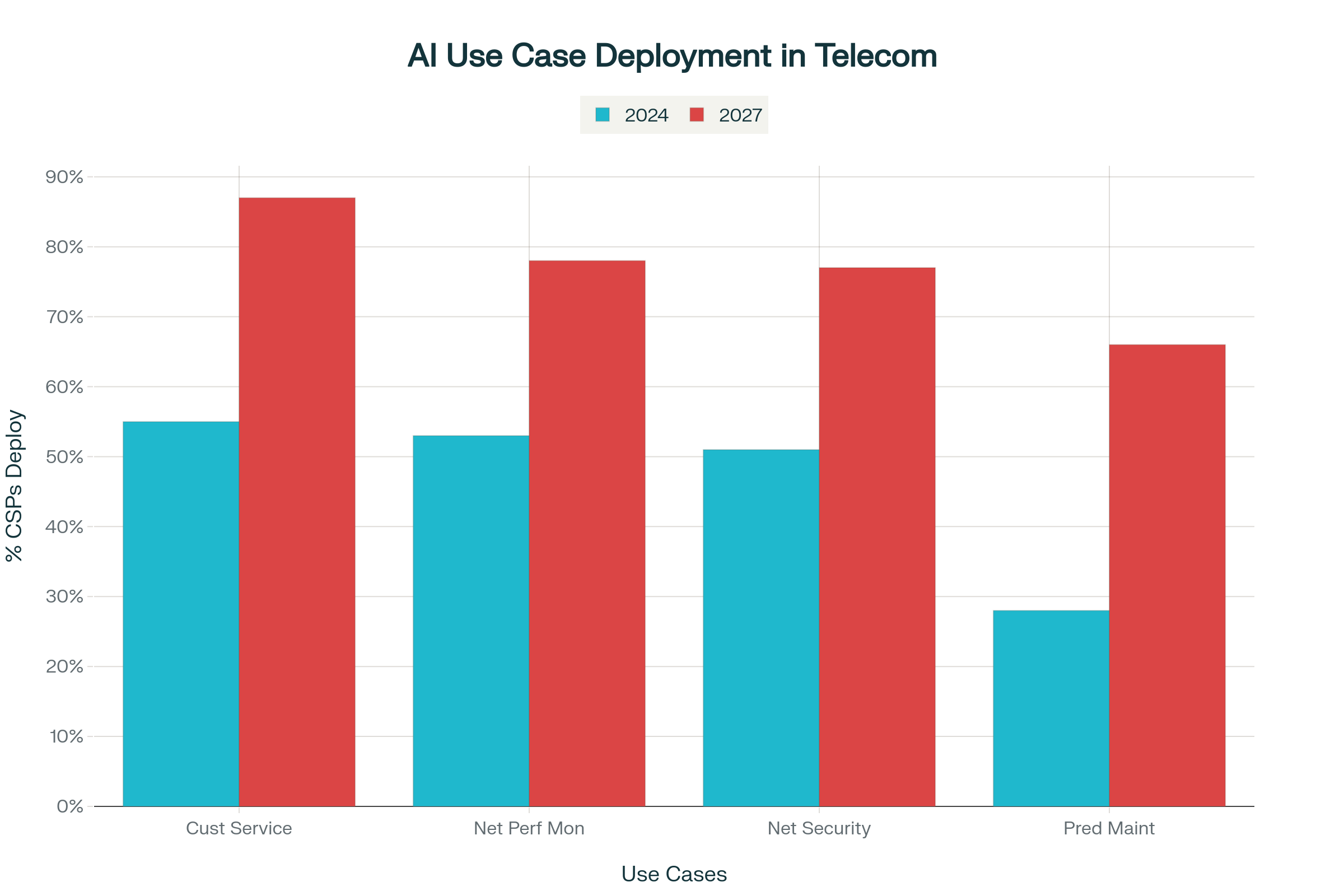
These use cases are rapidly expanding, with adoption rates expected to rise substantially by 2027, especially in customer service, network monitoring, security, and predictive maintenance.
AI Use Case Deployment in Telco and tracked ROI.
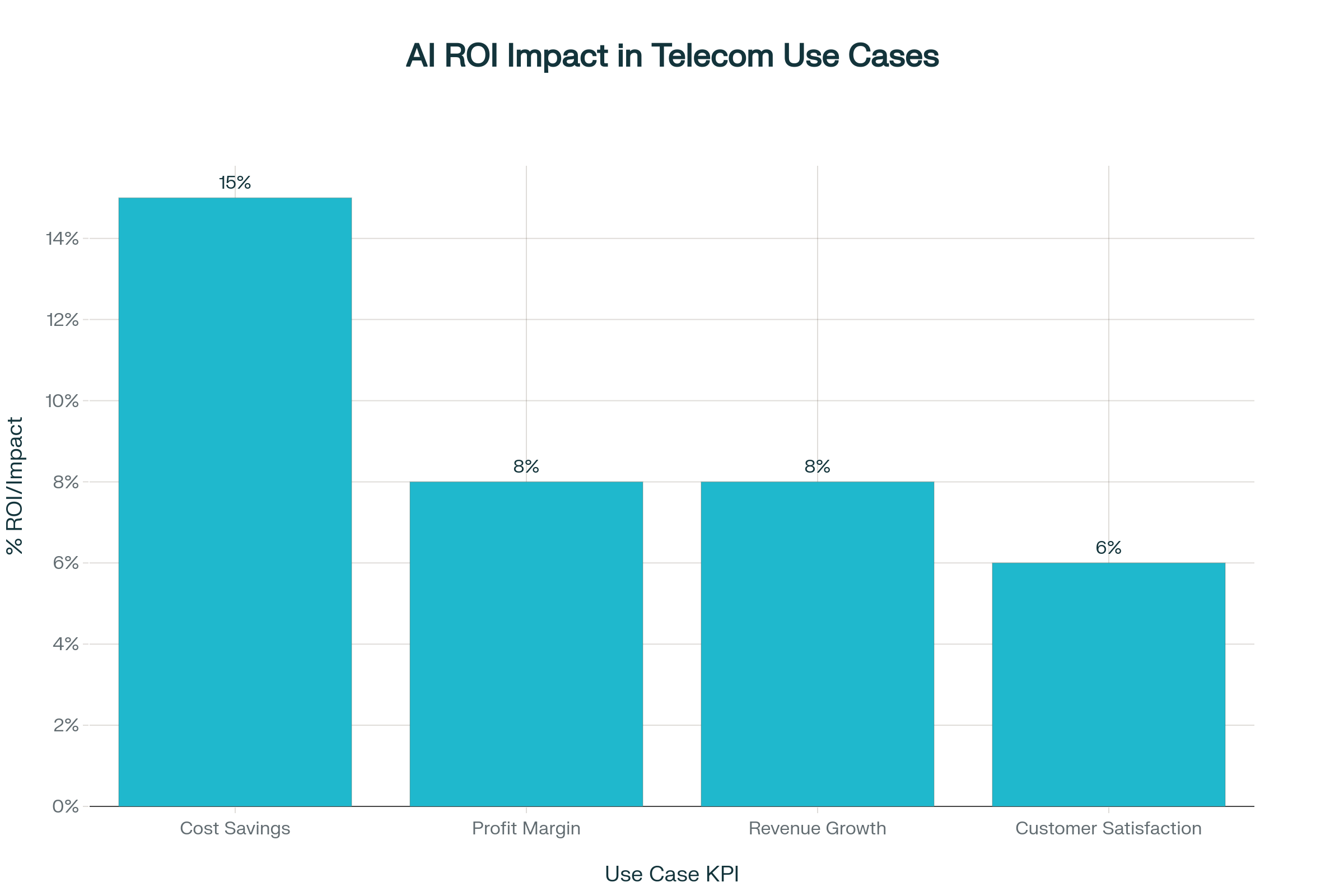
For top organizations, AI has led to a 15% improvement in cost savings, 8% improvement in operational profit margin, 8% boost in AI-driven revenue, and 6% improvement in customer satisfaction over the last year.
The most-tracked KPIs to measure AI’s ROI and business value: Cost savings (OPEX/CAPEX), customer satisfaction, AI-driven revenue growth, and operating margin.
Customer service, network monitoring, threat detection, and predictive maintenance are the fastest-growing use cases.
Key takeaways
Other than the Gen AI impact record, here are some of the key points made in the IBM report.
AI is transforming telecom operations: More than 80% of telecom leaders believe generative AI (gen AI) will redefine their organizations in the next three years.
Main focus so far: Most AI adoption remains centered around productivity gains and cost reduction, but there’s a growing push to use AI for business innovation and revenue growth.
Leadership support: 84% of executives report strong support for AI investments, and 75% expect AI to deliver competitive advantage within three years.
AI deployment challenges: 64% say their AI initiatives haven’t delivered the expected value so far. Key obstacles include technical silos, lack of quality data, and limited enterprise-wide rollout.
Agentic AI adoption: 44% of telecom companies have fully implemented agentic AI (AI that acts autonomously) in customer-facing chatbots; 42% use it for autonomous network and cybersecurity management.
Shift in investment: AI spending is expected to move from efficiency improvements (like network performance and predictive maintenance) to business model innovation and new services.
Scaling AI: Deep AI integration requires breaking down silos, refactoring legacy platforms, and modernizing data infrastructure with API-first, modular architectures.
Use cases expanding: By 2027, rapid expansion is expected in AI-powered customer service (from 55% to 87%), network performance monitoring, security threat detection, and predictive maintenance.
Edge AI benefits: Moving AI workloads closer to the network edge reduces latency for mission-critical telecom tasks.
Performance tracking: The most important KPIs tracked with AI initiatives are cost savings, customer satisfaction, AI-driven revenue growth, and operating margin.
Case studies: Airtel and China Mobile have both demonstrated success with large-scale, innovative AI deployments for spam protection, network optimization, digital platforms, and automated customer assistants.
Future action steps: Organizations should embed AI throughout the business; prioritize telecom-tuned models; industrialize data pipelines for real-time decisions; monetize through cross-industry ecosystems; and invest in responsible AI and governance.