



Telecom is crossing a threshold that will define the next decade of the industry. Operators have used automation, analytics, and isolated AI use cases to squeeze efficiency out of legacy operations, but those efforts have largely left the underlying operating model intact. What is happening now is different:
operations themselves are being rebuilt around AI, and that changes how networks are run, how value is created, and how operators compete.
The old model was built for a slower, more predictable world. Network operations centers relied on static rules, manual triage, ticketing systems, and human escalation because traffic patterns and service behavior changed at a manageable pace.
Today, networks span radio, transport, core, cloud, edge, enterprise, private infrastructure, and increasingly non‑terrestrial systems, with traffic and service demands shifting in real time. Enterprises expect guarantees rather than best effort. In that environment - manual operations do not just become expensive; they become too slow to stay competitive.
Table of contents
Why telecom is at an inflection point
From AI-enabled to AI-native
Why the old operating model is breaking
Data as the foundation of autonomy
Humans, agents, and the new operating model
How AI-native operations improve opex and resilience
From connectivity to outcome-based services
Enterprise use cases: slicing, SD-WAN, and non-terrestrial networks
The shift from reactive operations to proactive assurance
What changes inside the organization
New metrics for an AI-native network
What operators and vendors should do next
“what to do on Monday” playbook
From automation to AI-native
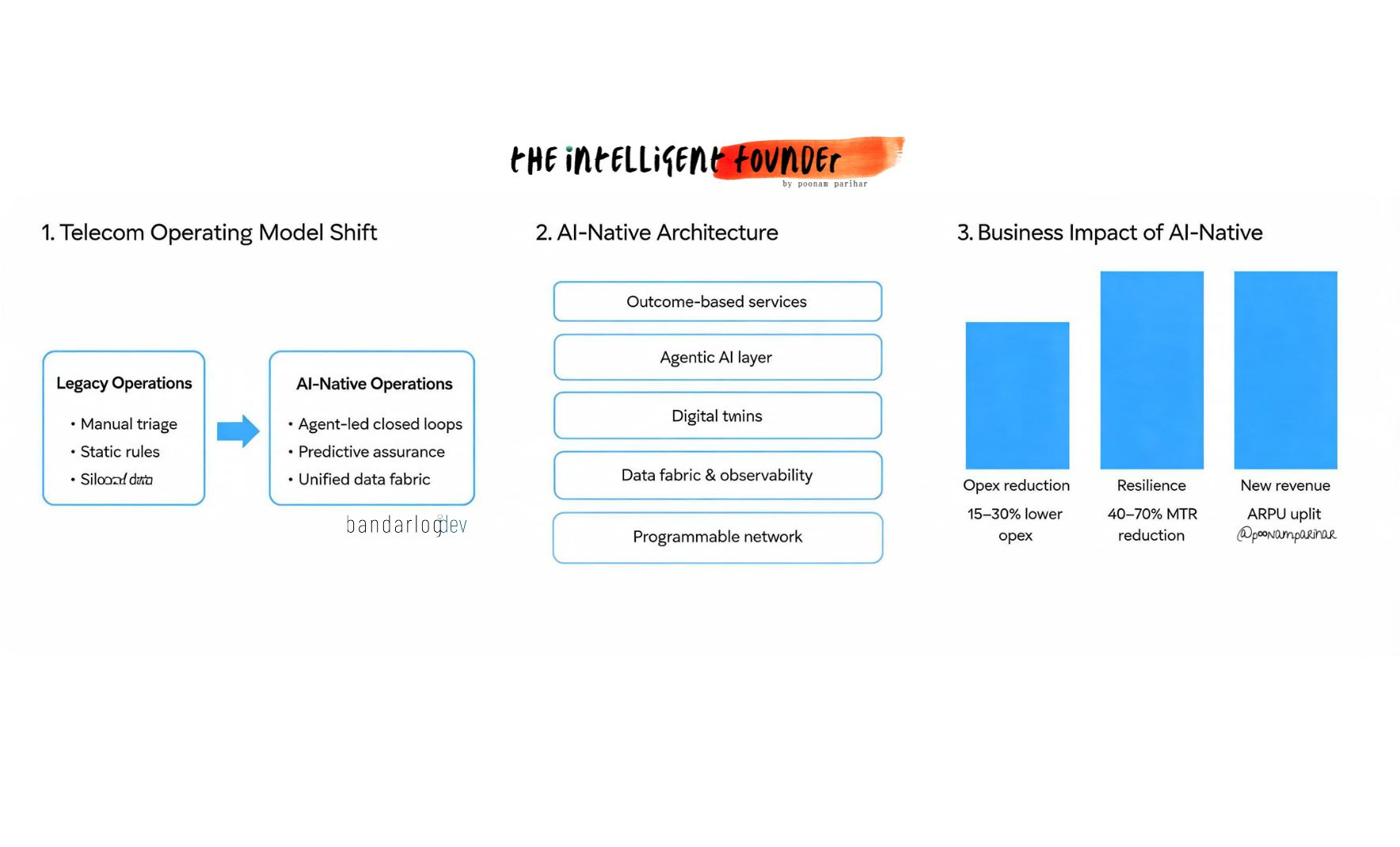
The industry has responded with automation for years, but automation alone is no longer enough. Traditional automation executes predefined tasks faster, yet still depends on human‑designed rules and brittle workflows. AI changes the equation because it can interpret context, identify patterns, predict failures, and recommend or even execute actions dynamically.
This is why the conversation has moved through three phases:
from automation, to AI‑enabled operations, and now to AI‑native operations.
AI‑enabled operations treat AI as an add‑on to existing processes.
AI‑native operations rebuild the operating model around intelligent systems.
In AI‑native environments, AI agents are not peripheral tools; they form part of the execution layer.
Agents monitor, analyze, decide, act, and learn, in closed loops.
That distinction matters. In a traditional model, humans are the primary operators and AI assists them.
In an AI‑native model, humans supervise intelligent systems that perform much of the operational work themselves.
People still matter, but as overseers, exception handlers, policy designers, and strategic decision‑makers rather than first responders to every fault and deviation.
Why the legacy operating model breaks
Two structural pressures are driving the shift. First, network complexity is growing faster than human teams can scale. Second, telecom economics are tightening ie cost, margin, and retention pressures, all are rising simultaneously.
Legacy operations struggle because:
Every new service and domain adds non‑linear operational overhead.
Fragmented OSS/BSS stacks make end‑to‑end visibility and correlation difficult
Manual workflows cannot match the speed at which events and dependencies propagate.
“More people and more scripts” does not scale in a world of dynamic traffic and programmable networks.
AI‑native operations are attractive because they address complexity and economics in one move: they reduce toil, improve service quality, and unlock new revenue opportunities grounded in assured outcomes.
Data: the real foundation of autonomy
AI‑native operations begin with data architecture, not model choice.
Telecom networks generate enormous volumes of data, but much of it has been trapped in silos, stored in inconsistent formats, or tied to single domains and systems.
For AI to be trusted in execution, operators need:
Unified data fabrics spanning network, IT, service, and customer layers.
Clear governance for ownership, quality, validation, lineage, and security.
Shared semantics so different systems and agents interpret telemetry and events consistently
Real‑time access so models act on the live state of the network, not stale snapshots
Without this, autonomy collapses into isolated automation pockets. With it, AI agents can reason over a coherent view of reality and coordinate decisions across domains
Governance is not just a compliance box to tick. Once operators allow systems to make decisions or trigger actions in real time, data governance becomes the safety layer that underpins trust, auditability, and explainability.
From human-led to agent-led operations
AI‑native operations also change the relationship between humans and digital employees.
Traditional telecom organizations are siloed: network, IT, field operations, customer care, and product teams often work with different systems, metrics, and incentives
Agentic AI begins to cut across those boundaries.
Agents correlate events from multiple domains, not just one stack.
Field engineers use AI copilots for troubleshooting instead of relying solely on back‑office calls.
Customer‑facing bots increasingly resolve issues end‑to‑end rather than handing off to multiple teams.
AIOps platforms automate detection, triage, and remediation in operations centers.
In this environment, AI becomes the connective tissue of the operating model. It does not replace humans, but it changes where human effort is most valuable.
Routine orchestration and correlation are handled by agents.
Humans focus on policy, escalation, architecture, and complex judgment calls.
Workflows become more fluid and less dependent on manual handoffs.
BT’s “Dark NOC” initiative with AWS is a concrete example:
agentic AI and generative AIOps monitor the network, automate management and diagnostics, and proactively handle issues on the path to zero‑touch network operations.
Quantifying the business case
The economics of AI‑native operations are increasingly backed by hard numbers. Across studies and live deployments, autonomous and AI‑native approaches show consistent impact on opex, resilience, and customer outcomes.
Evidence points to:
15–20% opex reduction at early automation levels, rising to 25–30% at more advanced stages, and 40–50% at full Level 4 autonomous networks, especially in energy and power cost reduction.
Autonomous networks delivering 1.7–3.4x ROI with payback in roughly 1.5–2.9 years, and potential opex savings of $150–300 million over five years per operator.
AI‑native BSS/OSS and autonomous support contributing to an average annual benefit of $800 million per CSP, including $350 million opex reduction and $144 million revenue uplift.
AI‑driven help desk bots cutting cost per call by 35% and increasing resolution rates by about 60%.
Hyper‑personalized upsell campaigns driven by AI delivering 5–15% ARPU uplift, depending on segment.
Early AI‑enabled services (e.g., anti‑spam/anti‑scam) driving measurable ARPU growth for operators like Indosat Ooredoo Hutchison.
These are not just pilot numbers, they are production‑scale signals that AI‑native operations can attack cost, protect margins, and selectively grow revenue
Connectivity is being replaced by outcomes
Telecom has long struggled with commoditization.
Basic connectivity is hard to price at a premium when every competitor offers similar bandwidth. Customers, especially enterprises, will pay more for certainty, performance, and outcomes. AI‑native operations make those outcomes deliverable and defensible.
Consider three domains:
Enterprise connectivity and slicing
Static, preconfigured services can connect sites but struggle to adapt to changing loads and SLAs.
AI‑native operations enable intent‑based slicing, predictive resource allocation, and dynamic QoS guarantees
The value proposition shifts from “we connect you” to “we guarantee this experience under these conditions.”
SD‑WAN and hybrid enterprise networks
Conventional SD‑WAN focuses on routing but often treats performance as best effort.
AI‑native SD‑WAN anticipates load, adapts to real‑time conditions, and assures performance dynamically
For operators, that creates room for premium, SLA‑backed offerings for customers, it also creates confidence in business‑critical applications.
Non‑terrestrial and remote connectivity
Satellite and terrestrial systems are frequently managed separately, limiting intelligent handover and optimization
Agentic AI and digital twins can make switching decisions context‑aware, factoring in weather, cost, and link quality.
That unlocks viable service models for remote, maritime, and underserved regions that previously carried high operational risk.
In each case, connectivity becomes the input. The product is an assured outcome. Assurance becomes the differentiator.
The commercial layer is the experience that can be guaranteed and monetized.
Architecture for AI-native operations
Under the hood, AI‑native operations converge several architectural elements into a cohesive system.
Key building blocks include:
