

The Tailwind Story and the Future of Open Source Sustainability
How radical honesty and transparency can become a strategy. The Tailwind story, market data, and playbook for founders and builders navigating the shift from search-driven to AI-mediated distribution

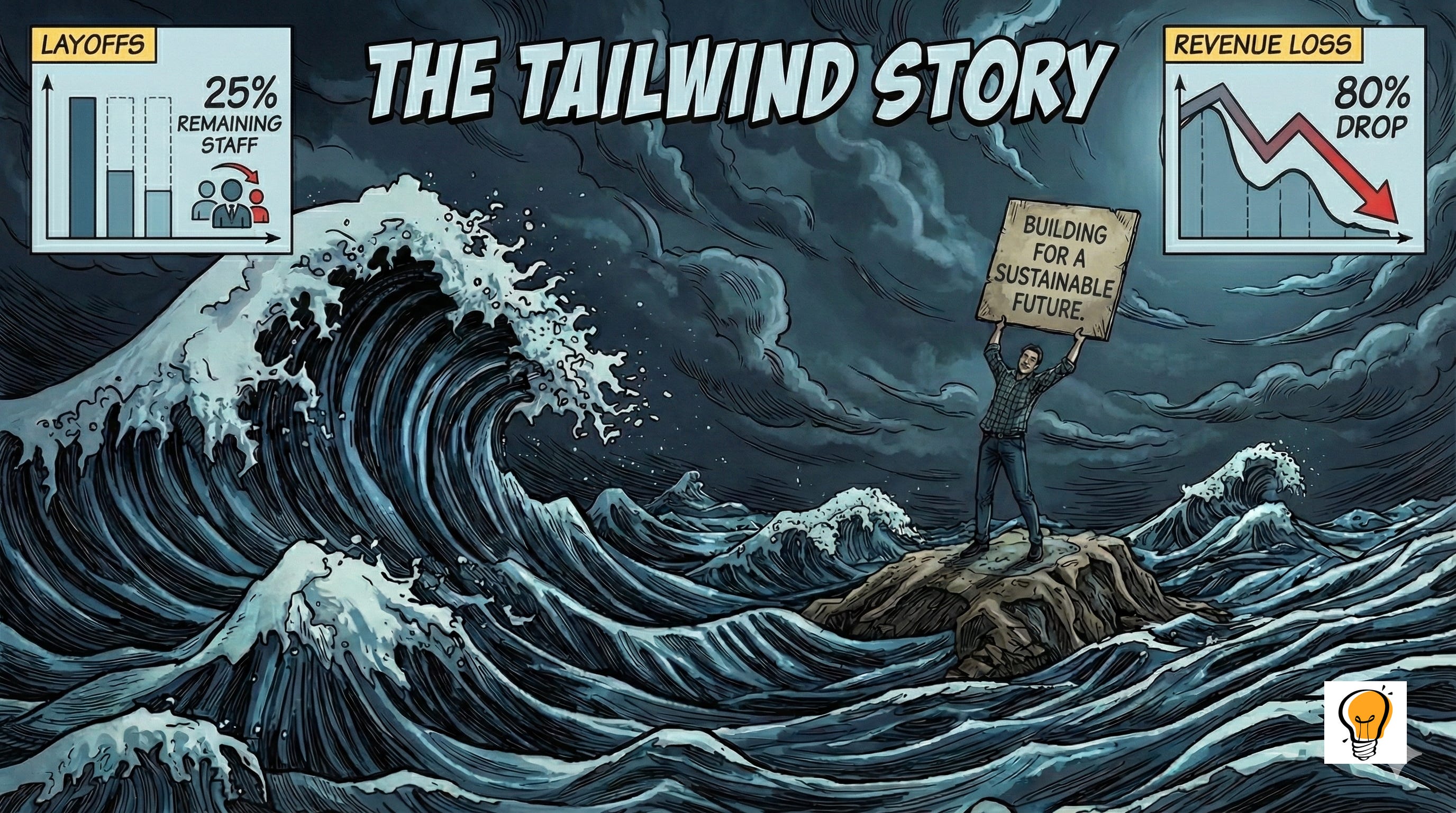
This story is about Tailwind Labs, the company behind Tailwind CSS, a very popular tool web developers use to style websites quickly. Tailwind was extremely successful: millions of developers used it every month, and its design system became so well-known that AI coding tools learned how to use it perfectly and that success itself became a problem, because once AI tools automatically knew how Tailwind works, many developers stopped visiting Tailwind's website or reading its documentation.
Less traffic = less revenue, since Tailwind Labs made much of its money from products and sponsorships tied to that documentation site; when Google traffic dropped by around 40%, revenue collapsed by about 80%.
In simple bullet points, -
What exactly happened?
Tailwind CSS reached massive adoption, with tens of millions of downloads per month.
Search traffic to its docs dropped sharply and revenue fell about 80%.
Tailwind Labs laid off around 75% of its engineering team.
Why it happened?
AI coding tools learned Tailwind’s patterns so well that developers could get Tailwind answers directly from AI instead of visiting the official docs.
Tailwind’s business model depended heavily on documentation-driven traffic and related product sales.
When that traffic shifted into AI tools, usage stayed high but income collapsed.
How the situation evolved?
The founder publicly explained the numbers, the layoffs, and the risk of Tailwind becoming unmaintained.
Major companies and many developers that rely on Tailwind stepped in with sponsorships and financial support.
Funding moved from indirect (docs/SEO) to direct support from the ecosystem that uses Tailwind.
I was working on this research this saturday night, and in last 3-4 days few more developments have come to light.
Latest Developments (as of January 13, 2026)
Since the initial transparency push on January 6-7, the sponsorship response has accelerated significantly. Google AI Studio officially joined as a sponsor on January 8, and within 72 hours, 26 new sponsor companies signed on, including 7 at the highest “Partner” tier.
Adam Wathan has clarified that Tailwind already had over $800,000 in annual sponsorships before the crisis, but rising costs and declining revenue still forced the decision. The company now has “6+ months runway” and is focusing on revenue-generating work rather than community feature requests.
The fact that Wathan, didn’t quietly hide the problem and instead of polished PR, he publicly explained what happened, shared numbers, and warned that without support Tailwind risked turning into “unmaintained abandonware, the kind of radical transparency which is unusual in tech, helped worked in his favor and triggered a wave of support. the ecosystem where companies often mask financial trouble behind vague messaging or hype. his honest message was simple. He made it clear that the main goal was simply to keep the project properly maintained for the long term.
the tool is widely used, but the business model broke, and help was needed to keep it alive.
In effect, the people and companies who benefit from Tailwind decided to pay to keep their own infrastructure health, and Tailwind became a real‑world example of “if this thing is important to you, help fund it so it doesn’t disappear.
Few key lessons this early 2026 crisis has brought in -
Popularity does not guarantee a stable business if the revenue model is narrow or fragile.
Products built mainly on “information value” are easy for AI to commoditize; services, hosting, support, and strong paid add‑ons are more resilient.
Depending on a single channel like search traffic is risky when AI becomes the main interface between users and information.
Clear, transparent communication can mobilize direct support from users and companies that rely on critical tools.
There is, however, much more that founders can learn from this story. We can turn these lessons into concrete frameworks and playbooks to avoid similar situations in the future. It is not all positive either. the tech and business community remains split on this - many developers are stepping up with financial support, but there are others questioning whether a CSS framework should operate as a multi‑million‑dollar business or instead be maintained more leanly. The conversation has shifted from “will Tailwind survive?” to “should open‑source infrastructure tools even be venture‑scale businesses?”.
In this article
The Tailwind story: what happened and why
How AI changed distribution (search → AI as the front door)
Why Tailwind’s model broke (docs traffic, single revenue stream)
What worked: transparency, community, and sponsor response
Who should care (frameworks, dev tools, OSS infra, SEO‑heavy products)
Key lessons for founders, operators, and builders (high-level only)
One framework: an AI‑era revenue risk check (fragile → more resilient)
The bigger questions (can sponsorships last, should OSS be venture‑scale, etc.)
Simple next steps for readers (audit risk, talk to dependencies, be transparent)
Where the detailed playbooks will live
How AI has changed developers’ journey.
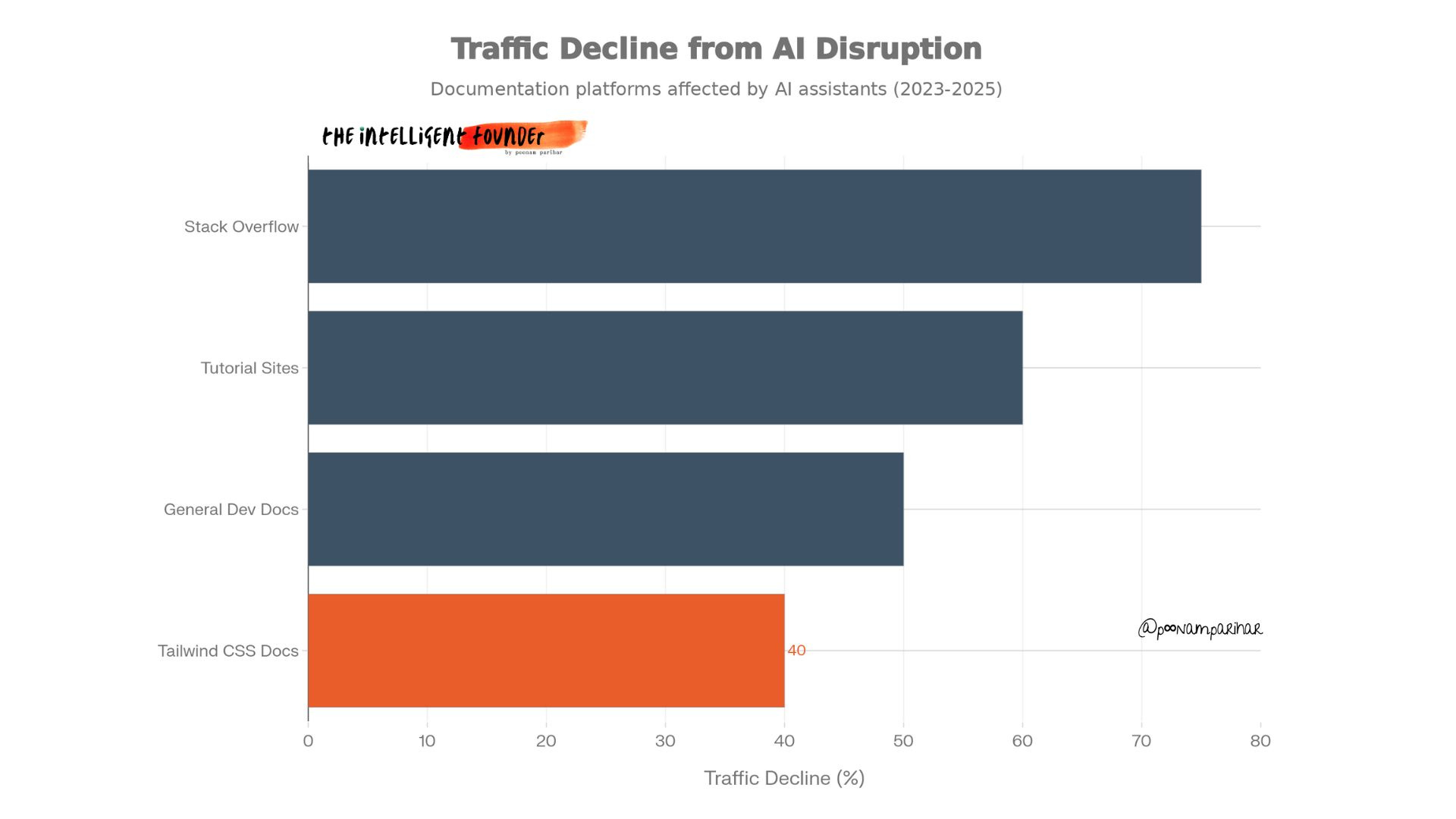
AI has quietly become the first place many developers go when they get stuck, and that changes the entire journey from question to product.
From search to AI front door
How many of us now go to Claude (or ChatGPT, Cursor, Copilot) to check or fix our code before even thinking about Googling the error? For a growing majority of developers, that’s the default habit, not the exception.
A large majority of developers now use AI tools as a primary way to get unstuck, often before (or instead of) searching the web. Industry surveys in 2025 report that about 84% of developers are using or planning to use AI tools, and more than half of professionals use them daily.
In the same research, roughly two‑thirds of developers (around 68%) say they turn to AI when they get stuck on a problem, making assistants the first stop for many everyday issues.
This replaces a lot of the old flow—copy error → Google → Stack Overflow/blog/docs—with “ask Claude/ChatGPT/Copilot, get an answer, keep coding,” meaning fewer automatic clicks to the original content and docs, even though those sources still underpin many answers.
