The Tailwind Story and the Future of Open Source Sustainability
How radical honesty and transparency can become a strategy. The Tailwind story, market data, and playbook for founders and builders navigating the shift from search-driven to AI-mediated distribution
This story is about Tailwind Labs, the company behind Tailwind CSS, a very popular tool web developers use to style websites quickly. Tailwind was extremely successful: millions of developers used it every month, and its design system became so well-known that AI coding tools learned how to use it perfectly and that success itself became a problem, because once AI tools automatically knew how Tailwind works, many developers stopped visiting Tailwind's website or reading its documentation.
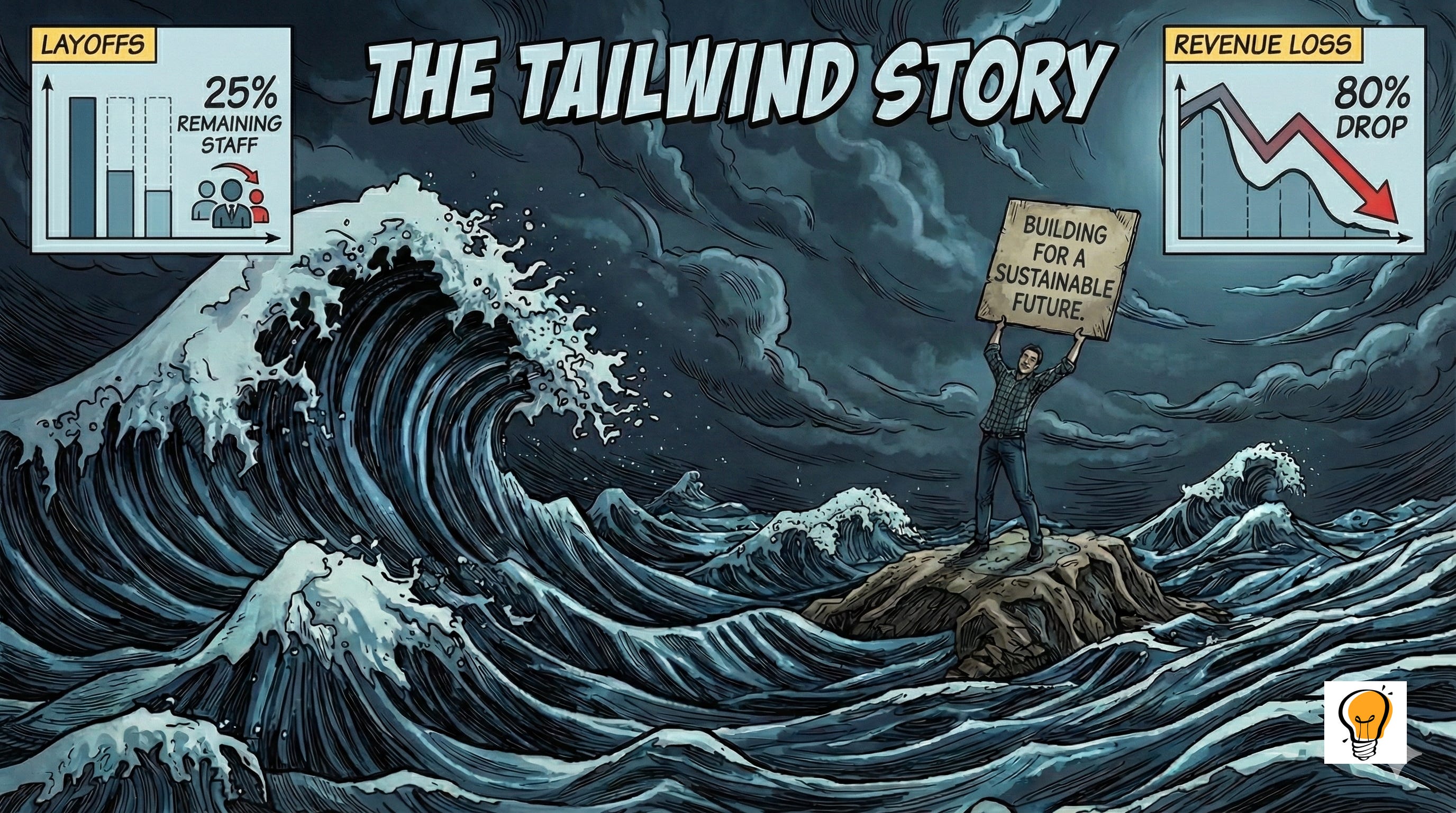
Less traffic = less revenue, since Tailwind Labs made much of its money from products and sponsorships tied to that documentation site; when Google traffic dropped by around 40%, revenue collapsed by about 80%.
In simple bullet points, -
What exactly happened?
Tailwind CSS reached massive adoption, with tens of millions of downloads per month.
Search traffic to its docs dropped sharply and revenue fell about 80%.
Tailwind Labs laid off around 75% of its engineering team.
Why it happened?
AI coding tools learned Tailwind’s patterns so well that developers could get Tailwind answers directly from AI instead of visiting the official docs.
Tailwind’s business model depended heavily on documentation-driven traffic and related product sales.
When that traffic shifted into AI tools, usage stayed high but income collapsed.
How the situation evolved?
The founder publicly explained the numbers, the layoffs, and the risk of Tailwind becoming unmaintained.
Major companies and many developers that rely on Tailwind stepped in with sponsorships and financial support.
Funding moved from indirect (docs/SEO) to direct support from the ecosystem that uses Tailwind.
I was working on this research this saturday night, and in last 3-4 days few more developments have come to light.
Latest Developments (as of January 13, 2026)
Since the initial transparency push on January 6-7, the sponsorship response has accelerated significantly. Google AI Studio officially joined as a sponsor on January 8, and within 72 hours, 26 new sponsor companies signed on, including 7 at the highest “Partner” tier.
Adam Wathan has clarified that Tailwind already had over $800,000 in annual sponsorships before the crisis, but rising costs and declining revenue still forced the decision. The company now has “6+ months runway” and is focusing on revenue-generating work rather than community feature requests.
The fact that Wathan, didn’t quietly hide the problem and instead of polished PR, he publicly explained what happened, shared numbers, and warned that without support Tailwind risked turning into “unmaintained abandonware, the kind of radical transparency which is unusual in tech, helped worked in his favor and triggered a wave of support. the ecosystem where companies often mask financial trouble behind vague messaging or hype. his honest message was simple. He made it clear that the main goal was simply to keep the project properly maintained for the long term.
the tool is widely used, but the business model broke, and help was needed to keep it alive.
In effect, the people and companies who benefit from Tailwind decided to pay to keep their own infrastructure health, and Tailwind became a real‑world example of “if this thing is important to you, help fund it so it doesn’t disappear.
Few key lessons this early 2026 crisis has brought in -
Popularity does not guarantee a stable business if the revenue model is narrow or fragile.
Products built mainly on “information value” are easy for AI to commoditize; services, hosting, support, and strong paid add‑ons are more resilient.
Depending on a single channel like search traffic is risky when AI becomes the main interface between users and information.
Clear, transparent communication can mobilize direct support from users and companies that rely on critical tools.
There is, however, much more that founders can learn from this story. We can turn these lessons into concrete frameworks and playbooks to avoid similar situations in the future. It is not all positive either. the tech and business community remains split on this - many developers are stepping up with financial support, but there are others questioning whether a CSS framework should operate as a multi‑million‑dollar business or instead be maintained more leanly. The conversation has shifted from “will Tailwind survive?” to “should open‑source infrastructure tools even be venture‑scale businesses?”.
In this article
The Tailwind story: what happened and why
How AI changed distribution (search → AI as the front door)
Why Tailwind’s model broke (docs traffic, single revenue stream)
What worked: transparency, community, and sponsor response
Who should care (frameworks, dev tools, OSS infra, SEO‑heavy products)
Key lessons for founders, operators, and builders (high-level only)
One framework: an AI‑era revenue risk check (fragile → more resilient)
The bigger questions (can sponsorships last, should OSS be venture‑scale, etc.)
Simple next steps for readers (audit risk, talk to dependencies, be transparent)
Where the detailed playbooks will live
How AI has changed developers’ journey.
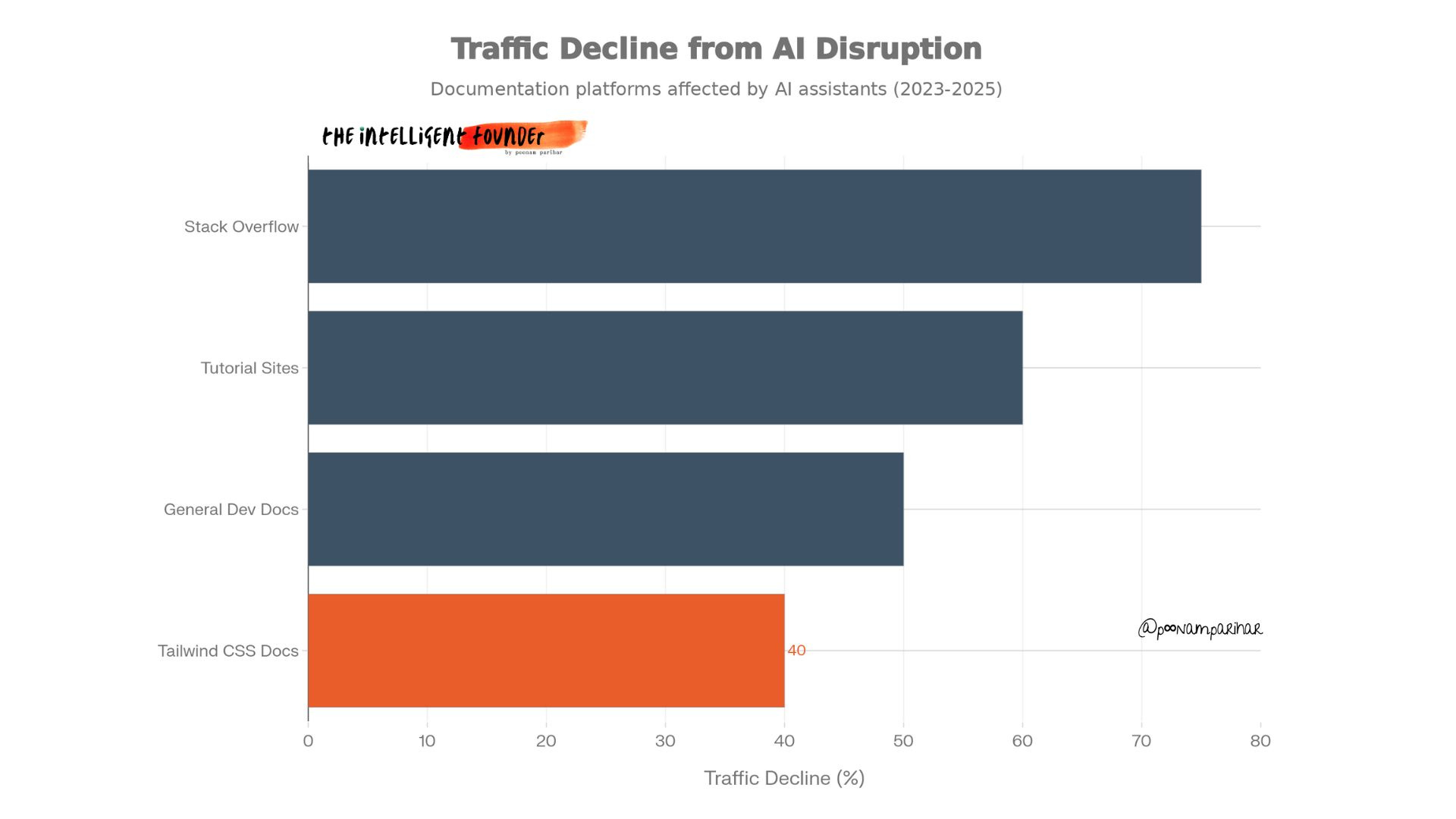
AI has quietly become the first place many developers go when they get stuck, and that changes the entire journey from question to product.
From search to AI front door
How many of us now go to Claude (or ChatGPT, Cursor, Copilot) to check or fix our code before even thinking about Googling the error? For a growing majority of developers, that’s the default habit, not the exception.
A large majority of developers now use AI tools as a primary way to get unstuck, often before (or instead of) searching the web. Industry surveys in 2025 report that about 84% of developers are using or planning to use AI tools, and more than half of professionals use them daily.
In the same research, roughly two‑thirds of developers (around 68%) say they turn to AI when they get stuck on a problem, making assistants the first stop for many everyday issues.
This replaces a lot of the old flow—copy error → Google → Stack Overflow/blog/docs—with “ask Claude/ChatGPT/Copilot, get an answer, keep coding,” meaning fewer automatic clicks to the original content and docs, even though those sources still underpin many answers.
What actually changes for dev tools
For frameworks, libraries, and developer tools, the underlying work docs, blog posts, examples still powers many of the answers developers see. The difference however is, that an AI assistant often stands in front of that work and condenses it, so the developer no longer needs to visit the original page every time they benefit from it. so usage and visibility can drift apart.
Three big shifts come out of this:
Docs become infrastructure, not the destination.
Developers still rely on the knowledge in your docs, but they increasingly consume it mediated by an AI assistant instead of visiting your site. The value is still there; the visibility and traffic are not.Usage and revenue decouple.
A framework or library can be used more than ever, because AI keeps recommending and auto-completing it while signups, docs views, and associated product sales go down. You can be “everywhere” in codebases and still see your top-of-funnel collapse.Your product moves one step further from the user.
The interface the developer sees most is the AI assistant, not your website, README, or marketing page. That means discoverability, onboarding, and even upgrade prompts now happen inside tools you do not control.
Why this is not all bad
This shift also brings upside:
Good tools get recommended more.
AI assistants tend to learn and suggest widely adopted, well-documented technologies. If your framework is strong, AI can amplify its spread with almost zero additional marketing.Friction for your users goes down.
Developers spend less time hunting through search results and more time shipping. If your business model aligns with that (for example, via hosting, APIs, or services), you benefit from faster adoption.You can design for the AI front door.
By structuring docs well, offering clear upgrade paths (like hosted versions or pro features), and making your brand and URLs unmissable in examples, you can still turn AI-mediated usage into relationships and revenue, just not through old-school traffic metrics.
first “click” is a prompt
In other words, AI has already moved itself between developers and the traditional documentation/search layer. The challenge now is not to fight that, but to decide how your product captures value in a world where the first “click” is a prompt, not a page view.
Why this matters for founders, operators, and builders
For founders
Your top of funnel is changing even if your usage graphs still look healthy.
A product can be “recommended everywhere” by AI and still lose revenue if it depends on docs traffic or SEO-heavy content to monetize.
Models that worked in the search era (free docs → eyeballs → one main product) can quietly break when AI absorbs the docs but not the business.
For operators (CEOs, Product Mangers /Engineering leaders)
Traditional metrics like page views and organic visits are less reliable proxies for product health; activations, retention, and paid conversion matter more.
AI has effectively become a distribution channel you do not own, so risk management has to cover docs dependence, single‑stream revenue, and OSS infrastructure you rely on.
Budgeting some money and attention for the tools your teams depend on (frameworks, infra, dev tools) is now part of operational resilience, not charity.
For builders (engineers, framework and tool creators)
Stars, downloads, and “everyone uses this” are no longer enough to guarantee a sustainable project.
Anything that is mostly information APIs, patterns, snippets is the easiest thing for AI to copy; hosting, support, integrations, and guarantees are harder to replace.
Designing your next feature, or your next side project, with “AI will sit between this and users” in mind gives you a head start on choosing the right business shape later.
The bigger questions this raises about open source and sustainability
This isn’t just a Tailwind problem. It raises some simple but important questions about how the tools we all use are paid for.
Can “donations and sponsors” really keep the lights on?
Big companies can sponsor a project for a while, but budgets change and people move on.
If a tool is critical to thousands of teams, relying only on goodwill feels shaky.
Does every popular open‑source project need to become a big company?
Some projects try to hire a whole team and run like a startup, then struggle when money gets tight.
Others stay small and lean, and make money from services or side products instead of a big payroll.
What is a fair way to pay for tools in the AI era?
AI tools learn from docs and examples, but those docs still cost time and money to write for example this one?.
In the long run, there probably needs to be a clearer way for the big users of a tool ie clouds, platforms, companies to help fund the work that keeps it alive.
A simple AI‑era revenue risk check framework
This doesn’t need a spreadsheet or a consultant. It’s a quick self‑check to see whether your business looks more like “Tailwind before the crisis” or like something that can handle AI sitting in front of it.
Step 1: List how you make money today
Write down each revenue stream: product sales, hosting, support, training, sponsorships, etc.
Next to each one, note if it depends heavily on people visiting your docs, blog, or website.
Step 2: Score how “AI‑exposed” each stream is
0 = AI can’t really replace this (e.g., hosting, SLAs, custom work).
1 = AI might help people find it, but can’t deliver it.
2 = AI can deliver a chunk of the value.
3 = AI can give almost all of it away (e.g., basic reference docs, simple tutorials).
Step 3: Look at the pattern
Add up how much of your total revenue comes from “3” streams.
If more than half your revenue is in that bucket, you’re very exposed to AI and traffic changes.
If it’s a smaller slice, you still need to watch it, but you have more room to experiment.
Step 4: Pick one move, not ten
Choose a single way to make at least one “3” stream less fragile:
Turn popular docs into a paid workshop or cohort.
Add a small support/SLAs offer for teams already using you.
Start scoping a simple hosted/managed version of your tool.
The goal is just one concrete step that makes your revenue a bit less dependent on page views.
The Tailwind story is a warning, but it doesn’t have to be a horror story. It’s what happens when AI quietly moves between you and your users while your business model stays stuck in the old world of search, docs traffic, and one main revenue stream. The good news is that the problem is now visible early enough for the rest of us to do something about it.
If you ran the simple AI‑era revenue risk check and didn’t love your score, you’re exactly who the rest of this work is for.
In upcoming paid posts, I’ll go deeper into:
The full AI‑era revenue risk matrix, with examples for real products
Fragile vs diversified revenue models, with numbers and trade‑offs
A 12‑month implementation roadmap you can adapt to your own framework or dev tool
I’ll also connect this case study to the 2026 AI Operating System series and go deeper into “how other teams are adapting their AI bets, what failed, and what’s worth copying” , including:
The full AI‑era revenue risk matrix,
revenue model breakdowns,
A 6–12 week execution playbook that extends the earlier 6‑week OS framework
This Tailwind piece will stay free so anyone can read it and join the discussion in the comments.
If you’re building a framework, dev tool, or any product that leans on docs and SEO today and you want the full playbooks rather than just the high‑level ideas, consider subscribing to the paid tier. That’s where the deeper frameworks and step‑by‑step playbooks will land as they ship.


Notes - Tailwind’s docs story maps cleanly onto Substack too.
if AI and platform UX give readers “good enough” answers without ever hitting your actual posts, your relationship and revenue both get invisibly taxed. The risk is letting algorithm- or AI-mediated distribution become the primary “front door” instead of treating it as a discovery layer that pushes people into channels you own (email, site, products).
For us, that means keep writing for the humans first,
>> design every key piece with a clear path into deeper work (subscriptions, products, community), and
>> use AI + Substack features tactically to amplify momentum rather than as the place where the full value gets consumed.