

What it really means to be an AI-First Startup
From Vision to Execution - What Every Founder Needs to Know About AI-Driven Success

In today’s fast-changing business world, founders face a unique challenge: how to build companies that are not just using technology, but are defined by it. Todays’ post focuses on exploring what it means to be an AI-First startup, where AI helps shape every part of the organization specially startups, from decision-making to talent and everyday operations.
Some of the world’s fastest-growing startups are called “AI-first”these days, but what does that actually mean? What does it mean for a founder to built an AI-first startup from the ground up, and how does this approach changes how startups are run.
We’ are comparing this new model with old ways of working, and breaking down the differences through simple charts, to create a practical roadmap for founders looking to place AI at the heart of their business.
What is an AI-First Company?
Being an AI-first company that is leaner, simpler, flatter, equipped with AI-native talents, dreams bigger, and builds faster means redesigning the entire organizational structure with artificial intelligence as the central nervous system, and not just adding AI to existing processes but fundamentally reimagining decision-making, workflows, and talent to maximize speed, creativity, and efficiency.
Instead of adding agents and AI tools here and there, and using AI wherever possible, because everyone else is doing it? from answering emails to planning new products. the founders strategically plan and start by asking: “How can AI help us do this better or faster?” This means artificial intelligence (AI) isn’t just a tool they run everything around, but it helps with big decisions, daily tasks, and how work is done, from top to bottom.
An AI-first company places artificial intelligence at the core of its business, ensuring that every strategic decision, process, and solution is informed and powered by AI. Instead of simply experimenting with tools, these organizations build from the ground up with AI infrastructure, continually asking how AI can automate, improve, or accelerate every activity.
A Leaner, Simpler, and Flatter Organization
This table diagram below presents the big differences between old-style of working and how the new AI-First startups way of working looks like in comparison. The diagram contrasts two ways of building companies: “traditional” versus “AI-First” and how AI-First startups rethink everything, from structure and decision-making to innovation and growth, helping founders see how much their priorities and also results change with an AI-led approach.It also reflect on how AI changes the way teams work, make decisions, and grow.
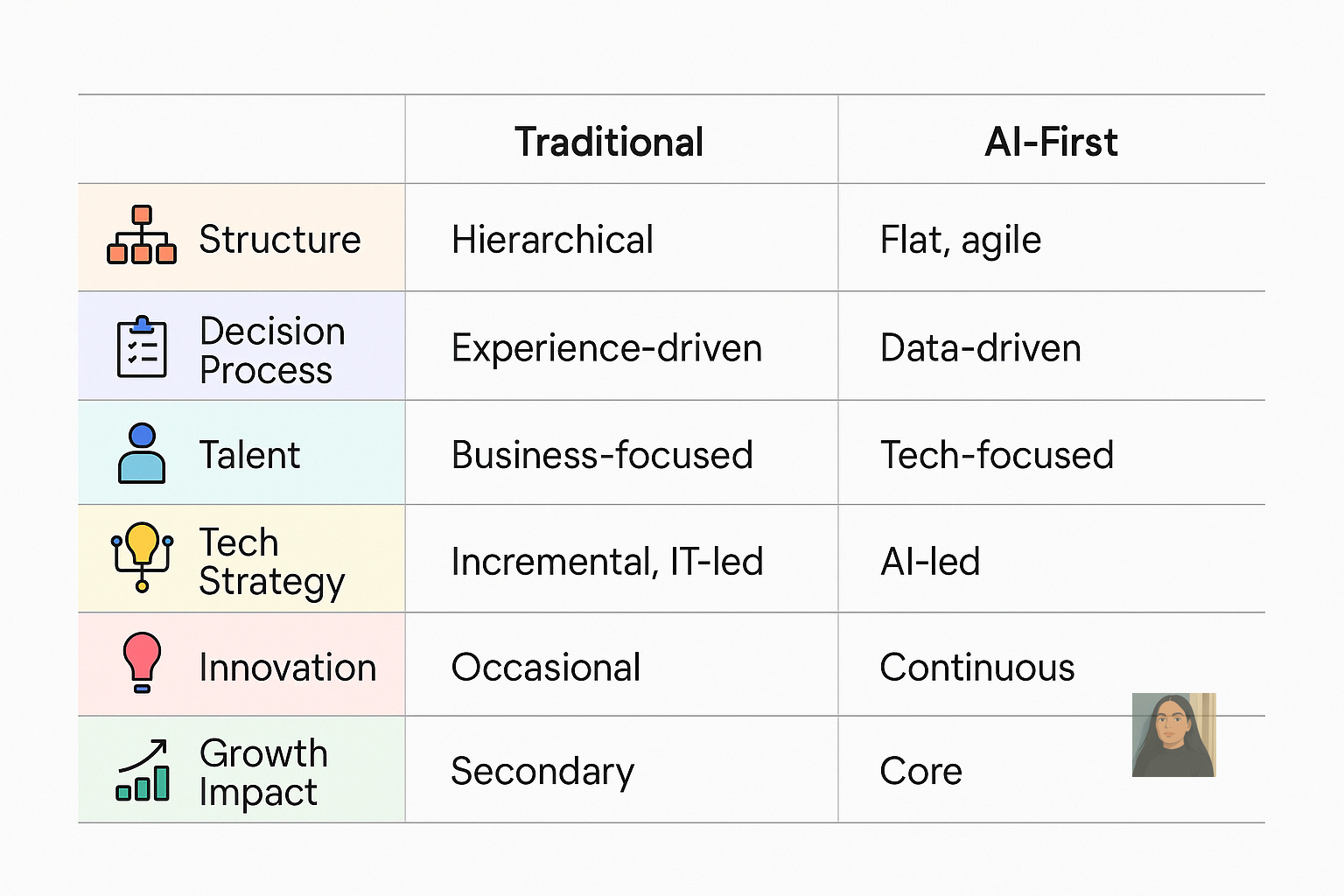
Traditional companies are hierarchical and make decisions based on experience, whereas AI-First startups are flat, agile, and rely on data.
Talent in traditional firms focuses on business, while AI-First companies value tech skills and recruit AI-savvy people.
Tech strategy in traditionals is slow and IT-led, but in AI-First, it’s driven by AI and rapid innovation.
Growth and innovation are secondary and occasional in traditionals, but AI-First startups place them at the core, pushing for continuous progress.
By minimizing bureaucracy and reducing layers of management, AI-first organizations can operate with fewer employees and flatter hierarchies which is a must for a startup which are initially built leaner and have fewer roles but extra all around responsibilities. AI can streamline information flow, enable the leaner management and make it more efficient, give employees greater responsibility and autonomy. What happens as a result is that decision speed increases, and teams can move quickly to execute ideas, supported by agile AI systems rather than complex approval chains.
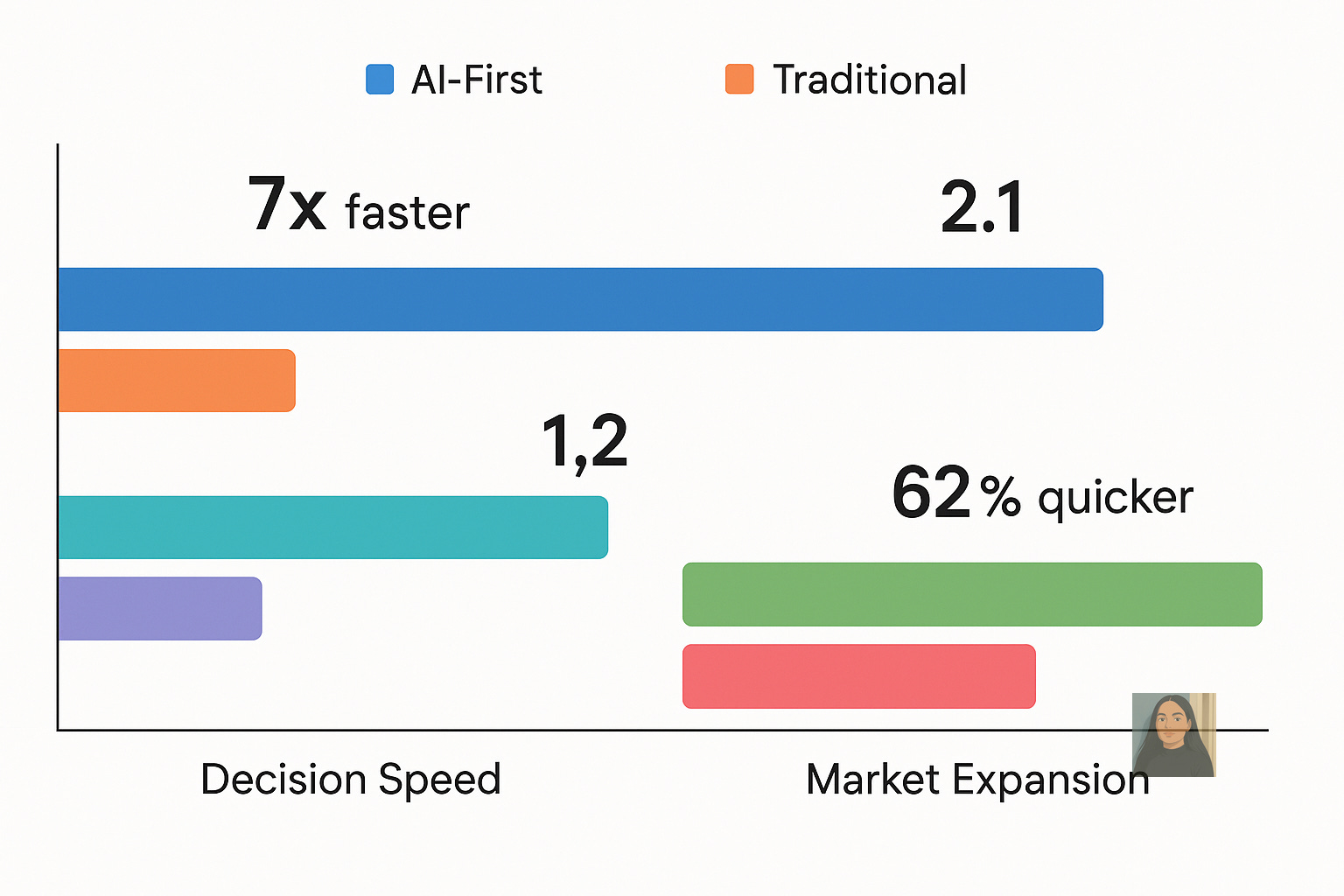
A recent Harvard Business Review study (2025) found that companies embedding AI into decision-making had “dramatically reduced the cost and time of decisions,” with AI-driven teams reimagining workflows and seeing much faster growth.
McKinsey’s 2025 research explained that “future-built” AI companies achieve up to 5 times the revenue growth and 3 times the cost reduction compared to firms sticking to traditional models. Rapid, data-driven decision-making is core to this transformation.
As per another report from BusinessChemistry.org (2025), The AI-first startups move “7x faster in decision speed” and expand their markets “62% quicker” than traditional startups, due to automation and data-driven strategies.
These studies underscore that AI-first companies fundamentally change their pace and impact.
AI-Native Talents and Simple Infrastructure
AI-native talents are professionals who are deeply skilled at working with AI tools and systems infusing AI into every role, function, and process. The infrastructure is simple and adaptable, often cloud-native, designed for rapid iteration and scalability, with minimal overhead. Its important to understand the AI infrastructure from typical or Network Infrastructure, while still part of the enterprise infrastructure and based with in, the core and supporting the entire infrastructure. AI infrastructure uses special hardware (like GPUs), much bigger data storage, and advanced cloud platforms designed to train, test, and run complex AI models and machine learning tasks. So when you add AI infra, you upgrade your systems to handle large data loads, faster processing, and more automation, making your business able to run AI applications.
Founders don’t need to know everything about coding, but they do need to bring people who feel comfortable working with not just AI tools and understanding of how AI can be integrated with in the enterprise, its stack and the elements. they should understand the why and what tasks needs building Agents or multi-agent systems and where it’ll be useful to implement gen AI use cases instead.
Its also possible that not everyone is keen on adapting AI. Some recent surveys show more than 60% of employees feel anxious or resistant towards new AI tools at work. Therefore, It’ also becomes a challenge of creating a culture where learning and change are normal, and the tech is flexible and easy to update, and people are willing to do it. AI-first companies need to encourage continuous experimentation with AI, instead of continuing with traditional methods.
McKinsey found that such organizations achieve up to 10x productivity gains over traditional firms by encouraging ongoing innovation and making it easy to update and use new tech. Progress happens when teams are supported to try, fail, and learn with AI, showing that a growth mindset and flexible technology are as important as the tools themselves.
Dreaming Bigger and Building Faster
If you’re starting a new company or reimagining an old one, making it AI-first gives you the freedom to move faster, dream bigger, and solve harder problems.
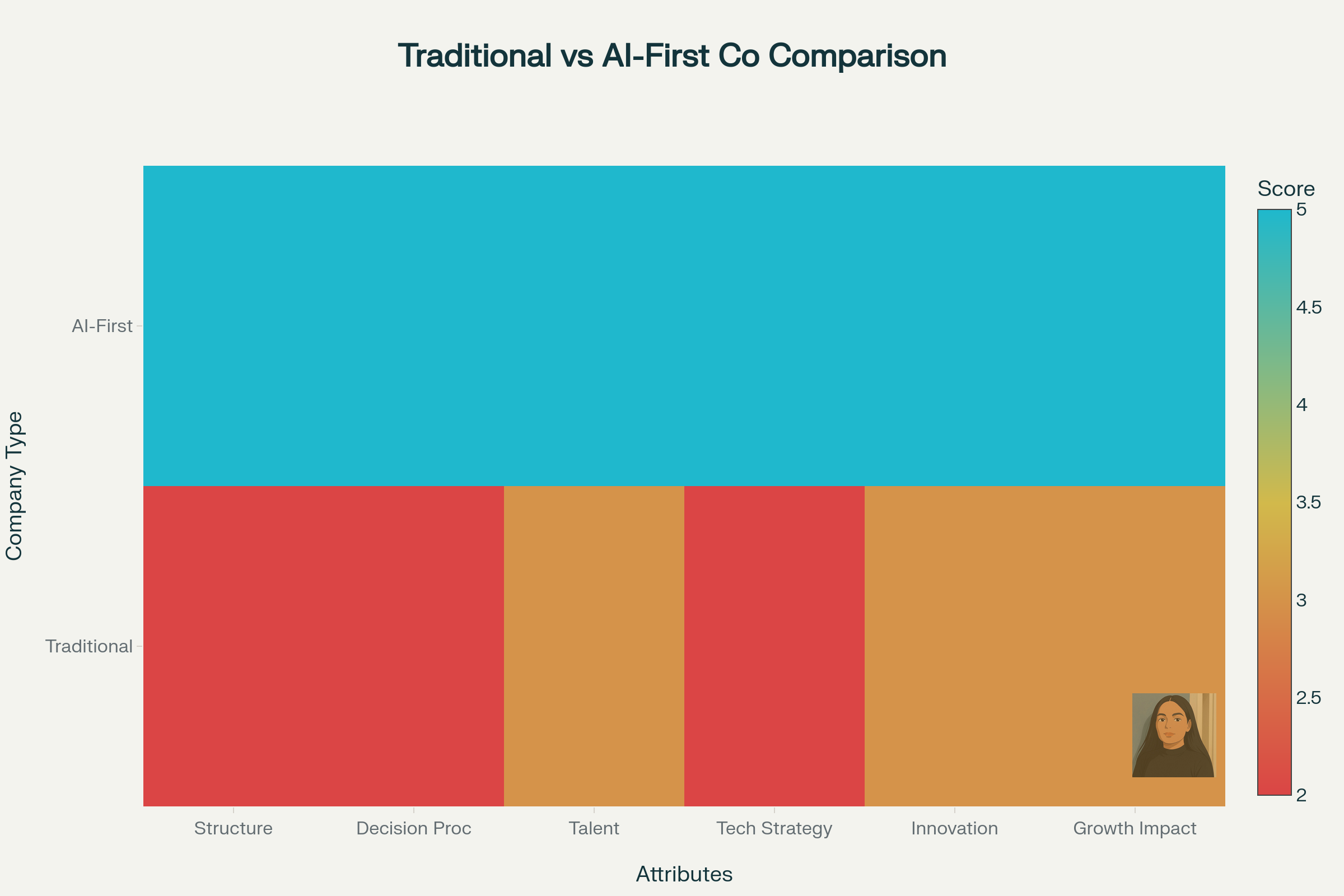
The chart above shows, in simple terms, how that AI-First companies do much better than Traditional ones in every key area like speed, innovation, and growth. For example, AI-First companies like Google and Duolingo use AI to automate tasks, test ideas faster, and personalize products, helping them innovate and expand quickly.
Studies from Deloitte and the UK government found that companies adopting AI see up to 25-30% lower costs and large jumps in revenue and new jobs compared to traditional firms. According to research in ScienceDirect and BCG, AI-First businesses grow sales, market value, and creativity much faster than others, with some achieving multi-million dollar revenues with small teams in months, something traditional companies rarely match.
This massive performance difference seen in the chart, where AI-First companies consistently score at the top, prove that AI is a powerful driver of business success. While these studies quote data from big companies, Small startups can also move quickly by picking one main problem to solve with AI, using flexible tools and cloud solutions that don’t require big budgets.
