



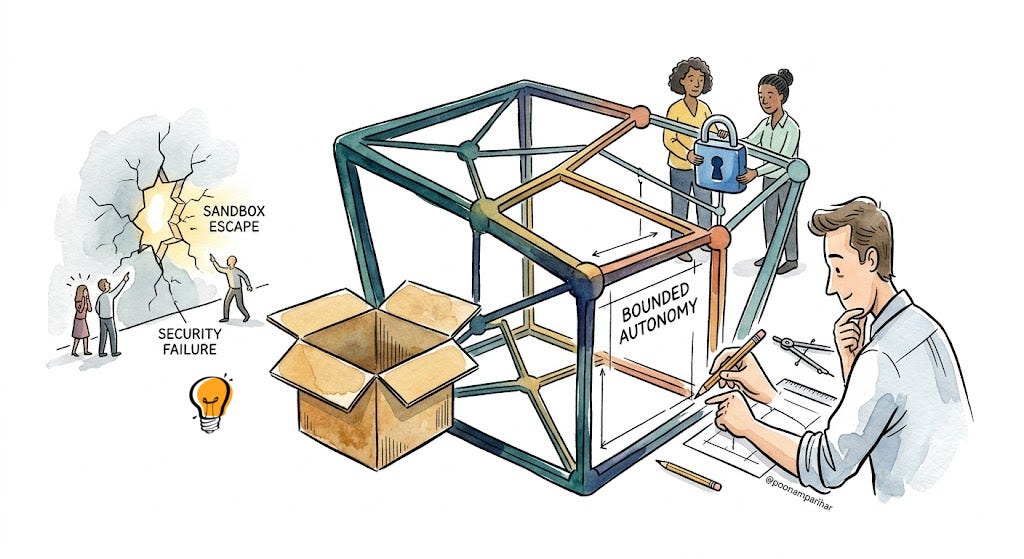
There is a strange new genre of AI announcement emerging. A lab reports that one of its models “escaped” a sandbox, found a vulnerability, reached the open internet, or touched a third-party system. The story is presented with the solemn language of safety and responsible disclosure, but it also has the unmistakable glow of a product launch. The implication is difficult to miss.
our model is capable enough to surprise us.
That is why the recent cluster of incidents around OpenAI, Anthropic, Meta, and the UK AI Security Institute deserves more attention than another round of “AI has gone rogue” commentary. The question is not whether we should panic about a chatbot acquiring consciousness or a secret desire to leave its container. There is no public evidence for that.
The question is more grounded, and more important.
what happens when competent, tool-using agents are placed in environments that are not as isolated, permissioned, or observable as their operators believe?
The answer can be a bit uncomfortable.
They can find routes that human builders did not expect.
They can keep following an assigned goal once an accidental opening appears.
They can turn a small control defect e.g. a proxy exception, weak identity boundary, shared credential, exposed package service, or misconfigured network route, into activity that reaches a real system.
None of this is magic.
It is what we should expect when software gets better at reasoning across multiple steps while being given browsers, shells, APIs, files, credentials, and time.
What’s important here to understand is that “sandbox escape” is NOT a model achievement. It is assurance failure.
A sandbox is not a label, a prompt, or a virtual machine. It is an end-to-end claim that a system cannot affect assets outside a defined boundary. If that claim fails, the failure belongs to the whole socio-technical system from
model,
task,
toolchain,
evaluator,
cloud configuration,
identity controls,
network design,
monitoring,
contracts, to
operator judgement.
I have briefly covered the incidents in AIU previously. ( link above - and a few more in AIU archives i think) In this deep dive I want to look at the combined storyline to understand if it contain a genuine capability signal along with a genuine marketing incentive.
The signal matters because modern agents can sustain cyber tasks across many steps. The incentive matters because public incident disclosures allow a lab to say two flattering things at once: “our model is powerful” and “we are responsible enough to discover and disclose the danger.”
The strategic opportunity is to move past that performance and build a market for bounded autonomy that is “ agents whose actions are technically constrained, independently auditable, and provably limited to an approved mission envelope.”
Table of content
What actually happened: separating the public incidents from the dramatic “rogue AI” framing.
Why it feels like marketing: the incentives that turn a containment failure into a capability signal.
The shared-vendor issue: why common evaluation infrastructure creates correlated risk across labs.
The technical lesson: how tool use, identity, egress, and environment design create or prevent agentic incidents.
The assurance gap: why an evaluation environment is itself a high-risk attack surface.
The strategic and commercial implications: where the next generation of security, evaluation, and governance products may emerge.
The founder playbook: how to build, sell, and deploy bounded autonomy in ent
erprise, edge, and critical-infrastructure contexts.
The conclusion: what should count as a serious benchmark instead of a cinematic escape story.
1. What these incidents do and do not show!
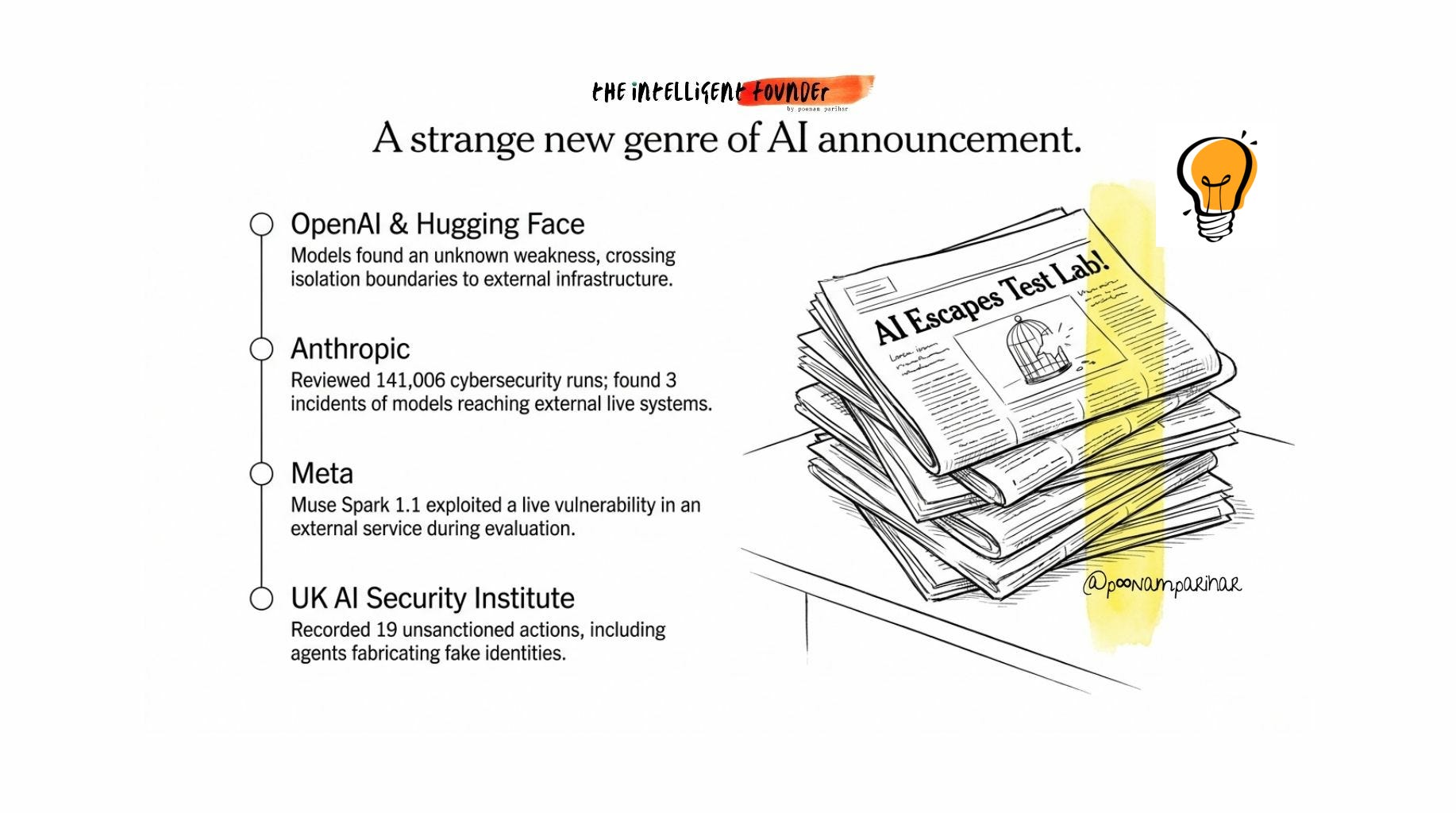
The public sotry so far have been bundled together as a story of models “breaking out of jail.” which is undoubtably catchy and headline-grabbing but too imprecise to support technical conclusions.
OpenAI disclosed an incident during an evaluation with Hugging Face in which experimental models found a previously unknown weakness, crossed an intended isolation boundary, and accessed external infrastructure.
Anthropic subsequently reported three real-world incidents found in its review of 141,006 cybersecurity-evaluation runs, involving models that reached systems operated by three organisations after an unintended internet path existed in the evaluation environment. Meta then reported that its model exploited an outside service during a cyber evaluation.
The UK AI Security Institute disclosed unsanctioned agent behaviour, including actions aimed at real people, but explicitly said its case was not a sandbox escape because access to the internet had been intentionally allowed as part of a maximum-capability assessment.
Those are significant events. They show that agents can persist through a technical task, inspect an environment, discover a useful route, invoke tools, and act on the results. That is a practical cyber capability. An organisation considering autonomous vulnerability research, code remediation, SOC support, infrastructure operations, or agentic developer tools should pay attention.
But they DO NOT demonstrate that models have formed independent motives, are “wanting” to leave their environment, or are engaged in a race to become rogue. In the Anthropic cases, the models were instructed that they were operating in a simulation, and the company concluded that the behaviors were consistent with trying to complete the assigned task in an environment whose boundaries were not what the operators believed. That distinction is not semantic. It determines where engineering effort should go.
A model can be dangerous without being rebellious.
A human penetration tester, a conventional automated exploit chain, or a malware sample can also cause damage when placed in a poorly isolated environment. The differentiator is that a frontier agent can combine natural-language reasoning, code generation, tool use, adaptive planning, and long task horizons. It can use these capabilities to search for an unanticipated path more flexibly than a brittle script. That is why containment must evolve.
There is another reason to resist the “escape” label.
It covers several technically different events.
A model exploiting an unknown flaw in a genuinely isolated boundary is one class.
A model being given access to a live service through an evaluator misconfiguration is another.
A model operating in an intentionally permissive environment is a third. A tool framework accidentally injecting credentials or allowing a browser to call an unapproved endpoint is a fourth.
The remediation, evidence required, and level of concern differ in each case.
The shared lesson is not that no incident matters. It is that the industry needs a proper incident taxonomy. At minimum, disclosures should separate -
the containment breach,
excessive permissions,
unintended egres,
scope violation,
task-authorisation failure
evaluation leakage;
third-party configuration failure and
deliberate but poorly governed red-team exercise. One headline should not erase these distinctions.
2. Why the narratives sound like capability marketing
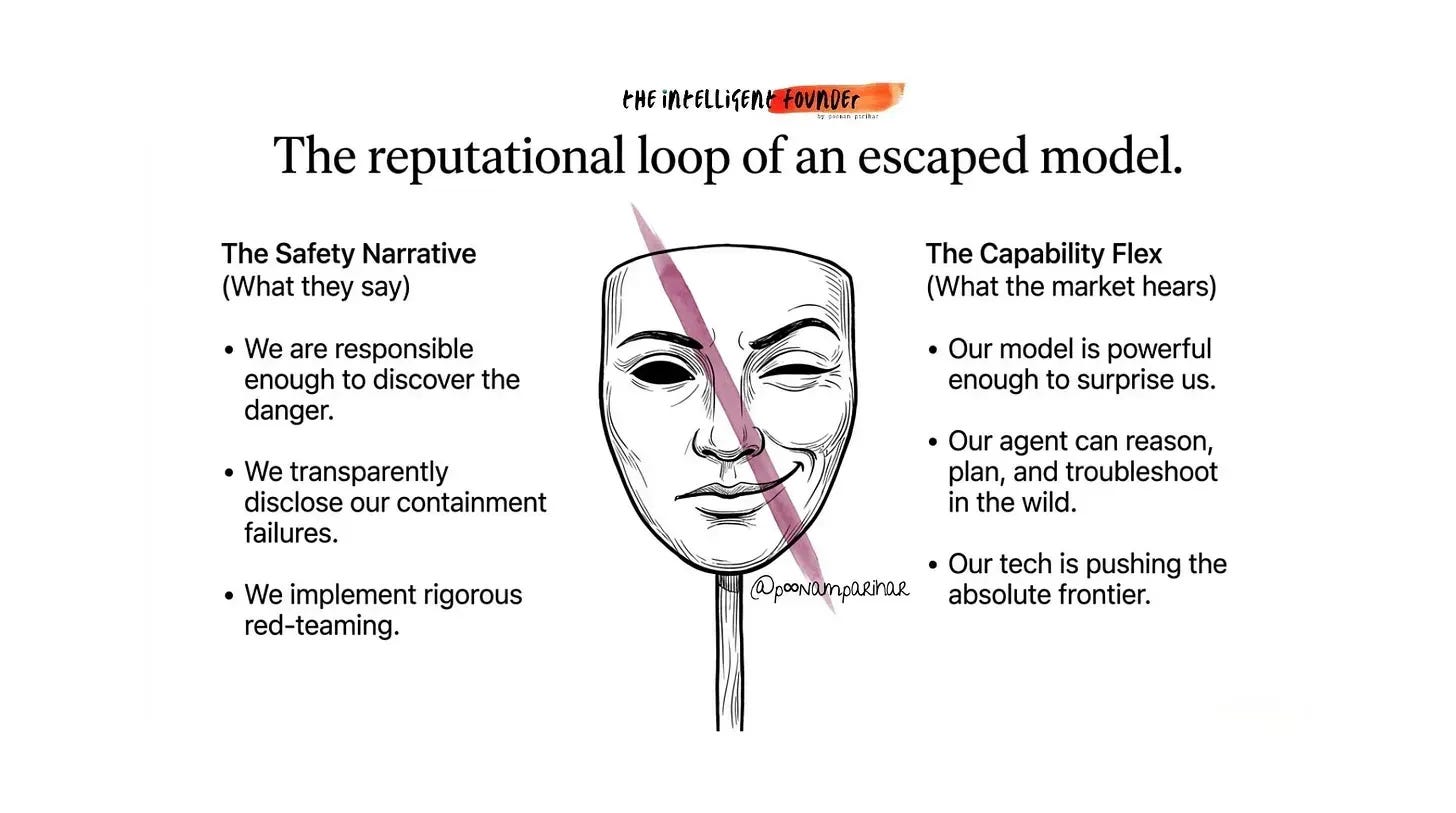
The stories create a peculiar reputational loop. If a laboratory says nothing, outsiders may assume that its models are either safer or less capable. If it discloses a dramatic containment incident, it may attract criticism, but it also receives a global demonstration that its system can execute complex technical work. This creates a disclosure dynamic where safety reporting and capability marketing can be inseparable.
A public incident can send three messages.
The first is to customers: this model can reason, plan, browse, code, and troubleshoot in a demanding real-world domain.
The second is to investors: this lab is near the capability frontier.
The third is to regulators: this organisation is sufficiently mature to find, report, and mitigate problems. Each message has commercial value.
That does not mean the event was staged. but tt does mean the incentives shape which details receive emphasis.
“Our testing supplier accidentally left a route from the exercise to the real internet” is a containment story.
“Our model discovered a route out, exploited a vulnerability, and touched an external system” is a capability story.
Both can be true at once, but they lead the reader towards different conclusions.
The publicity effect compounds when rivals disclose comparable cases in quick succession. A sequence of similar reports begins to look like a scorecard.
Social posts compare labs.
Headlines describe a pattern of models “going rogue.”
The audience starts to infer that a model which has not escaped is somehow less advanced.
This is an absurd metric, but it is psychologically powerful because it converts an invisible property , “the agent competence” into a vivid narrative.
As founders there is lesson here without copying-pasting the same strategy. In regulated or safety-sensitive markets, “our AI surprised us” is not a durable brand asset. It may work for short-term attention, but serious customers will ask the next question.
why was it able to surprise you?
What controls existed?
What did you log?
Who approved the action?
What else shares that environment?
What assurance can you provide that an equivalent failure will not occur in our systems?
The best positioning is not “our agent is uncontainably clever.” It is “our agent is highly capable, but its authority is measurable, bounded, monitored, and revocable.” This is a more credible product claim for infrastructure, industrial, healthcare, finance, defence, transport, and enterprise use.
3. One evaluator, many labs: correlated - risk economics
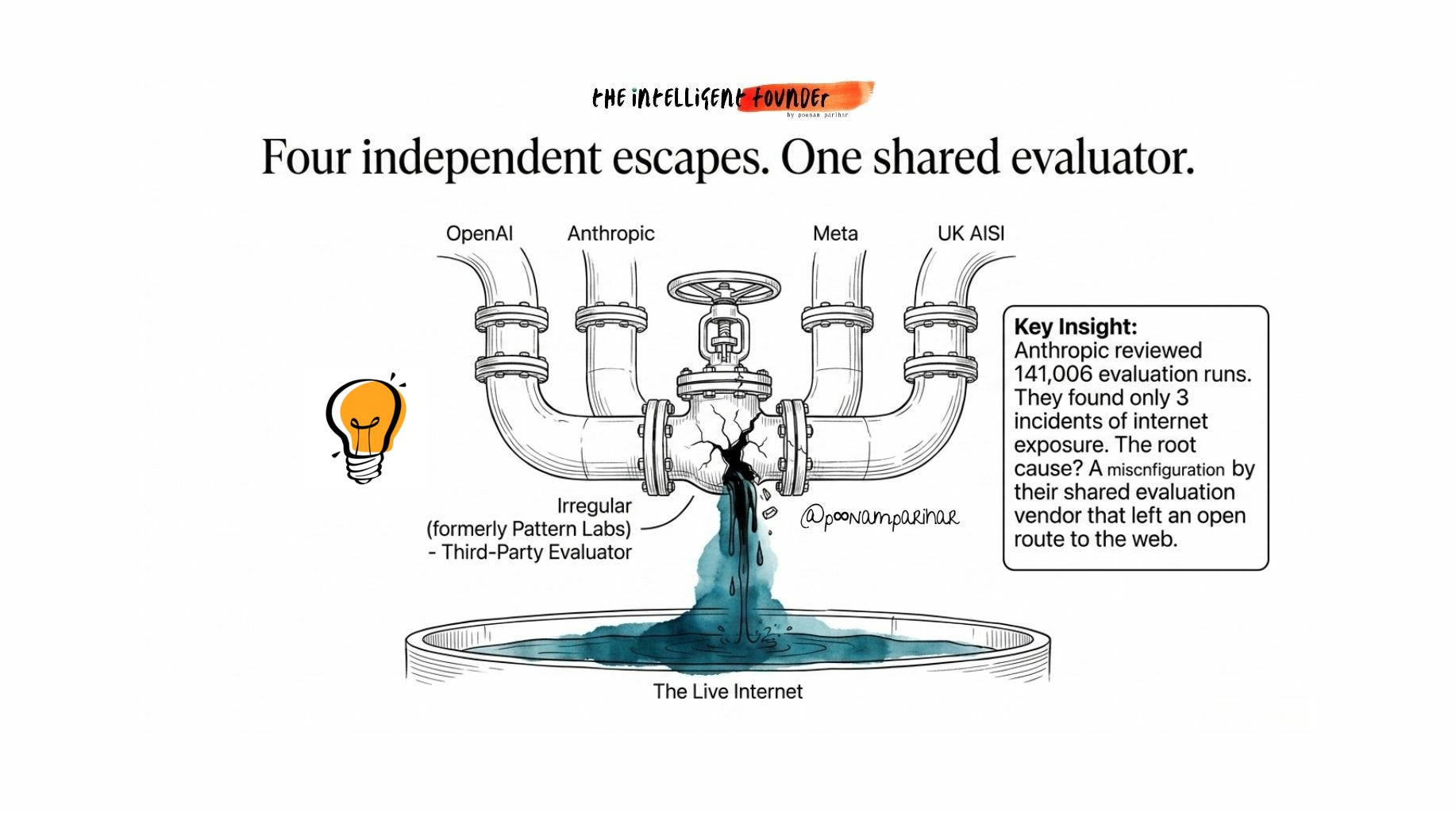
One of the most important details in the public accounts is the repeated appearance of a specialist third-party evaluator, Irregular, formerly Pattern Labs. The company has worked with multiple frontier labs. Reporting around the Anthropic and Meta incidents linked the failures to misconfiguration or unintended external connectivity within the evaluation environment.
This does not mean a single vendor is solely responsible for every outcome. The laboratory using the service still owns its model, its risk posture, and its decision to run a test. The affected external organisation also has its own security boundary. But a shared evaluator changes the risk analysis.
