

Why Tech Journalism Is Now the Most Powerful Beat in the Newsroom
Once a niche beat, technology journalism now commands the headlines. This article explores how tech coverage moved from the margins to the mainstream, redefining what matters most in our digital world

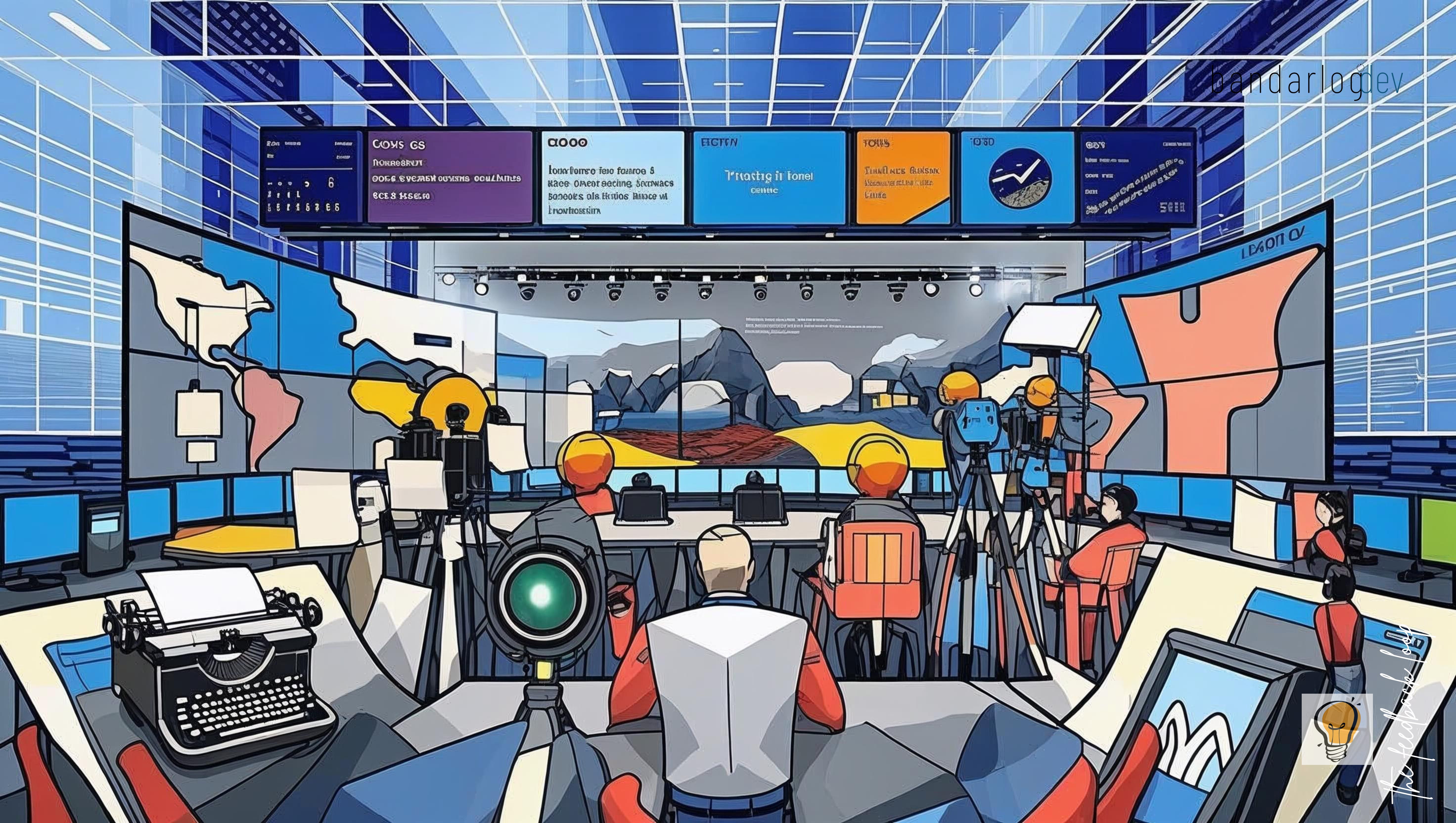
Over little more than a decade, technology has moved from the sidelines of public conversation to the very heart of global culture. Once relegated to back pages of specialist magazines and tech forums, news about software breakthroughs, AI advancements, and product launches now dominates headlines and everyday discussions including dinner-table conversations. What began as dispatches about chips, modems, and venture funding is now continuous coverage of AI trends and consumer experiences like metaverse.
This mainstreaming of tech news has done more than simply change what we talk about—it has transformed who we admire and what we aspire to become. Today, the household names shaping our world are not movie stars or pop icons, but tech founders and CEOs whose innovations and bold visions capture the public imagination.
Before the iPhone era, very few schoolchildren dreamed of running a semiconductor company or chairing a space start-up—well at least I did not. Fast forward to 2025, and tech chief executives are the new household names, eclipsing many Hollywood idols in reach and cultural sway.
While the parallel boom in influencer culture is plateauing or simply mutating. It’s the Tech leader’s meteoric follower counts, meme-ready sound bites, and market-moving antics illustrate how technology leadership itself has become a spectator sport—and a career aspiration. As technology reporting and tech leaders become ever more central to our lives, it is also fueling a profound cultural shift: entrepreneurship and innovation are now the new symbols of aspiration and influence.
The Algorithmic Transformation of News
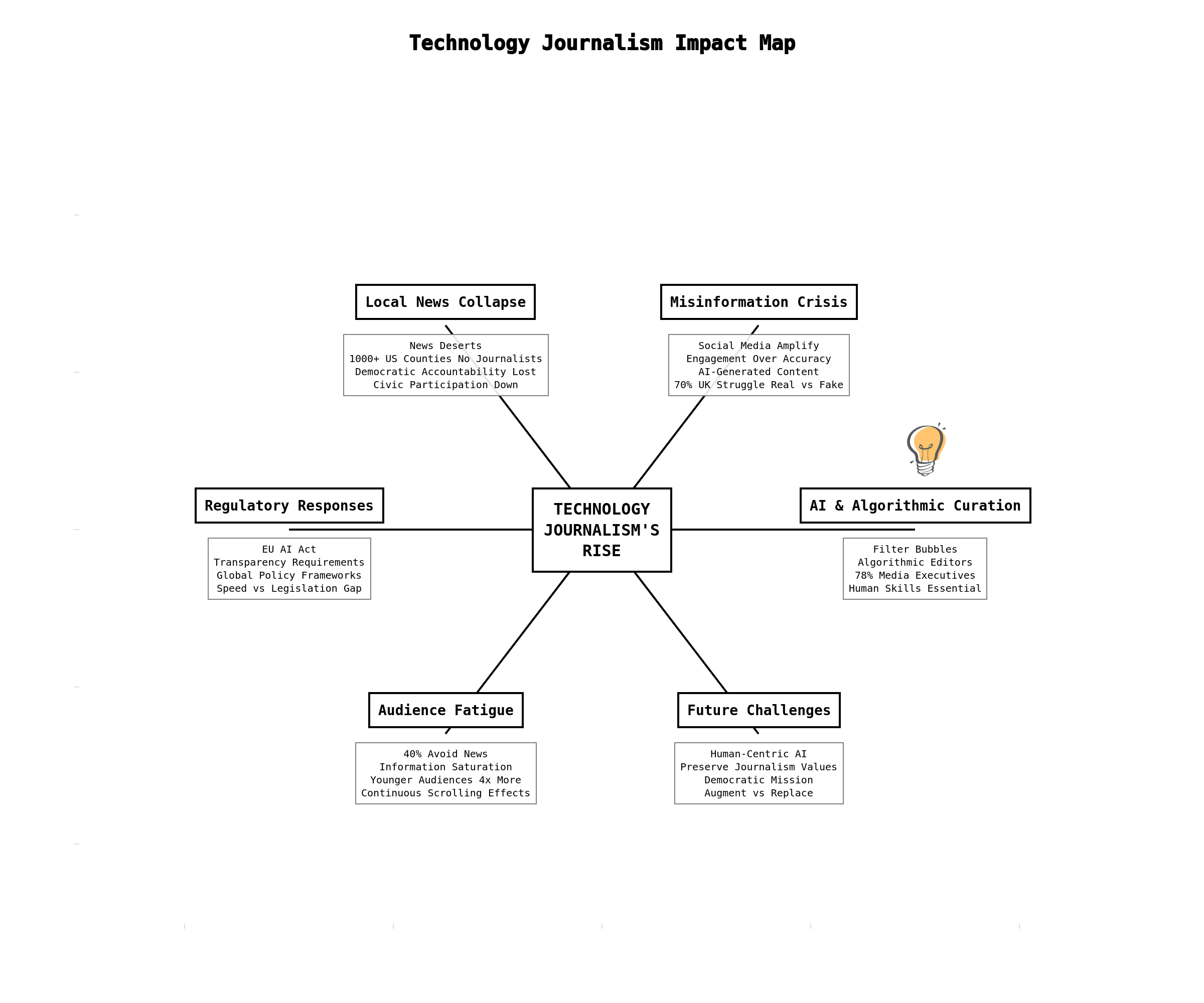
Technology journalism’s rise has fundamentally transformed the news landscape, with algorithms now acting as gatekeepers that shape what stories reach audiences and how they are presented. This shift is not just technical but philosophical, as editorial decisions are increasingly driven by algorithmic logic rather than human judgment. Newsrooms are rapidly adopting AI tools for both efficiency and creative purposes, with a majority of media executives viewing AI as essential for journalism’s future. However, this integration raises concerns about the erosion of distinctly human journalistic qualities—such as judgment, curiosity, and skepticism—while also fostering “filter bubbles” that personalize content at the expense of shared civic understanding. The proliferation of misinformation, amplified by social media algorithms and AI-generated content, has created a crisis of trust, as traditional fact-checking struggles to keep pace with the scale and sophistication of false information. At the same time, local news is in steep decline, with many communities becoming “news deserts” lacking any full-time journalists, which undermines democratic accountability and civic engagement.
The Mainstreaming of Technology News
The 1990s – A confined beat
Early technology desks catered to investors and hobbyists. Circulations were modest, and stories rarely crossed into mainstream newspapers unless a spectacular IPO or antitrust case arose.
2005-2015 – The smartphone era
Apple’s iPhone (2007) and Android’s rapid rise normalized the idea that every consumer is a technology user. Newsrooms responded by adding “Tech & Gadgets” verticals and liveblogs; conference keynotes began to attract audiences rivaling political debates.
2020-2025 – Always-on tech coverage
Average time US adults spend with digital media has climbed steadily, reaching 7.58 hours per day in 2025. The news industry follows eyeballs; as daily digital engagement grew, so did demand for real-time reporting on the platforms, policies and personalities shaping those screens.
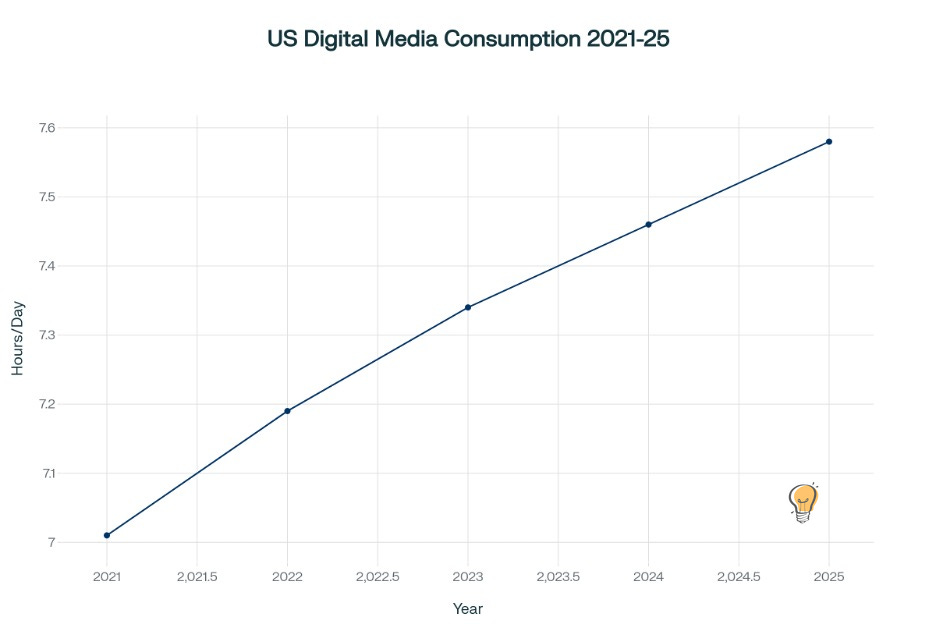
U.S. adults now spend nearly 8 hours per day with digital media, up 57 minutes since 2021
Engines of the Tech-News Boom
Digital ubiquity
Two-thirds of humanity – 5.64 billion people – is now online. Smartphones, wearables and connected appliances turn even lifestyle stories into technology stories, pulling general-interest outlets into the beat.
Platform gateways reshape discovery
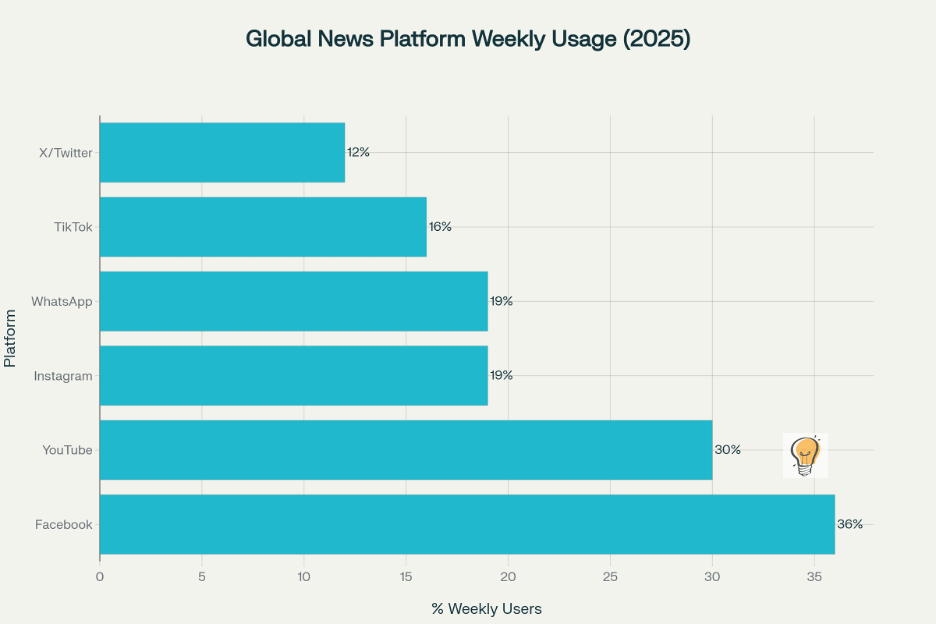
Traditional homepages no longer dominate traffic. Only 22% of consumers in 47 markets start their news journey at a publisher site; most begin on social platforms, search or aggregators. The biggest gateways for news in 2025 are Facebook (36%), YouTube (30%), Instagram and WhatsApp (both 19%).
Capital markets and corporate drama
Technology now accounts for almost one-quarter of global equity value. Quarterly earnings calls from Apple, Microsoft or Nvidia move broader indices, so mainstream outlets cover them as closely as treasury reports or labour statistics.
Influencers and personality-driven storytelling
A generation of creators – from Marques Brownlee to TikTok gadget reviewers – reaches tens of millions directly, demonstrating to legacy newsrooms that personality, demonstration and entertainment can coexist with rigorous reporting.
Social and Cultural Consequences
A more tech-literate public
Surveys show rising familiarity with concepts such as encryption, algorithmic bias and quantum computing, driven in part by explanatory journalism and YouTube explainers. This literacy empowers consumers to demand better privacy standards and product transparency.
Information overload and news fatigue
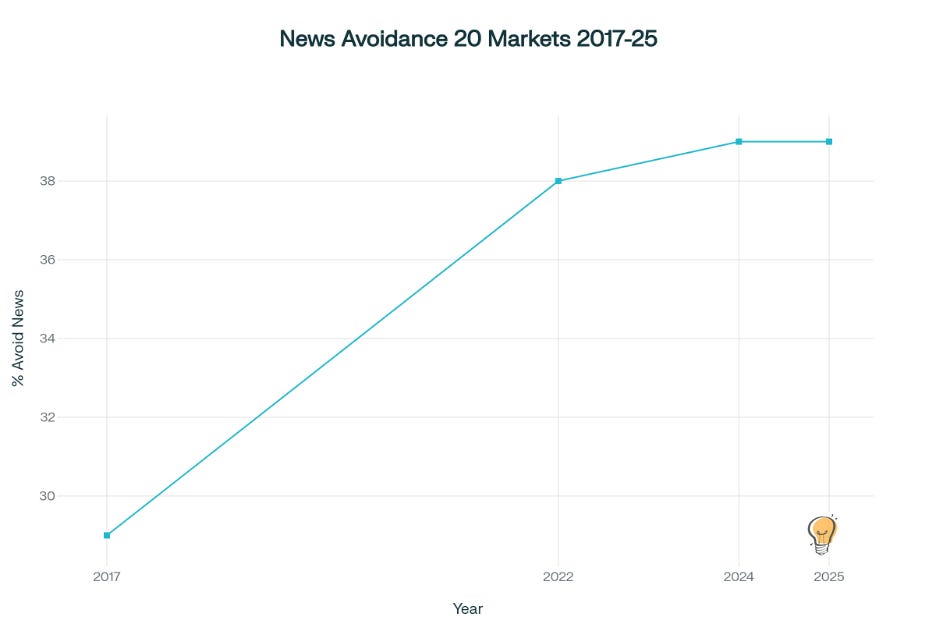
The volume and velocity of tech headlines also fuel psychological strain. Four in ten adults across 47 countries now say they feel “worn out” by the news cycle, a record high. Selective avoidance of news – choosing to skip stories perceived as negative or relentless – has climbed from 29% in 2017 to 39% in 2025.
Shifts in newsroom practice
Data-driven beats: Journalists increasingly interrogate training-data sets, carbon footprints of data centres and supply-chain spreadsheets.
Solutions framing: Editors, responding to fatigue studies, package constructive angles on digital harms and “what can be done” pieces to retain readers.
Cross-disciplinary teams: Product, design and investigative units now work side-by-side, mirroring the agile culture of the sector they cover.
Economic and Political Repercussions
Regulatory urgency
Mainstream exposure has accelerated policy timelines. The EU’s Digital Services Act, multiple US congressional hearings and Australia’s bargaining code all drew momentum from sustained public coverage of data breaches, AI hallucinations and social-media harms.
Advertising realignment
Brands have followed engaged audiences into tech sections, but keyword blocklists on “crypto,” “hack” or “AI risk” sometimes choke revenue even for high-quality outlets. Simultaneously, specialised tech newsletters command some of the industry’s highest open rates – 34.6% on average – supporting subscription and sponsorship models.
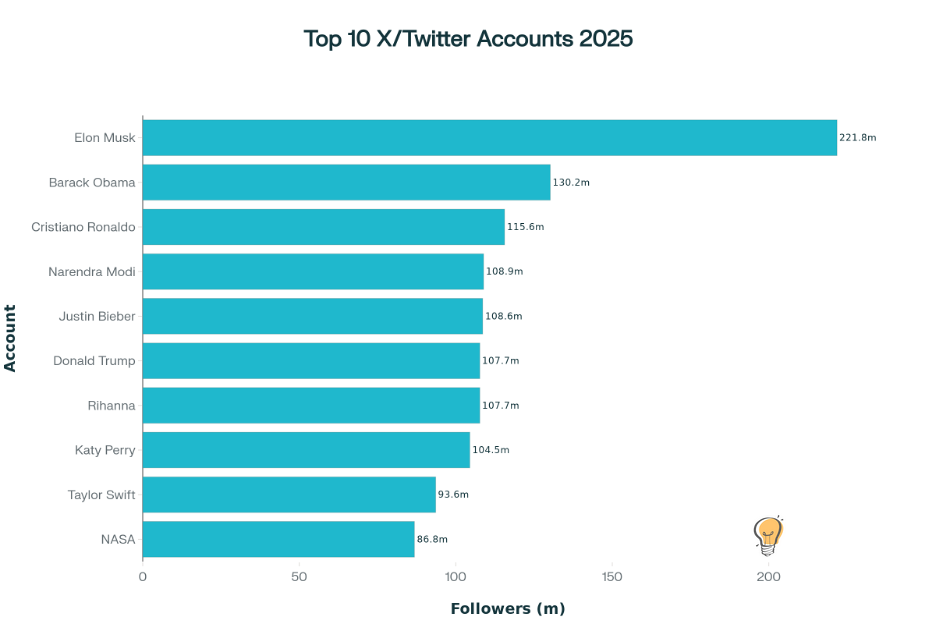
The timeline showing tech coverage’s journey from niche newsletters to nightly news still stands, but its climax now includes a celebrity subplot: live-streamed launch events draw ratings that rival awards shows, and CEOs’ tweets are dissected like red-carpet outfits. CEO charisma has become headline fuel because direct-to-public channels let leaders bypass traditional media and instantly sway markets, while social platforms amplify bold personalities and dramatic moments for maximum visibility. The spectacle of outspoken CEOs—whose remarks can move billions in market value—draws relentless media attention, further fueled by the para-social bonds audiences form with these figures online. for example Elon Musk’s following on X (formerly Twitter) recently crossed 220 million, outperforming every entertainer on the platform. This dynamic creates a feedback loop where coverage of CEO antics drives market volatility, which in turn generates even more coverage, often benefiting celebrity leaders with higher pay and job security, even as their companies’ long-term performance may suffer.
Celebrity Tech Titans vs. Old-School Fame
Follower math: tech outruns Tinseltown
Elon Musk: ≈ 222 M followers on X
Dwayne Johnson: ≈ 393 M on Instagram
Tim Cook: sub-15 M on X—yet Apple’s product keynotes still command 30 M live streams.
Despite Hollywood’s longevity, four of the ten most-followed social accounts belong to tech or sports figures, not actors. The data suggest a tectonic shift in who society finds aspirational.
Why kids now cosplay CEOs
A 2019 Lego-Harris poll found that only 11% of US and UK children wanted to be astronauts, while 30% aimed for YouTube stardom. Fast-forward to 2025 and a Whop survey shows 32% of Gen Alpha wanting to become YouTubers or TikTok creators, but another emergent ambition is “tech founder/CEO,” cited by 14%—twice the share dreaming of acting careers.
Is Influencer Culture Really Dying?
Audience trust is fragmenting, not evaporating
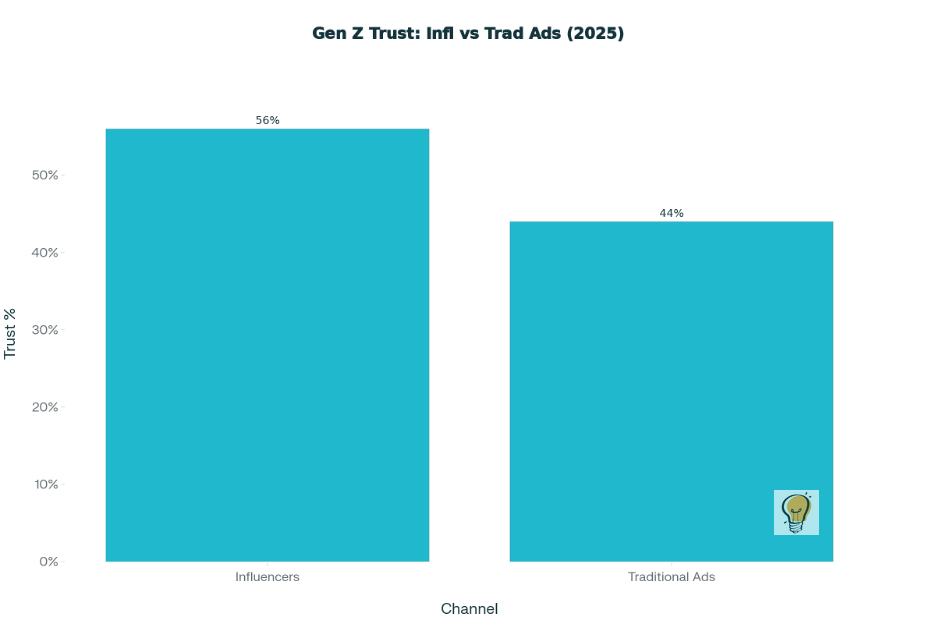
Edelman’s multi-market Brand Trust study reveals 56% of Gen Z still prefer influencer recommendations to brand ads, yet user fatigue with mega-creators is climbing. Among Gen Z, influencers still hold a trust edge over conventional advertising in 2025.
Macro-influencer fatigue, micro-influencer boom
Engagement rates for creators above 1 M followers fell 23% between 2023-25, while micro-influencers (10-100 K) grew 14%.
Brands now allocate 59% of their creator budget to <100 K-follower talent for authenticity
Creator-led commerce is far from dead: Sprout Social shows 49% of consumers still make monthly purchases triggered by influencers, with Gen Z the most responsive cohort.
Influencer culture may not be dying as yet—but the era of one-size-fits-all celebrity endorsements is waning. Trust is migrating toward niche experts and, intriguingly, towards charismatic CEOs whose updates feel “inside track.”
Social and Cultural Consequences – New Signals
Aspirational spillovers
Tech’s rags-to-riches narratives inspire grassroots learning: Udemy reports 40% YoY growth in under-18 enrollments for “how to build a start-up” courses following high-profile CEO interviews.
Downsides of CEO idolatry
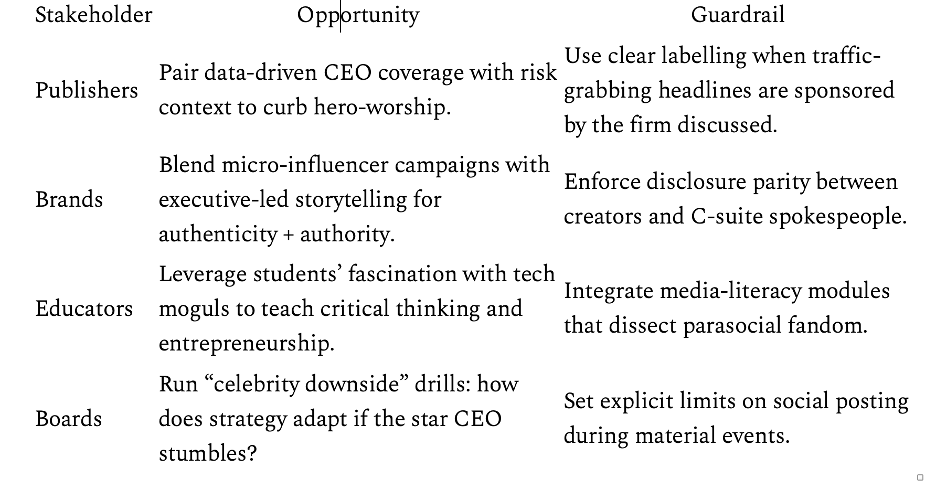
Academic meta-analyses warn that celebrity chiefs tend to double down on the behaviours that earned them fame, even when markets shift, raising strategic risk. Boards now debate whether public adoration is a governance asset or a liability.
Tech journalism is now people journalism. When CEOs accumulate fan followings that dwarf pop icons, their every keynote, meme and regulatory rebuke becomes mainstream news. Yet the same surveys that declare influencer fatigue reveal persistent trust in relatable voices—be they nano-creators or charismatic founders. The next decade will test whether audiences can maintain curiosity without surrendering critical distance, and whether celebrity capital can be channelled from hype to long-term value. The spotlight is brighter than ever; so is the need for clear-eyed coverage.
Where We Go Next
Rise of AI-mediated news journeys
Generative AI search and chatbot answers already divert clicks from publishers, with 69% of news searches yielding no website visit. Journalists will need structured data, licensing deals and conspicuous added value (for example, interactive testing or verifiable sourcing) to stay visible.
Diversification of formats
Vertical video and shoppable reviews for younger audiences.
Long-form podcasts retaining older, high-engagement segments.
Immersive explainers in XR as devices become lighter and cheaper.
Strategies for stakeholders
I hope you found this article interesting, informative, and useful. Do like subscribe, share it with you colleagues and friends and on social media — X, LinkedIn, or the platform of your choice.