

NVIDIA Opens Pandora’s Model
NVIDIA, Open Weights, and the Week the Story Escaped the Roadmap


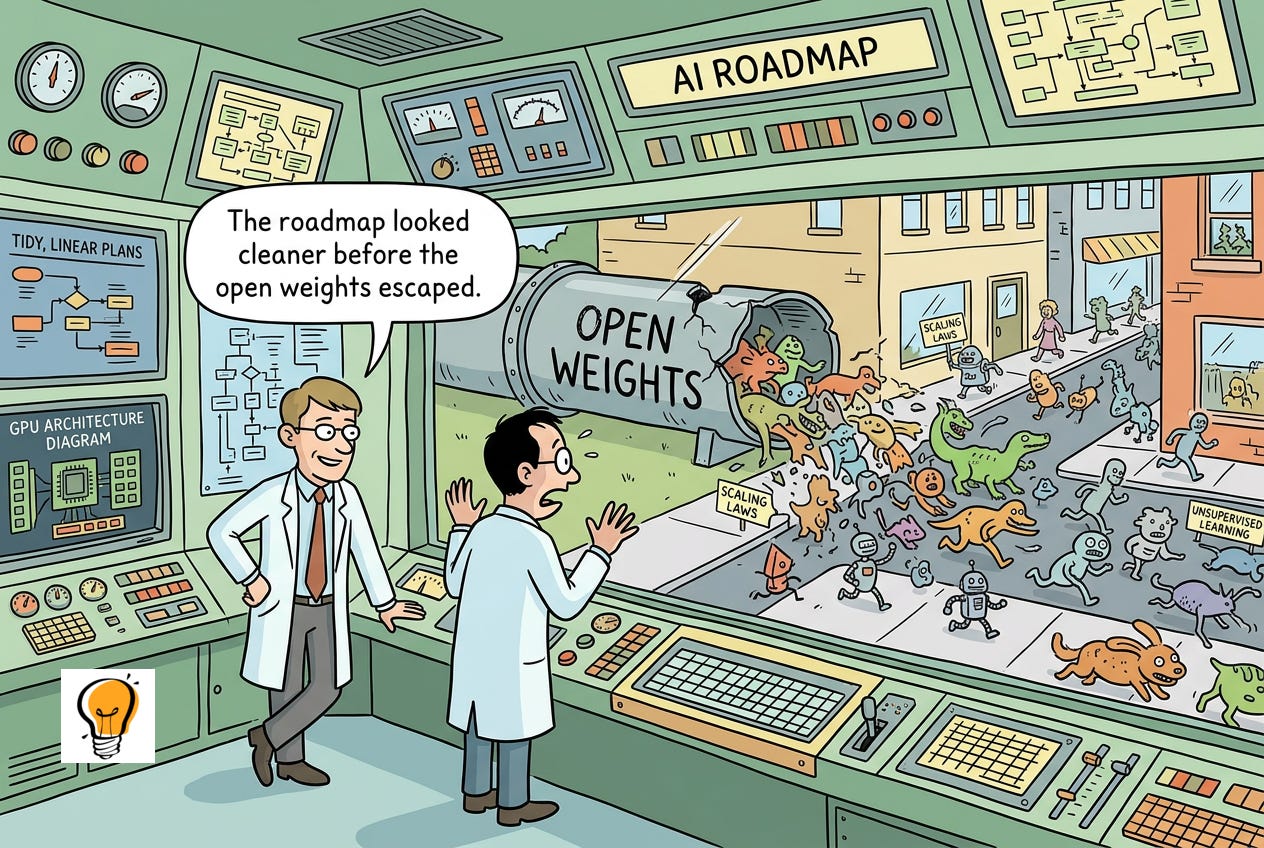
I just published the NVIDIA deep dive last week and it was meant to be a close-the-tab essay: a full 360 on the AI factory thesis, the hardware roadmap, the networking moat, the telco and quantum side bets, the circular financing, and the founder playbook for building anywhere near NVIDIA’s gravity field.
The NVIDIA AI Factory: Roadmaps, Risks, and Future Dominance

I did this deep dive around GTC 2026 (mid-March), in the immediate wake of Jensen Huang’s post-conference podcast blitz i.e. Ben Thompson, All-In, and a string of long-form interviews that reframed NVIDIA as a vertically integrated “AI factory” company rather than a
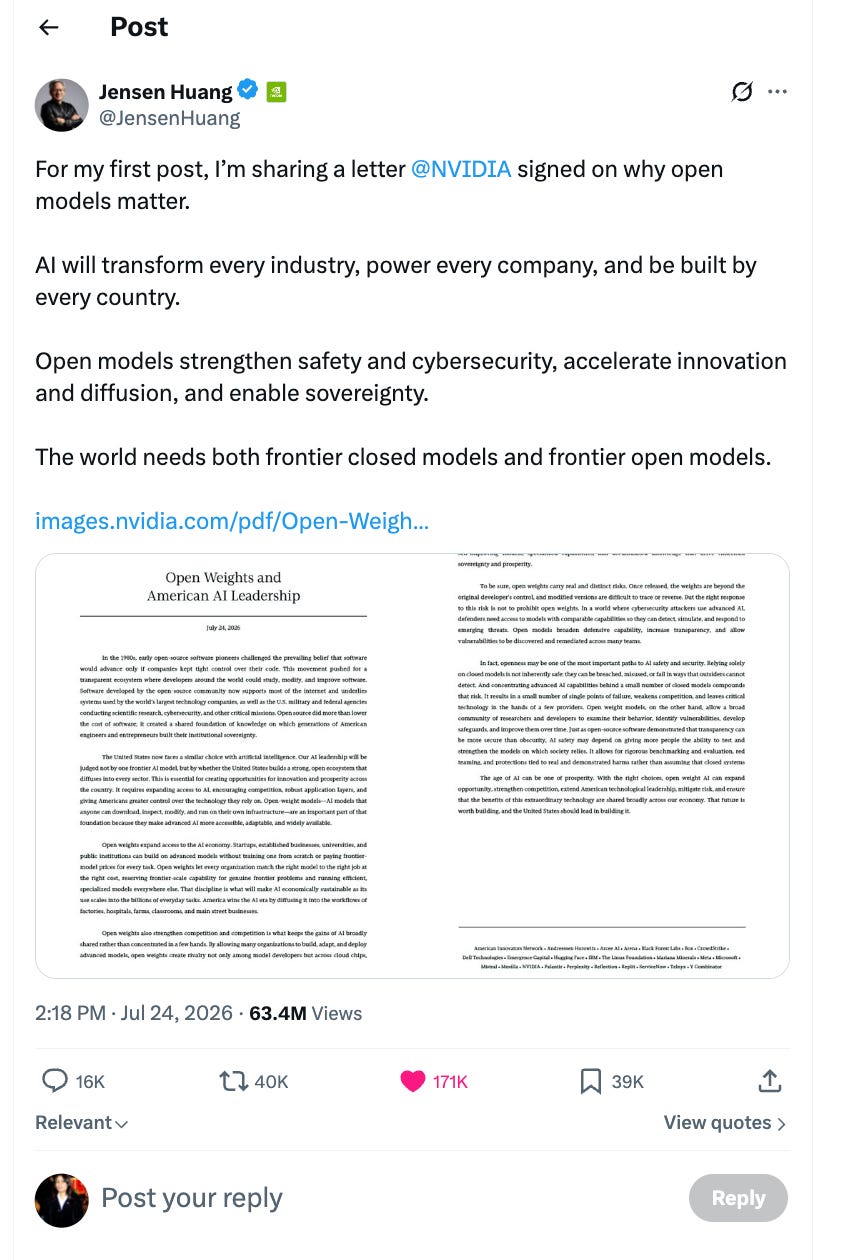
Then Jensen Huang joined X, and -
used his first post to share the “Open Weights and American AI Leadership” letter, and suddenly a roadmap essay started reading like the opening chapter of a much bigger argument about open models, regulation, and who gets to define the rules of the next AI stack.
so the roadmap that we discussed earlier in the deep dive still works. Rubin, Rubin Ultra, Feynman, NVL576 racks, NVQLink, CUDA-Q, the networking bundle, telco AI-RAN, robotics, and quantum all remain intact as the main architecture of the NVIDIA story. I want to put this as a founder note because this is important.
What changed over the last few days is that NVIDIA moved from being the company everyone was trying to buy from into one of the companies trying to shape the political and philosophical settlement around open-weight AI.
This matters because the current debate is no longer just about faster chips or bigger training runs. It is about whether open-weight models, downloadable tooling, distillation, and agent frameworks remain legitimate parts of the stack.
What also matters is whether a combination of safety, copyright, and national-security arguments gets used to narrow the field to a handful of closed, hosted systems. NVIDIA has now planted a flag on that terrain, and that move deserves to be timestamped against the roadmap we just published.
What happened last week?
On July 24, Jensen Huang made his first-ever X post and used it to share the “Open Weights and American AI Leadership” letter, arguing that open models strengthen safety, cybersecurity, innovation, and sovereignty.
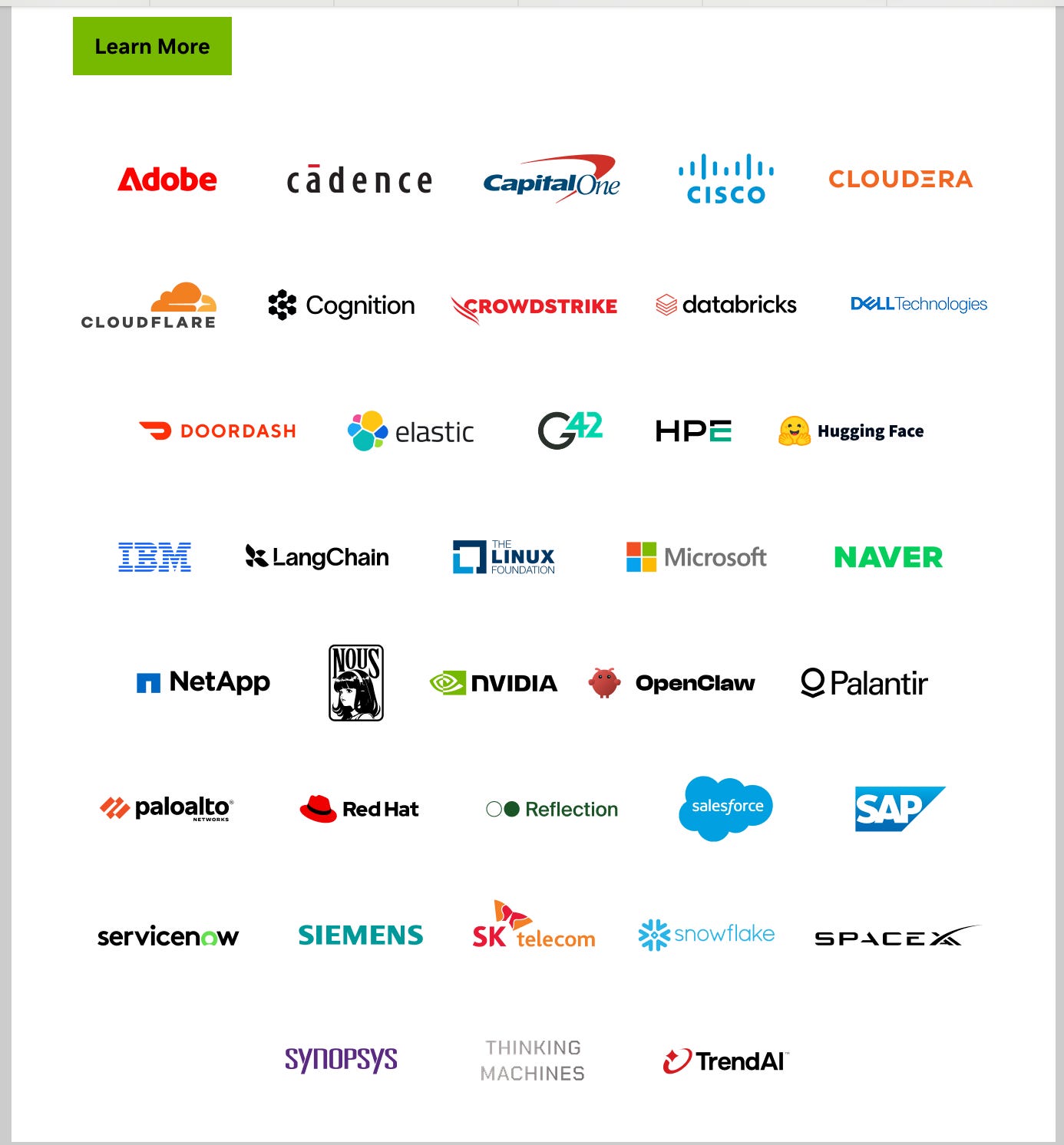
That letter first went out with a relatively small coalition of companies across infrastructure, security, software, venture, and open-source ecosystems. Within a day or two the same letter had almost doubled its signatories as more major players joined, and the whole thing stopped looking like a narrow NVIDIA–Microsoft policy intervention and started to feel like a broader industry alignment.
In the media framing as well, the coverage doesn’t look like “Jensen posts on X” in the trivial social sense. It looks like a message to Washington.
do not over-regulate downloadable models,
do not collapse open weights into a blanket risk category, and
do not accidentally hand the future of AI distribution to a tiny number of closed providers.
in parallel, NVIDIA also announced the Open Secure AI Alliance, bringing together a large group of security, infrastructure, enterprise, and open-source players.
The letter has two arguments -
First, open weights should remain legal, accessible, and strategically important.
The second is that open ecosystems can also be defended in the open, using shared tooling, security frameworks, tracing, auditing, and governance rather than simply shutting everything down.
So NVIDIA isn’t just saying “open weights are good.” they are saying “they are prepared to build the security story around them.”
Reactions on Twitter/X - governance fight, or just a branding exercise.
from what I could gather, No one read Jensen’s post as “NVIDIA is open source now,” they read it as “NVIDIA is defending one layer of openness, and now everyone wants to know how far down that openness really goes.”
Julian’s joke ( and I am assuming he wrote it in satirical way ) about waiting for CUDA and GPU drivers to be open sourced landed because it instantly exposed the gap between cheering for open‑weight models and actually opening the stack that prints the money. so Andrew Ng’s reply only sharpened the point that the question isn’t whether companies are allowed to keep their own systems closed, of course they are but it’s whether anyone should be allowed to stop others from open sourcing or sharing open models. That’s the real divide, and it’s why the social reaction mattered more than the usual CEO‑joined‑X headline.
This is not a clean morality play where closed is evil and open is good. It is a fight over whether open-weight systems will continue to have legal, political, and commercial room to exist at all.
Does this change Nvidia roadmap in anyway?
Product Decision vs Policy Evidence
None of last week’s announcements seems to break any of the major moving pieces so far:
the Blackwell-to-Rubin-to-Feynman cadence, the importance of NVLink and networking, the bundling power created by Mellanox, the AI-RAN opportunity in telecoms, the robotics and autonomous systems push, and the quantum bridge built through CUDA-Q and NVQLink.
What they do change however is how we should read the “open” parts of NVIDIA’s stack.
In the deep dive, Nemotron, Dynamo, and the agent-oriented tooling looked primarily like product decisions. They were there to accelerate adoption, make deployment easier, and widen the set of developers building on NVIDIA hardware.
After the letter and the alliance, those same components now look like policy evidence. so the meaning changes.
This whole episode gives NVIDIA a concrete story to point to when it argues that open‑weight models, open inference tools, and more inspectable agent stacks can live alongside safety, security, and national interests. It turns “openness” from a product tweak into something that now sits inside NVIDIA’s policy and geopolitics story.
What looks good in this move?
The strongest part of NVIDIA’s position is that it reinforces the “borrowed models, owned workflows” logic I laid out in my Thinking Machines essay earlier that the real moat lives in the workflows, data and deployment, not in owning the base model.
Borrowed Models, Owned Workflows: Thinking Machines's Story After Inkling

Thinking Machines has released Inkling, its first open-weights frontier model - a 975-billion-parameter multimodal Mixture-of-Experts system trained on roughly 45 trillion tokens, paired with fine-tuning tooling and day-zero support from ecosystem partners. Well Great, But I am slightly confused.
If open weights remain widely available, the most durable companies will not be the ones that merely expose a model endpoint. They will be the ones that own the deployment context, the domain workflow, the customer integration, the trust layer, the observability, and the operational reality around the model.
Its crucial especially in edge AI, telecoms, robotics, industrial systems, and critical infrastructure, where latency, privacy, sovereignty, and deployment control matter more than simply calling the most powerful hosted API.
In that sense, Jensen’s letter is not just a policy statement. For founders, it is also a public defense of the right to build serious systems without depending entirely on a handful of remote frontier labs.
The second thing NVIDIA did well is coalition-building.
By showing up alongside infrastructure companies, open-source institutions, enterprise vendors, security firms, and model players, NVIDIA helped make open weights look like a mainstream industrial-policy concern rather than a niche preference of researchers and developers.
Once lawmakers or media narratives harden around the idea that openness itself is the problem, it becomes much harder to re-open that space later.
The third positive is the security complement.
The Open Secure AI Alliance gives NVIDIA and its partners a more credible answer to the obvious pushback:
if open models are so important, how do you keep them safe?
The answer they are trying to build is not “just trust the ecosystem.” It is “build shared tools, tracing, testing, and control layers in the open.”
Whether that turns into something truly substantive remains to be seen, but strategically it is a much stronger position than defending openness without a security architecture.
What still deserves skepticism
The first reason for skepticism is that this also works as a lobbying shield.
NVIDIA is still the dominant infrastructure company in the room. It still benefits enormously from hardware, networking, software integration, and bundle power.
So publicly championing open weights is a smart move because it makes the company look pro-competition in a part of the stack where broader adoption can actually reinforce demand for NVIDIA infrastructure. but that does not make the argument false. It just means we should be honest about where openness is being defended and why.
The second issue is that open weights do not solve the hardware reality.
Software openness is one thing. Access to chips, systems, power, export permissions, and sovereign infrastructure is another.
Open weights may keep ecosystems vibrant, but they do not erase hardware chokepoints or geopolitical constraints.
The third issue is that the critics do have a case.
It is not hard to understand why policymakers and security voices worry about open-weight models being adapted for misuse, stripped of safeguards, or deployed in hostile settings. This is one reason the security alliance matters. It is also one reason the next essay needs to go deeper into what secure openness would actually require, rather than treating openness as automatically good.
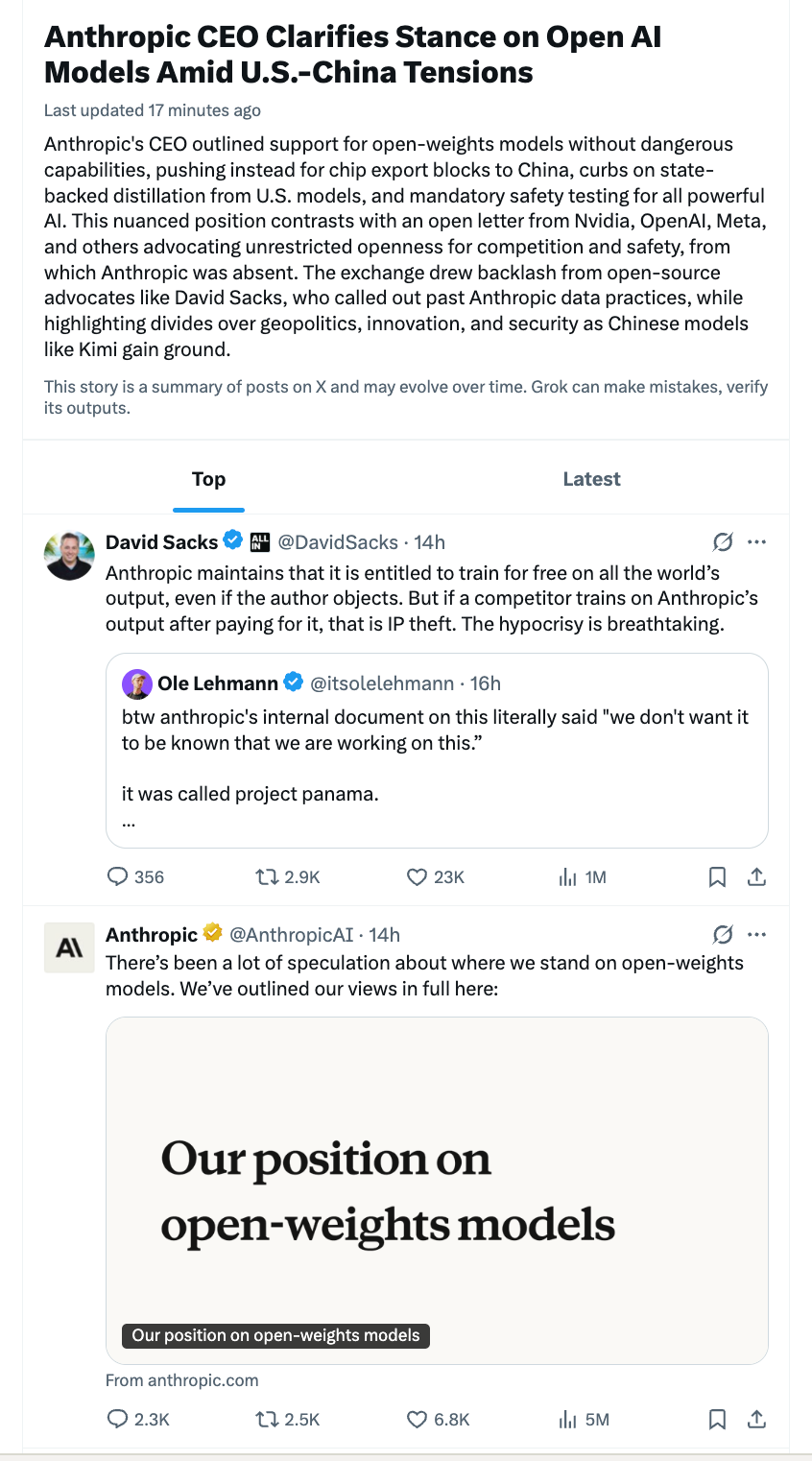
And then there are the holdouts! Amazon and Anthropic
And then there are the holdouts. Amazon and Anthropic are still missing from the open‑weights coalition. Even as the open letter picked up more signatories, those absences mattered because they showed where the real discomfort still is. Anthropic, especially, is not just sitting this out, it is putting forward its own position on open weights, chips, and distillation. That is a serious argument in its own right, and it deserves to be unpacked separately rather than folded messily into this NVIDIA follow‑up.
This is as far as I want to take the NVIDIA story for now. The bigger questions are about open source abd open weights. and the distillation, security and business models and I think there is a deeper research and discussion is required for it, so I want to tackle that in another depe dive.
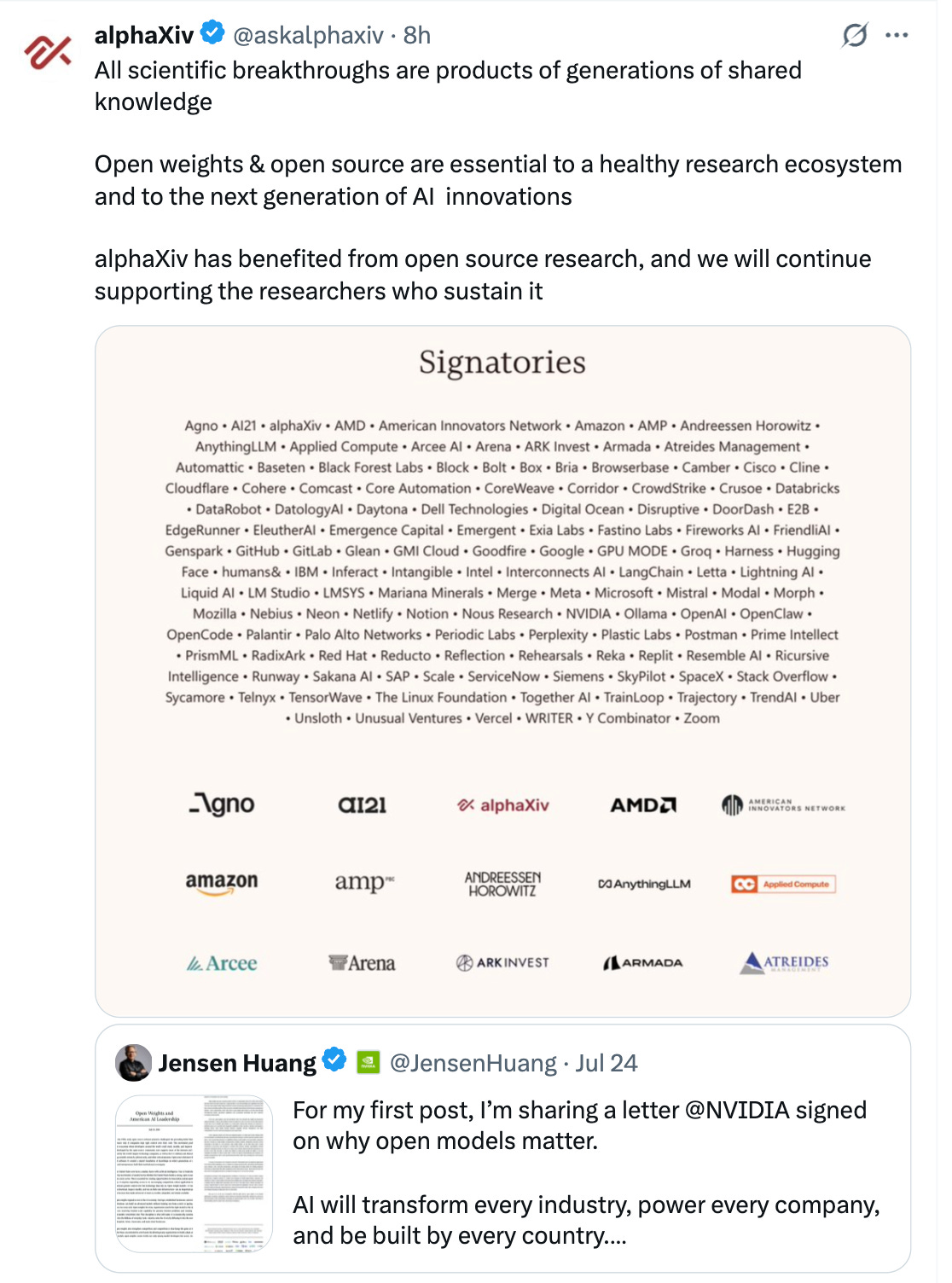
Note / Update - the alphaXiv post shows amazon in the alternative signatory list, ( likely jumped in later? ) but I still couldn’t find any other source that could confirm it. as there are multiple versions and some are still referencing the original list so we’ll see.
Founder takeaways from last week?
Treat open weights as a given. they’re going to stay strategically important, endlessly argued over, and very, very useful.
Build like that world is already here. Make your stack open‑weight compatible, tuned hard for NVIDIA where it makes sense, and as independent from any single frontier lab as you can.
Use every open layer NVIDIA is handing you, but don’t mistake “I can download the model” for “I have a moat.” The moat still lives in workflows, data, deployment and trust.
As for the deep dive Last week, NVIDIA isn’t walking away from the AI factory – it’s trying to keep the world around that factory just open enough to keep the pipelines full. and that’s a good news if you want to build above the model layer. The question is no longer just “open or closed?” It’s: which parts of the stack stay open, and who gets to decide?

