

The AI Investor Deck: GTM Frameworks the Super Bowl Just Taught You ( AI Super Bowl Part 2)
Monetization matrix, 120‑day launch system for turning your own “Super Bowl moment” into lasting revenue, and 90‑day funnel founders can plug straight into their next release

In Part 1 of the AI Bowl 2-Part series, we looked at the spectacle called AI Super bowl and investigated why Super Bowl LX’s ad breaks suddenly felt like a demo day for AI labs and B2B SaaS, how tech brands quietly re‑skinned themselves in pastels to look less scary, and how a single monetization decision of putting ads into ChatGPT turned into a public fight between OpenAI and Anthropic. If you’ve n’t read it yet,
You can read the part 1 of this series here -
This follow‑up is the operator version that covers section 5-9.
If Part 1 was “what happened,” Part 2 is “how to use it.” The most important part, you don’t need OpenAI’s budget to play this game. You just need a clear lane, a simple launch system, and the discipline to run it. So I’m going to keep it practical and short. we’ll be picking a lane on the monetization matrix, define what your own “Super Bowl moment” should look like (without spending $8M), and then walk through the 120‑day system, funnel, and launch checklist that turn one spike of attention into actual revenue.
What are we covering? /Table of Contents (Part 2)
📊 Monetization Matrix: Pick Your Lane
Decide if you’re really consumer‑ads, prosumer‑SaaS, enterprise‑usage, or infra‑platform—and why it matters.🚀 Super Bowl Moment Playbook
Define your own “Super Bowl moment” and the 5‑phase launch system around it.📉 90‑Day Funnel: From Hype to Habit
The simple funnel that turns one spike of attention into paying users.🧠 Founder Launch Checklist
A single, punchy checklist to sanity‑check your positioning, pricing, and launch narrative before you hit publish.🧩 Final Strategy Snapshot
A one‑page summary of the key decisions to make before your next big launch.
📊 Building Your Monetization Matrix - One Choice That Drives Everything Else
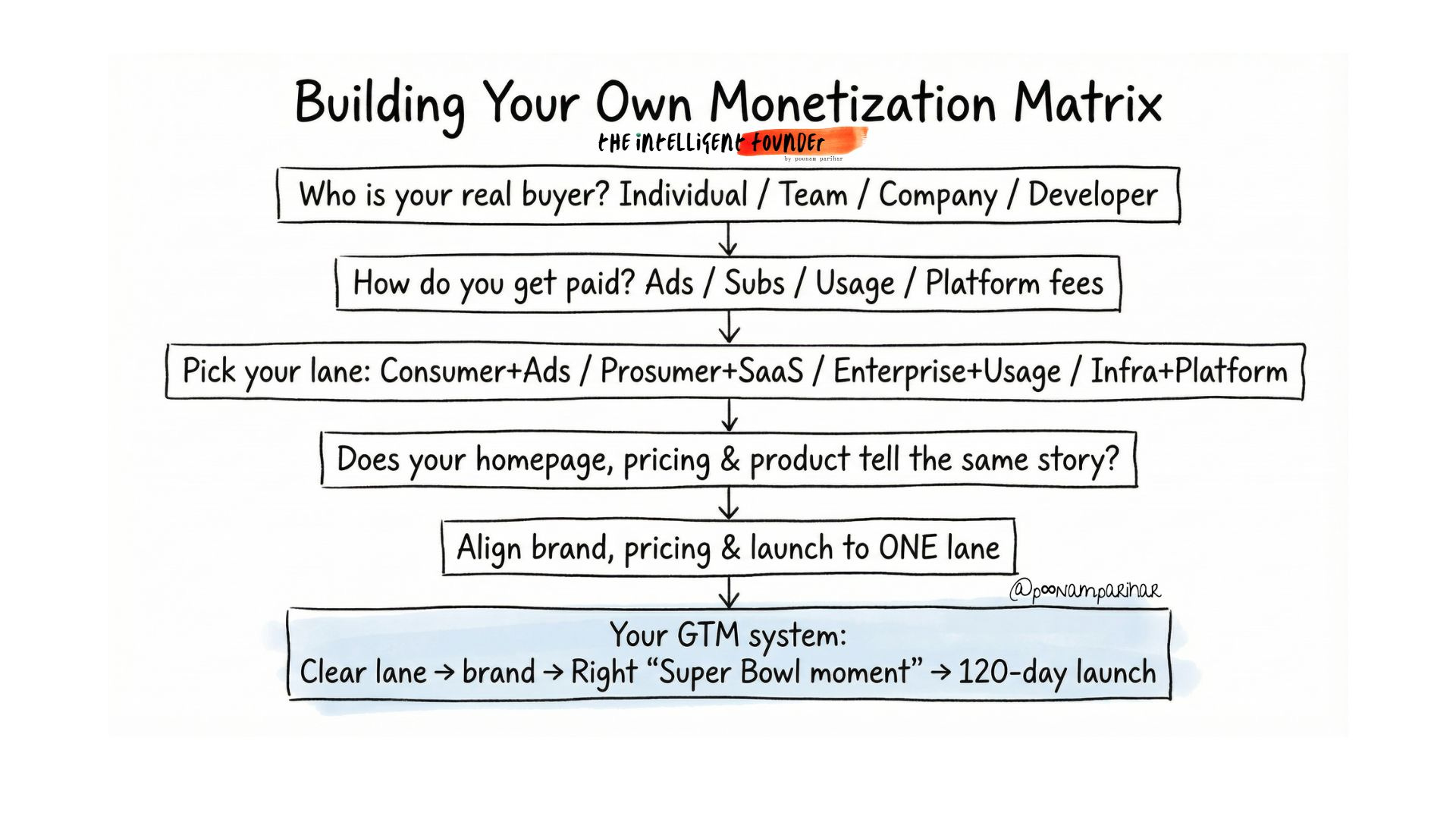
So what is the one question that matters the most for GTM:
what game are you actually playing?
Not “what does my product do?” but
“who am I really serving, and how do I plan to get paid for it?”
Most AI products look similar on the surface for example chat-boxes, sidebars, agents, but under the hood they’re in totally different businesses. If you don’t pick your lane early, everything else (brand, pricing, launch) ends up fuzzy.
5.1 The Simple Matrix
Think of your strategy as two choices:
1. Who are you for? (X‑axis)
Individual / prosumer
Education / creators
Enterprise
Infra / platform
2. How do you make money? (Y‑axis)
Ads / sponsorships
SaaS / subscription
Usage / API
Platform / marketplace
Combine those, and you get four very different lanes:
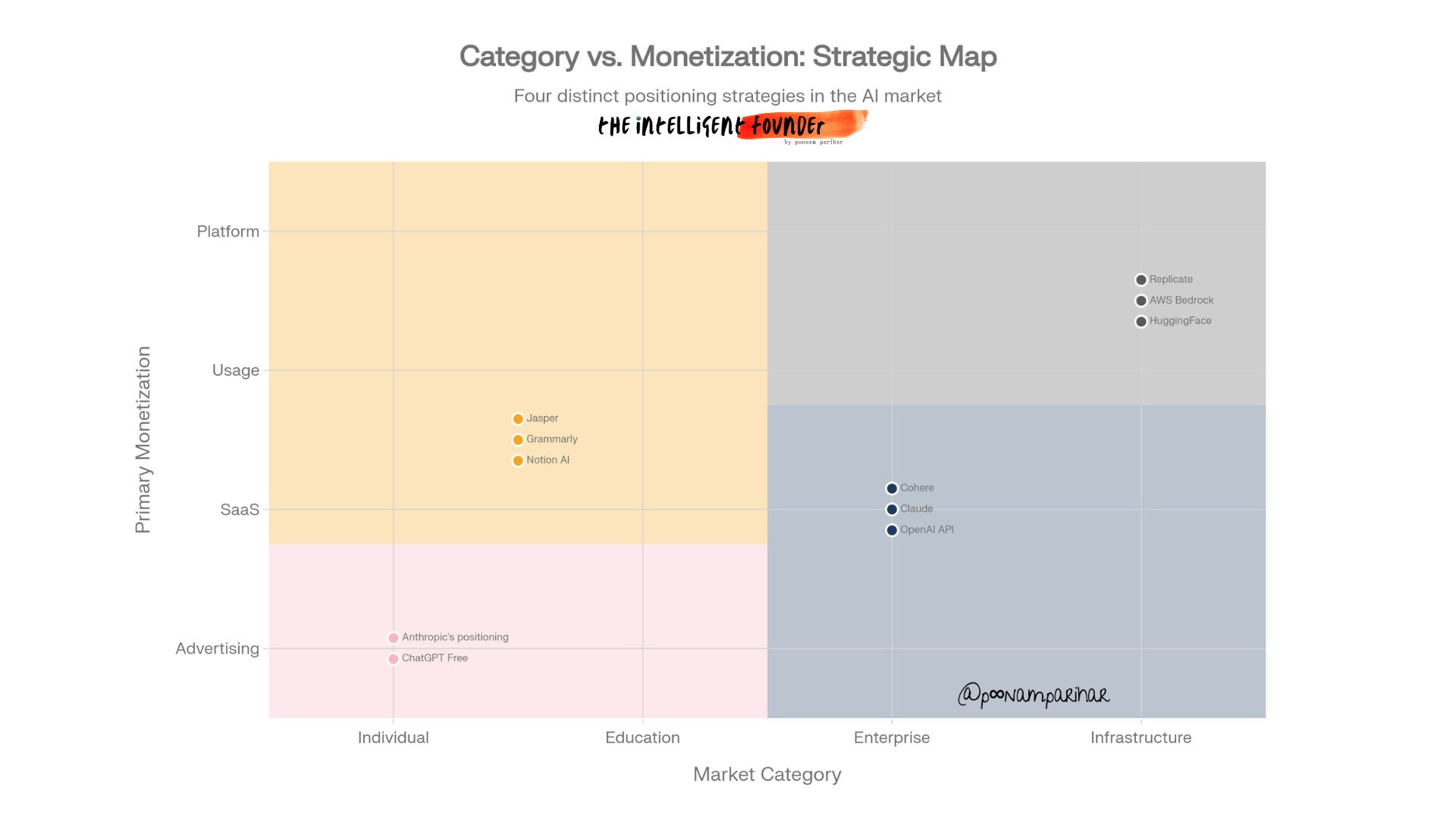
Lane 1 – Consumer + Ads
Free assistants and tools monetized by attention.
Examples: ChatGPT free, AI inside search, “answer engines” that will sell clicks.
Metrics: DAUs, attention, ad yield.
You win with distribution, UX, and brand; you lose if you can’t reach massive scale.
Translation: If this is your lane, you’re building media as much as you’re building product.
Lane 2 – Consumer / Prosumer + SaaS
Tools individuals or small teams put on a card.
Examples: Notion AI, Grammarly, Jasper‑style copy tools.
Metrics: signups, activation, retention, ARPU.
You win with clear value and a smooth product‑led funnel.
Translation: You’re in the “Netflix for X / $10‑$50 per month” business. Volume matters.
Lane 3 – Enterprise + Usage / Seats
API‑heavy or seat‑based products sold to companies.
Examples: OpenAI / Anthropic / Cohere APIs, vertical SaaS with AI baked in.
Metrics: pipeline, win‑rate, expansion, usage.
You win with reliability, integrations, security, and sales.
Translation: You’re not trying to go viral; you’re trying to sit in QBR decks.
Lane 4 – Infra + Platform
You’re selling the rails: model hosting, orchestration, marketplaces.
Examples: AWS Bedrock, Hugging Face, Replicate‑style platforms.
Metrics: workloads, GMV, ecosystem health.
You win with ecosystem, not just features.
Translation: Your real product is the network, not the UI.
5.2 A 60 Second Quick Self‑Audit
Who is my primary buyer?
“A person,” “a small team,” “a department,” or “a platform/developer”?
What do I want $10M ARR to look like?
Mostly ad dollars, mostly subscriptions, mostly usage/seat fees, or platform take‑rate?
Do my homepage, pricing, and product all tell the same story?
Or does the homepage talk like a prosumer app, the pricing page look enterprise, and the product feel like an API toy?
If those answers don’t line up, your problem isn’t growth yet, it’s that you’re sending mixed signals about what you are.
5.3 Why This Matters Before You Copy Any “AI Bowl” Move
Any and everything what was shown in the Super Bowl can only makes sense once you know their lanes.
Rippling spends TV money because it lives in Enterprise + Usage and each new customer can be worth millions over time.
ChatGPT can justify building an ad network because it’s betting on Consumer scale + Ads + API combined.
Anthropic chooses subscriptions and enterprise contracts because it wants its brand to be “calm, safe, ad‑free AI”.
We need the same clarity as these company regardless of the budget
pick your square on the matrix first, be it consumer‑ads, prosumer‑SaaS, enterprise‑usage, or infra‑platform and then design everything else (brand, launch, pricing) to make that choice obvious.
6. 🚀 The Super Bowl Moment Playbook - A 120‑day launch operating system
We don’t need to be at the Super Bowl to have a Super Bowl Moment.
It’s could be any event that can give you 10–100x your normal attention for a short window period. For some founders that’s a Product Hunt launch. For others it’s a keynote demo, a big integration announcement, a viral post, or a creator collab that lands with exactly the right audience.
The format really doesn’t matter. What matters is that you’ll only get a handful of these in the life of your company and most teams waste them.
And how do these moment get wasted?
Say you treat the spike as the goal. Ship the launch post, watch the traffic, screenshot the dashboard, share it on LinkedIn, and then… nothing. You have no system for what happens next and Two weeks later the chart goes back to baseline and you’re wondering what actually went wrong.
The companies you watched on Super Bowl Sunday don’t work that way. Their TV spot is just Day 0 of a much longer system.
Anthropic was seeding the “no ads” narrative weeks before game day. before it released the “Claude is place to think ad campaign remember the principles and constitutional announcements?
OpenAI had onboarding and ad‑partner pipelines with many big brands including Target, ready to absorb the attention. Slack had MrBeast content cut into multiple formats for weeks of social distribution after the spot aired.
The pattern is always the same:
pre‑load the story,
spike the attention,
then catch and convert what comes in.
Here’s what that looks like as a system:
The 5 Phases
Phase 1 — Pre‑Launch (Day −30 to 0): Set the stage
And, This is where most founders under‑invest.
Before your spike hits, you need:
A tight narrative — one sentence that explains what you are, who it’s for, and why now. If you can’t say it in one breath, it’s not ready.
Community primed — your early users, beta testers, and friendly voices should already know something is coming. They’re your Day 0 amplifiers.
Landing and onboarding tested — whatever page that traffic hits needs to load fast, communicate clearly, and move people to a first action in under 60 seconds.
Press and partners briefed — embargoed previews, demo access, quotes ready. You don’t want to be chasing journalists on launch day.
Think of Phase 1 as building the net before you cast it. No net, no catch.
Phase 2 — Launch Spike (Day 0 to 7): Your “AI Bowl” moment
This is the part everyone obsesses over the most and it matters really, but less than you think. The spike itself is about:
One clear event — a post, a demo, a listing, a talk, a partnership announcement. Not five things at once. One thing, done well, that gives people a reason to look.
Coordinated amplification — your team, your investors, your partners, your early users all sharing within a tight window. Algorithms reward velocity.
Fast response — bugs will surface, questions will come in, journalists will DM. The 48 hours after launch are a customer‑support event as much as a marketing event. Be present.
The goal of Phase 2 isn’t “get big numbers.” It’s get the right people into the funnel while they’re paying attention.
