Welcome to the AI Bowl! Forget the game: the Super Bowl is now a tech investor deck. ( Part 1)
ChatGPT is putting ads in the interface, Anthropic is attacking it on TV - and everyone else has to choose a side.
This year’s Super Bowl wasn’t just a football game… it was a three‑hour pitch deck for the AI economy. Between drives and timeouts, the usual parade of beer, cars and movies was crowded out by chatbots, HR platforms, AI glasses and prescription molecules. Slack showed up with MrBeast, Squarespace handed a sledgehammer to Emma Stone, Amazon used Chris Hemsworth to humanise Alexa+, and Anthropic used its very first TV buy to roast OpenAI for putting ads inside ChatGPT.
Business Insider and others report including ad trackers say Anthropic’s spot actually out‑performed OpenAI’s in positive sentiment, even as OpenAI drove more overall chatter. Meanwhile, ChatGPT ads just moved from announcement to execution yesterday with partners like Target’s Roundel being among the first to try contextual ads.
So ChatGPT officially added ads in the interface, Anthropic attacked it on TV, and now everyone else has to choose a side.
I wrote about how tech journalism was going mainstream back in July, and this whole saga lines up perfectly with that shift, as well as with the way tech brands now look more like lifestyle companies and AI is taking over the biggest advertising stage in the world.
I want to use this article to zoom out from the OpenAI vs Anthropic drama and look at what’s actually shifting in culture. I’m writing it this way because founders just don’t just need a hot take on Open War, they need a practical lens on what this new “AI Bowl” moment means for how they design brands, plan launches, and monetize products in 2026, and to understand if You/I need a Super Bowl moment too?
Table of Contents ( Part 1, 2)
🏈 AI Bowl, Not Football
Super Bowl LX as the moment AI platforms, B2B SaaS, and health‑tech took over the world’s most expensive ad inventory.🎭 Brand Glow‑Up: From Scary to Soft
How AI companies use pastels, nature vibes, and friendly UX to defuse fear and build trust—and what founders should copy.📰 AI as Front‑Page Sport
Why tech journalism now treats AI like the NFL, and how that changes the risk/reward of every launch, mistake, and pivot.⚔️ ChatGPT Ads vs. Anthropic: Monetization War
Deep dive into ChatGPT’s new ad model, Anthropic’s “no ads” stance, and what this reveals about business‑model positioning.📊 Monetization Matrix: Pick Your Lane (Framework) ( in part 2)
A category × revenue matrix to decide if you’re playing in consumer‑ads, prosumer‑SaaS, enterprise‑usage, or infra‑platform, and how that drives GTM.🚀 Super Bowl Moment Playbook (System)
A 120‑day launch operating system—pre‑launch, spike, activation, retention, monetization—for handling your own 10–100x attention moment.🔁 90‑Day Funnel: From Hype to Habit (Template)
Numbers‑driven funnel showing how to turn one big spike into activated, retained, and paying users instead of one‑day vanity metrics.🧠 Founder Checklists & Scripts (Paid Section)
Concrete checklists, positioning scripts, and landing‑page/announcement patterns to align brand, pricing, and narrative around your “AI Bowl” moments.🧩 Final Strategy Snapshot
A concise, plug‑and‑play summary of the key decisions (segment, brand, GTM, monetization) every founder should make before their next big launch.
Note: This deep dive got way too long in 5 sections only so I am breaking this article down in two parts, so I can release it now. Part 1 is section 1-4 and is free, and section 5-9 in part 2 that will be paid and I’ll release it day after. I am still writing it so if you’ have questions on the content skeleton do post them in comments or chat.
1. 🏈 AI Bowl, Not Football
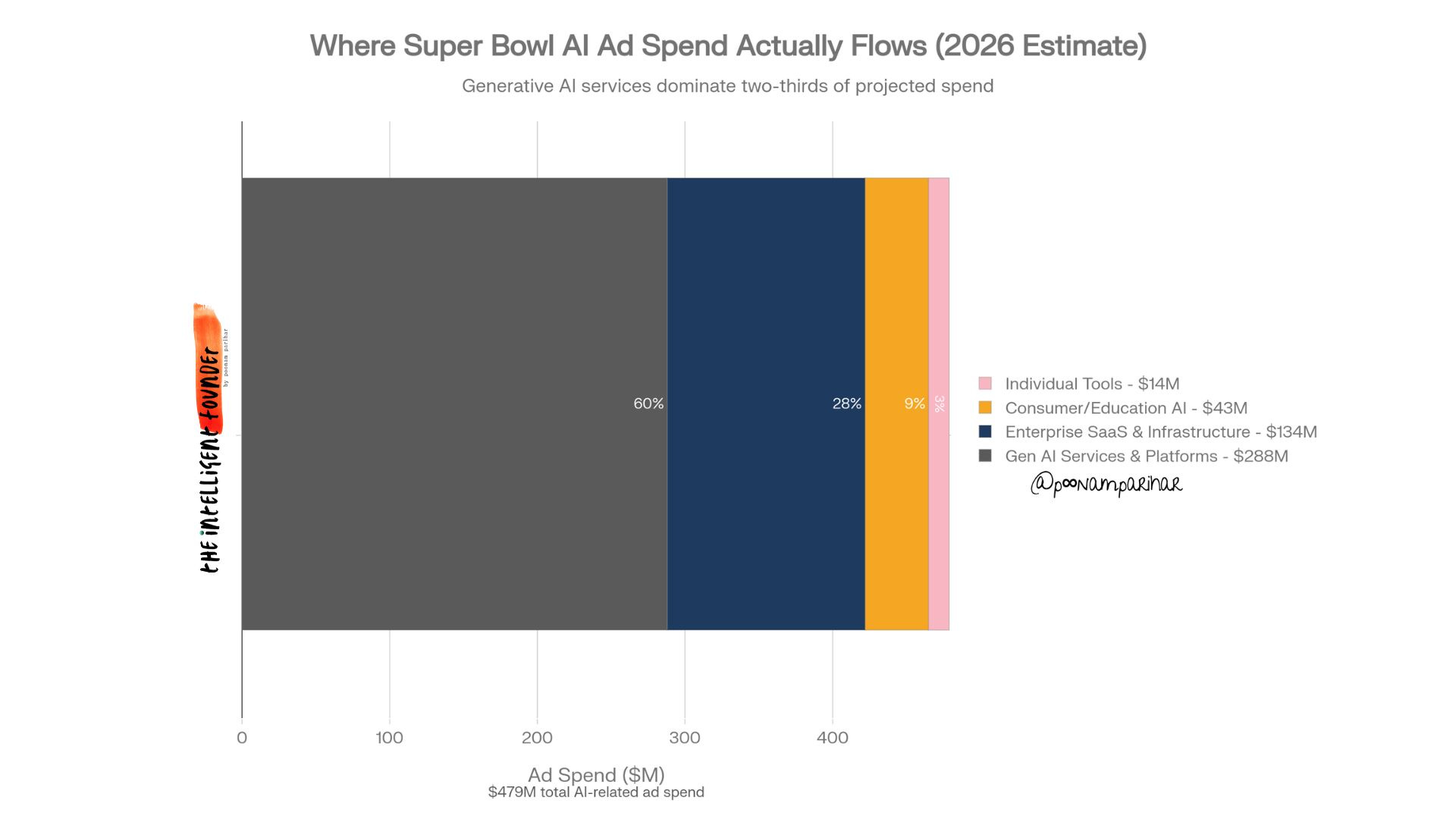
This year’s Super Bowl wasn’t just a football game; it was a three‑hour status update on who actually runs the modern economy. Broadcasters were selling 30‑second units for an average of $8M, with premium slots pushing beyond $10M, a new all‑time high. That price tag is only rational if you believe two things: first, that the Super Bowl is one of the last true monoculture moments (120M+ simultaneous viewers); and second, that your category is in a winner‑take‑most race where mass awareness compounds into long‑term dominance. That’s precisely how the leading AI and software players seem to see the world.
The chart above sketches how AI‑related spend in this year’s game clusters: the heavy dollars come from Gen‑AI services and platforms, followed by enterprise SaaS and infrastructure, with a smaller slice from consumer/education tools and individual players. Even without exact disclosure from every brand, the pattern is obvious from the roster.
1.1 Who Actually Showed Up in the AI Block
If you only half‑watched the breaks, here’s who was really buying attention in what many are calling the “AI pod” of the night:
OpenAI (ChatGPT) – A cinematic 60‑second spot framing ChatGPT as the next great interface for creativity and problem‑solving, and, between the lines, justifying why there are now ads in the free tier.
Anthropic (Claude) – A 30‑second in‑game ad plus a 60‑second pre‑game film mocking the idea of ads interrupting intimate AI conversations, implicitly targeting OpenAI’s new ad product.
Slack – Workplace chaos turned into comedy with MrBeast trying—and failing—to keep up without channels and workflows, making the point that Slack is infrastructure, not “just messaging”.
Squarespace – A surreal, film‑noir, computer‑smashing ad starring Emma Stone, leaning into high‑end craft to position website building as cinematic and almost mystical.
Amazon Alexa+ – Chris Hemsworth and Elsa Pataky in a domestic, self‑aware story about living with an AI assistant, acknowledging fears about AI while playing them for laughs.
Google Gemini – A family‑focused Gemini spot showing everyday use (planning, learning, creativity) rather than lab demos, continuing Google’s shift from “search” to “AI companion”.
Artlist AI – A fully AI‑generated ad that parodied other Super Bowl brands, explicitly bragging it was made in days for a fraction of the usual cost, using Artlist’s own tools.
Rippling – Tim Robinson as an evil mastermind whose plan for world domination falls apart because his HR/IT/finance tools don’t work, turning a boring category into a memorable narrative about operational risk.
Genspark AI – Matthew Broderick in a Ferris‑Bueller‑style “ditch work” fantasy where AI agents tackle soul‑destroying office tasks, positioning Genspark as the platform that lets knowledge workers escape the grind.
Meta / Oakley AI glasses – High‑energy, athlete‑driven spots showing AI‑enhanced performance and real‑time capture with Ray‑Ban or Oakley frames, pushing the idea that the assistant can live in your eyewear, not your phone.
Ring – A sentimental story about AI‑powered “Search Party for Dogs” that helps neighbors find lost pets, wrapping surveillance tech in neighborly emotion.
Wix Harmony & Base44 – Website and app builders selling AI as a creative collaborator; Harmony and recently acquired Base44 both framed their tools as “vibe coding” partners rather than full automation.
Salesforce Agentforce – A sequel to last year’s “What AI Was Meant to Be” campaign, this time highlighting AI “agents” doing meaningful customer work instead of abstract hype.
Health‑tech & Pharma – Hims & Hers, Wegovy, Ro, and others used AI‑inflected narratives around diagnostics, personalization and longevity to pitch treatments directly to consumers.
Put differently: the block that used to belong to sedan launches and beer mascots now reads like a portfolio of AI platforms, enterprise software, and algorithm‑enabled healthcare.
1.2 Why AI and B2B Are Spending Like This
At first glance, it’s strange. Why would an HR platform or an API‑first AI company buy the same real estate once reserved for Budweiser’s Clydesdales?
A few reasons:
Winner‑take‑most dynamics
In AI infra, assistants, and horizontal B2B, the spoils go disproportionately to whoever becomes the default choice. The Super Bowl’s 120M‑plus audience is one of the only places left where you can simultaneously reach current users, future users, investors, regulators and potential hires with one piece of creative.Category education at scale
A lot of these companies are not just selling a product; they’re selling a mental model:“AI assistants belong in your living room” (Alexa+, Gemini)
“Your back office is a single operating system, not a pile of tools” (Rippling)
“AI video/audio assets are good enough for prime time” (Artlist)
A Super Bowl slot buys 30–60 seconds to deliver a story that will be replayed, dissected, memed, and YouTubed for weeks.
Investor‑deck logic
Many of the brands airing tonight are either venture‑backed or trading on their growth narratives. Spending $8–10M on an ad is easier to justify if it also functions as:proof of scale (“we can afford this”),
recruitment marketing (“we’re playing on the biggest stage”), and
a narrative wedge (“we’re an AI company with consumer pull, not just boring infra”).
Arms race signaling
The OpenAI–Anthropic clash is a perfect example. Anthropic’s decision to use its first TV appearance to attack ChatGPT’s ad model—rather than just promote Claude generically was as much about signalling to investors and policymakers (“we’re the safer, more principled AI”) as it was about end‑user conversion and Super Bowl was simply the loudest place to do it.
For three hours, the Super Bowl stopped being just a game and became the storyboard for how AI companies see the world and how much they’re willing to spend to shape it.
2. 🎭 Brand Glow‑Up: From Scary to Soft
Here’s a question nobody is asking: why does an AI company that builds large language models look like it sells scented candles? Why does a vibecoding company called Lovable sound more like an underwear or skincare brand, why are webinars suddenly shot in warm, ambient living‑room lighting, and why do even giants like Microsoft and OpenAI now lean on soft gradients and almost floral, dreamlike backgrounds like in those meditation apps to sell hardcore infrastructure?”
Anthropic’s homepage is all muted earth tones and watercolor‑style textures. Google Gemini leans into warm gradients that wouldn’t look out of place on a yoga app. Even Amazon’s Alexa+ campaign was wrapped in cosy domesticity with Chris Hemsworth padding around the kitchen, not a server rack in sight. These are companies building some of the most powerful technology in human history, and they’ve collectively decided to dress like a farmer’s market.
Its not an accident. It’s one of the most deliberate branding shifts in tech history, and understanding why it happened is genuinely useful for any founder trying to earn trust in a market that’s increasingly nervous about what AI can do.
2.1 What Tech Used to Look Like? (And Why)
For most of computing history, tech brands wanted to look powerful, precise, and serious. Their visual playbooks had:
Hard edges and sharp geometry: think IBM’s horizontal stripes, Cisco’s spiky skyline, early Microsoft’s windowpane tiles. Every line said engineered, reliable, corporate.
Primary colors, especially blue: Facebook, LinkedIn, Skype, PayPal, Dell, HP, Intel—the tech industry was basically a blue paint swatch. Blue tested as “trustworthy” and “stable” in every brand study, so everyone used it.
High contrast and bold type: logos were designed to command a boardroom slide, not a phone screen. They needed to say “take us seriously” to a CTO signing a six‑figure contract.
That made sense when the buyer was an IT department and the product lived in a closet somewhere. Nobody needed a firewall to feel friendly. They needed it to feel bulletproof.
2.2 What Changed? = AI Moved Into the Living Room
The shift started around 2019 and accelerated sharply after ChatGPT’s launch in late 2022. What changed wasn’t just aesthetics—it was who the customer is and where the product lives.
When your product is:
Writing someone’s emails
Helping a teenager with homework
Suggesting what to cook for dinner
Sitting in someone’s kitchen as a voice assistant
Potentially replacing parts of someone’s job
…then looking like a defense contractor is the worst thing you can do.
The new visual language flips every old rule on its head:
Pastels replace primaries that say we’re advanced but we’re not going to hurt you.
Organic shapes replace sharp edges: Every rounded button on an AI interface is quietly telling your lizard brain to relax.
Nature imagery replaces tech imagery: human-centered, grounded, and thoughtful, a counterpoint to the potentially scary implications of AI”.
Airy whitespace replaces dense information: generous spacing, and lead with a single emotional sentence rather than a feature list.
One brand strategist summed up the psychology perfectly: a softer palette “slows you down - it asks you to read instead of scan. It suggests that the company behind it isn’t in a rush to impress, because it has nothing to prove. That confidence, ironically, says more than blue ever could”.
2.3 The Trust Gap They’re Trying to Close
This isn’t just a design trend; it’s a strategic response to measurable fear and These numbers tell the story clearly:
Public awareness of AI tools has surged to roughly 90% globally, so almost everyone knows this technology exists.
But surveys also show high and rising concern about AI’s impact on jobs, misinformation, surveillance, and privacy.
Users judge a product’s credibility in as little as 0.05 seconds based on visual design alone, and 75% of people base their trust assessment on how something looks before they read a single word.
So nearly everyone is aware of AI, a huge chunk is anxious about it, and they’ll decide whether to trust you in the time it takes to blink.
Your colour palette, your typography, your button shapes, all these aren’t the finishing touches. They’re the first trust conversation you have with a user, and it happens before your product even loads. the equation is now brutal.
And, that’s why Anthropic’s Claude uses calm earth tones and watercolor backgrounds. That’s why Google Gemini wraps its capabilities in warm family stories rather than benchmark charts. That’s why Amazon put Chris Hemsworth in a kitchen cracking jokes instead of explaining neural network architecture. The brand has to absorb the anxiety before the product gets a chance to prove itself.
2.4 What Founders Should Take From This?
You don’t need Anthropic’s budget to apply these lessons. The core principle is simple: your visual identity should match the emotional state you want users to be in when they first encounter your product.
A few concrete moves:
Audit your palette against your audience’s anxiety level. warmer/softer for sensitive AI (money, health, jobs), bolder/darker for infra where power and control signal confidence.
Round your edges—literally. rounded corners in UI, logos and layouts test as more approachable and reduce “enterprise software” intimidation on first glance.
Lead with outcomes, not architecture. show the human transformation your product creates, not the model diagram or infra stack behind it.
Use real‑world textures and metaphors. nature, hand‑drawn elements and real people in real rooms make abstract AI feel grounded and trustworthy.
Don’t fake it. if your product is cold, complex and enterprise‑grade, keep the brand honest or the gap between vibe and reality will destroy trust.
the more powerful your technology becomes, the harder your design has to work to make people feel safe.
The deeper lesson from the AI Bowl’s brand glow‑up is almost paradoxical: The companies on Sunday night’s broadcast understood that. The ones that win long‑term will be the ones whose product experience actually delivers on the calm their branding promises.
3. 📰 AI as Front‑Page Sport
A decade ago, the kind of Super Bowl ad breakdown I just wrote would have been buried in a tiny “technology” tab that everyone ignored—but not anymore. This Monday after the game, CNN, the BBC, Fortune, Business Insider and the New York Times were all dissecting which AI company “won” the commercial battle, while Anthropic’s spot went viral, Sam Altman’s salty response became a running joke on X and TikTok…, and sentiment charts for OpenAI vs Claude were passed around LinkedIn like fantasy‑football stats.
A Super Bowl ad feud between two AI labs was covered, and memed with the same intensity as a playoff rivalry. That level of mainstream (and social) attention would have been unthinkable even three years ago, and understanding why it happened and what it means for anyone launching a product is the third pillar of this story.
3.1 The Numbers Behind the Shift
The chart above tracks two lines that tell the whole story:
AI media mentions have surged over 200% since 2022, with the sharpest inflection right after ChatGPT’s public launch in November of that year. What was once a specialist topic now generates daily coverage across every major outlet.
Weekly AI tool usage has climbed from low single digits to roughly 24% of the population in key markets—meaning about one in four people is now using an AI product at least once a week.
Public awareness has reached saturation levels. As of late 2025, approximately 90% of people globally said they were aware of at least one AI tool, up from 78% just a year earlier. AI crossed the line from “thing techies talk about” to “thing your mum asks you about at Christmas.”
But awareness and comfort are not the same thing. The Reuters Institute found that 76% of people worry about AI‑driven misinformation, and only 12% are comfortable with news made entirely by AI. People are simultaneously more interested in AI and more anxious about it than ever—which is exactly the emotional cocktail that makes every AI company’s move front‑page material.
3.2 How We Got Here: Three Accelerants
This didn’t happen gradually. Three forces compressed what should have been a decade‑long shift into roughly 36 months:
1. ChatGPT made AI tangible.
Before November 2022, AI was an abstraction for most people »
ChatGPT gave 100 million people a text box where they could talk to AI and get an immediate, sometimes startling response. That turned AI from a policy topic into a personal experience, and personal experiences generate media coverage at a completely different velocity.
2. AI became a jobs story, not just a tech story.
The moment AI could write marketing copy, draft legal briefs, generate images and pass medical exams, it stopped being a technology beat and became a labour beat, an education beat, a politics beat, and a culture beat simultaneously.
Every newsroom in the world has reporters covering employment, schools, regulation and creative industries and suddenly AI was relevant to all of them. The topic didn’t just get more coverage; it got coverage from reporters who had never written about software before.
3. News organizations are themselves being transformed by AI.
The Reuters Institute found that 87% of newsrooms say they are being “somewhat or fully transformed” by generative AI. Journalists are using AI for transcription, research, translation, and personalization. That means reporters covering AI are also using AI, which gives them firsthand experience to draw on and a professional stake in understanding where the technology is heading.
AI isn’t just a story they cover; it’s infrastructure they depend on, and thats what makes this feedback loop self‑reinforcing.
3.3 The New Information Ecosystem
The way people actually find AI news has changed just as dramatically as the volume of coverage.
In the US, news accessed via social media and video networks (54%) has overtaken both TV news (50%) and news websites/apps (48%) for the first time. That means AI stories increasingly travel as clips, threads, memes and creator commentary rather than traditional articles.
When Anthropic’s Super Bowl spot went viral, it wasn’t because people read a press release, it was because the clip was reposted, reacted to, and debated across X, LinkedIn, TikTok and YouTube within minutes.
At the same time, 24% of people now use AI tools themselves as a primary way to seek information weekly up from just 11% the year before.
So AI is simultaneously the subject of the news, a tool for making the news, and increasingly a channel through which people consume the news. That triple role is unprecedented for any technology, and it’s why AI coverage has an intensity and self‑referential quality that no previous tech wave not mobile, not social, not crypto could ever achieve.
3.4 What This Means for Founders?
If you’re building in AI (or adjacent to it), the mainstreaming of tech journalism changes your operating environment in four concrete ways:
Every move is public by default.
Pricing changes, outages, policy updates, hiring decisions, even your choice of color palette—any of these can become a news cycle. OpenAI’s decision to test ads in ChatGPT was announced in mid‑January; by February it was the narrative spine of a Super Bowl feud watched by 120 million people. Assume your decisions will travel beyond your intended audience and plan your communications accordingly.Your audience is no longer just “tech people.”
When 90% of the public is aware of AI tools and a quarter use them weekly, your product updates are being read by teachers, nurses, small‑business owners and retirees—not just developers and VCs. Your messaging, your docs, and your crisis communications need to make sense to someone who has never opened a terminal.Journalists are now influencers (and vice versa).
Individual tech reporters are building direct audiences and creator‑style followings. A single well‑placed relationship with a reporter who has 200K followers on X can generate more signal than a traditional press tour across five outlets. But that also means a single critical thread from the same reporter can reshape perception overnight. Founders need to treat media relationships as ongoing, trust‑based partnerships, not transactional pitch‑and‑pray cycles.Narrative is a product surface, not a PR function.
In a world where AI news is consumed as entertainment, debated on podcasts, memed on social media, analyzed on YouTube, the story around your product is as much a part of the user experience as the interface itself. Anthropic understood this intuitively: their Super Bowl ad wasn’t really about Claude’s features; it was about what kind of AI company they are. That narrative now lives permanently in public memory, shaping how every future product decision gets interpreted.
tech journalism went mainstream because AI went mainstream. And because AI went mainstream, every founder building in this space is operating under a level of public scrutiny that used to be reserved for banks, pharmaceutical companies and politicians. Your branding, your pricing, your partnerships and your Super Bowl strategy (literal or metaphorical) will all be interpreted, debated and judged by a general audience that is paying closer attention than any tech audience in history.
That’s a massive distribution opportunity if you’re thoughtful about it. And a massive reputation risk if you’re not.
4. ⚔️ ChatGPT Ads vs. Anthropic: The Monetization War
So far we focussed on how AI took over the cultural stage, now this section is where the plot actually thickens: the product itself is becoming the ad platform, and the biggest rivalry in AI just turned into a public street fight over whether that’s okay.
So 3 weeks before the Super Bowl, OpenAI quietly announced it would start showing ads inside ChatGPT. ( I wrote in detail about it, link below ) Three weeks later, Anthropic spent millions on prime‑time television to tell 120 million people that what a terrible idea it was. Now what happened in between and what’s happened since is the clearest example yet of how monetization strategy and brand positioning have become the almost same thing in the AI era.
4.1 How ChatGPT Ads Actually Work
Since I wrote the last article which focussed more on strategy and background of “why ads” we have some more information on how these ads actually work or rather integrated. Here’s the mechanics:
Placement: ads appear below ChatGPT’s response, clearly labelled as “Sponsored.” They sit in a separate visual container—not woven into the answer text itself.
Targeting: ads are contextually matched to the conversation. Ask about kitchen appliances, you might see an air fryer from a Target brand partner. Ask about travel, you might see a hotel. OpenAI does not (it says) use individual conversation data for profiling; only aggregated, anonymised campaign metrics are shared with advertisers.
Who sees them: only logged‑in users on the free tier and ChatGPT Go. Users on Plus ($20/month), Pro ($200/month), Team, Business, and Enterprise plans do not see ads. Essentially, it’s pretty similar to the Spotify model: pay for premium, or accept ads for free access.
Guardrails: users under 18 are excluded, and sensitive verticals » politics, health conditions, mental health are off limits.
It sounds quite modest on paper. But the economics behind it are anything but.
4.2 The Numbers That Forced OpenAI’s Hand
ChatGPT now has roughly 800 million weekly active users and only 20 million pay for a subscription. That’s a conversion rate below 3%. the cost of running AI inference at this scale is staggering, with projections putting OpenAI’s operating costs north of $70 billion by 2028.I covered this in detail in my last article ( link above) so not repeating it here.
OpenAI’s internal models project that free‑tier ad monetization could generate roughly $1 billion in 2026, potentially scaling to $25 billion by 2029. The chart above shows the structural shift: from a two‑pillar model (subscriptions + enterprise API) to a three‑pillar model where advertising and lead generation become a significant new revenue layer.
That third pillar changes everything, not just the business model, but the incentive structure, the product roadmap, and, that could become Open AI’s new competitive narrative.
4.3 Anthropic’s Super Bowl Counterpunch
We know that Anthropic had never bought a television ad before. And Its first‑ever TV appearance was a 60‑second pre‑game film and a 30‑second in‑game spot, both built around a single provocation:
“Ads are coming to AI. But not to Claude.”
The pre‑game spot was a serious gut punch. The message landed without subtlety: this is what happens when the most personal digital interaction you have gets monetized. Them came the in‑game spot, much shorter and but extra sharp with a direct juxtaposition of “AI with ads” versus “AI without ads,” closing on the Claude logo and tagline.
Anthropic never said “OpenAI” or “ChatGPT” by name. Well, They didn’t need to.
4.4 The Public Brawl
What happened next turned a Super Bowl ad into an industry‑defining moment.
Sam Altman responded with a 420‑word post on X, opening with a concession—”First, the good part of the Anthropic ads: they are funny, and I laughed”—before pivoting to attack.
He called the campaign “so clearly dishonest,” arguing that OpenAI’s own ad principles explicitly prohibit the kind of intrusive, answer‑interrupting placements Anthropic depicted. He accused Anthropic of “doublespeak” and of catering to an elite audience while restricting access to its own tools.
The internet’s response was brutal.
Social media users widely characterized Altman’s lengthy rebuttal as defensive and “thin‑skinned,” with many noting that the length and tone of the response revealed exactly how effectively Anthropic’s ad had struck a nerve. The irony was hard to miss: the more Altman protested, the more airtime Anthropic’s narrative got for free.
4.5 Now Who Actually Won? What does the Data say?
Ad trackers ran the numbers in the 48 hours after the game, and the scorecard is genuinely interesting: ( source perplexity)
OpenAI drove more raw engagement (likes, reposts, replies), but Anthropic dominated positive sentiment by nearly 10 percentage points and generated 5× more YouTube views.
EDO, the TV measurement firm, confirmed that Anthropic’s two spots drove more online searches and website traffic than OpenAI’s three commercials.
Worth noting!
the overall “AI ad” winner by engagement was actually AI.com, a new platform by the founder of Crypto.com whose ad drove 9.1× the median engagement of all Super Bowl LX ads and briefly crashed its own website. But in the head‑to‑head that mattered for the industry narrative, Anthropic came out ahead.
Both brands saw stronger visibility in the lead‑up to the Super Bowl than during the live broadcast itself, suggesting the real impact was driven by the pre‑game feud and social‑media debate, not just the 30‑second slots.
4.6 Brands Are Already Lining Up
While the Anthropic–OpenAI drama played out on TV, the ad machine behind ChatGPT was already spinning up.
Target announced on February 10 that it would be among the first companies to pilot contextual ads in ChatGPT, including placements from its Roundel retail media network, which has over 2,000 vendor partners and generates roughly $2 billion in annual value. Target noted that organic traffic from ChatGPT to its website was already growing 40% month‑over‑month on average making paid placements a logical next step.
And Target isn’t alone. WPP, the world’s largest advertising holding company, announced that clients including Adobe, Audible, Ford, and Mazda would also participate in OpenAI’s ads pilot. so its clear that major brands and their agencies see ChatGPT & AI ads as a new advertising surface worth testing regardless of what Anthropic or us thinks about ‘em.
4.7 The Deeper Lesson: Business Model Is Brand
If we put aside the data and the drama, what we’re left with is a principle every founder should tattoo on their wall:
How you make money is part of how people perceive you.
OpenAI’s ad decision wasn’t just a revenue play. It was a positioning statement: we believe AI should be free and widely accessible, and advertising is how we fund that.
Anthropic’s response wasn’t just competitive trolling. It was a counter‑positioning statement: we believe AI conversations are too personal to monetize with ads, and we’ll charge subscriptions instead.
Neither position is inherently right or wrong. But each one shapes:
Who trusts you (privacy‑conscious users lean Claude; cost‑conscious users lean free ChatGPT).
Who builds on your platform (advertisers and retail media networks flock to OpenAI; enterprises wary of ad conflicts lean Anthropic).
How every future decision gets interpreted (if OpenAI ever makes ads more prominent, the Anthropic narrative is pre‑loaded and ready to resurface).
And this is the part most founders miss.
They treat monetization as a spreadsheet problem
”what maximises revenue?” when it’s actually a positioning problem: “
what does this revenue model say about who we are and who we serve?”
The OpenAI–Anthropic Super Bowl clash didn’t just entertain 120 million people. It proved that in the AI era, your pricing page is a brand asset, your terms of service are a competitive weapon, and your business model is the story your biggest competitor will tell about you on the world’s most expensive stage.
What Comes Next
Four forces collided on Super Bowl Sunday:
AI bought the biggest cultural stage in the world
Tech brands redesigned themselves
Tech journalism crossed over into mainstream news, meaning every move these companies make now plays out under general‑audience scrutiny. and,
Business models became brand positioning, as OpenAI and Anthropic turned a monetization disagreement into the most talked‑about rivalry of the night.
These aren’t four separate stories. They’re one system. The companies winning in AI right now are the ones where brand, distribution, narrative, and revenue model all reinforce each other. The ones losing are the ones where those pieces contradict, and competitors are only too happy to put that contradiction on a Super Bowl screen.
If you’re a founder watching all of this, the obvious question is: what do I actually do with it?
How do you pick the right segment?
How do you design a launch that converts attention into retention, not just a one‑day traffic spike?
How do you choose a monetization model that strengthens your positioning instead of undermining it? And
how do you build a repeatable system around those decisions?
That’s Part 2: The AI Bowl Playbook & Frameworks, Funnels, and the 120‑Day Launch System for Founders.
Coming day after. Subscribe so you don’t miss it.


Part 2 of the series is now up - https://www.intelligentfounder.ai/p/the-ai-investor-deck-gtm-frameworks