



A very happy new year to all the readers / subscribers.
For this final post of 2025, I had the follow up for ‘What not to do in 2026” ready but while reviewing my archives, I realized I haven’t had a chance to focus much on Quantum in last 6 months except a few short sections in past articles that I could write about innovations in Quantum sector. ( I am adding those in buttons links below) So instead of going with that, and appending the substack archives relook - I am going Quantum!
For those not very familiar with Quantum, do not fret, I have very deliberately avoided the high end physics or technical jargon that makes in feel like complex subject especially for an year-end article. My focus is more on Quantum AI integration, which is also something I am working on at the moment - the application layer ( I’ll explain below and also in future posts, what that is) and have used it as an accelerator metaphor to AI, so it’ll feel like a breeze to read.
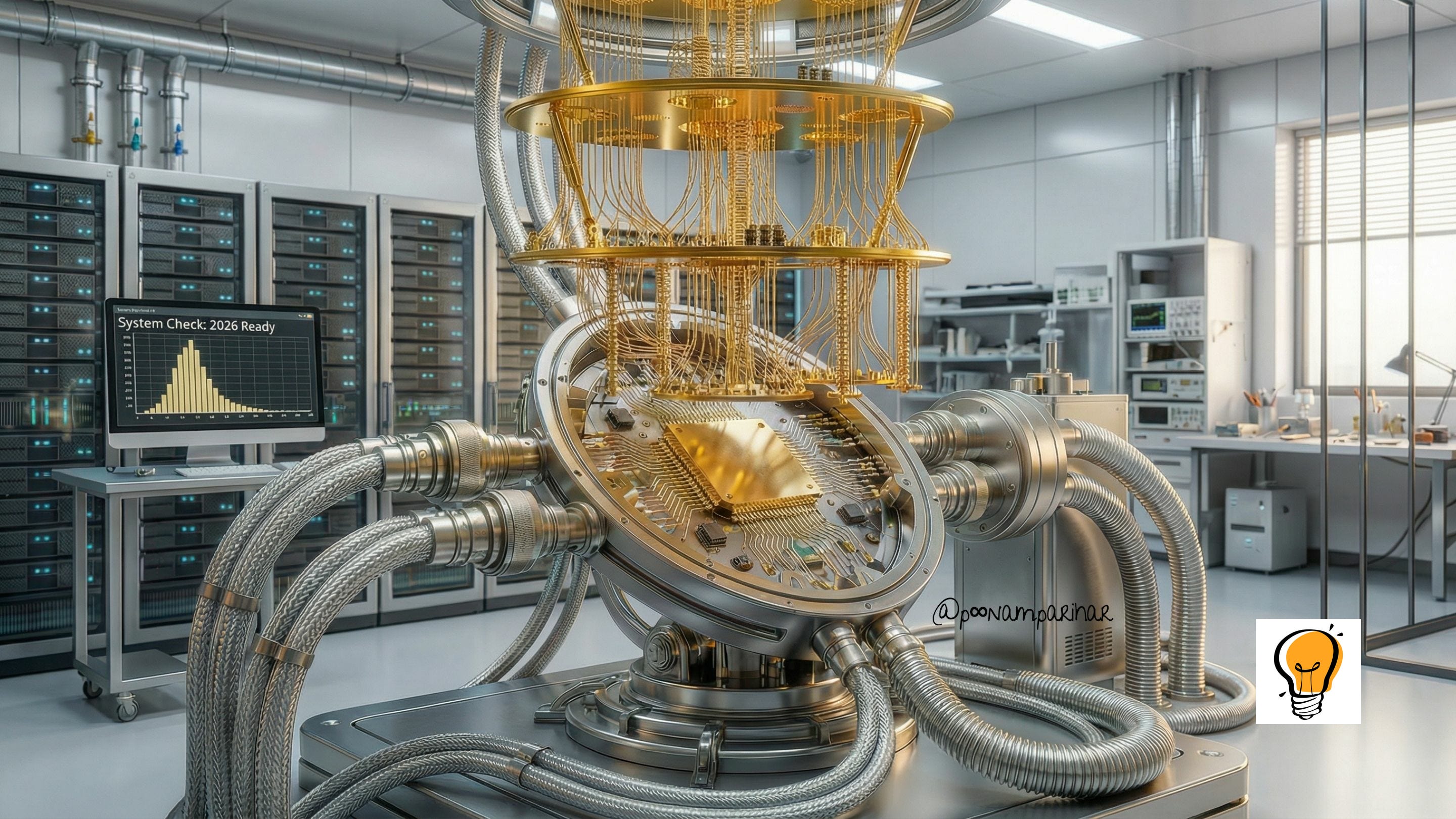
When most people hear the word “Quantum,” they imagine those massive, gold, chandelier-like computers sitting in freezing laboratories. That imagination is correct. when I created the image above, I made sure it was technically correct, while depicting something progressive.
For years, we have talked about “qubits” and “superposition” like they were far-off magic tricks. But over the last two years, lot of things have shifted. In 2024 and specially in 2025, the industry has moved away from just building bigger “gold machines” and have started focusing on the application layer, meaning the “software” that connects quantum power to the AI tools we already use.
Think of the AI tools you use today as high-performance engines. They are incredible, but they eventually hit a ceiling when problems become too complex.
Quantum is the super-charger that helps AI break through that ceiling.
While traditional AI looks at options one by one, a “Quantum-AI” system can explore countless possibilities simultaneously. It’s the difference between a librarian searching for a book page-by-page and one who can see every page of every book at the exact same moment.
What has changed in 2025, and especially as we close the year is that we have stopped treating quantum as a standalone experiment or deep-quantum ie qubit counts and physics of it. Instead, it became a specialized “plugin” for our global networks, where quantum systems are becoming reliable components of a broader computational stack Whether it’s helping a 6G phone network stay perfect in a crowded city or helping a scientist find a life-saving drug in days instead of years, Quantum is no longer just a laboratory curiosity. it’s the next gear for the AI revolution. and you don’t need to understand the physics of the “gold machine” to benefit from its power; you just need to be ready for your AI to get a lot more capable.
But its not about replacing classical AI. its about integrating Quantum with AI a building Quantum Kernels ie modular subroutines that can solve specific bottlenecks where traditional machine learning ends up failing.
Quantum Development Roadmap (2024–2030)
2026 is the first year where non‑quantum teams ship products that quietly call quantum kernels over an API, often without their users ever seeing the word ‘quantum’
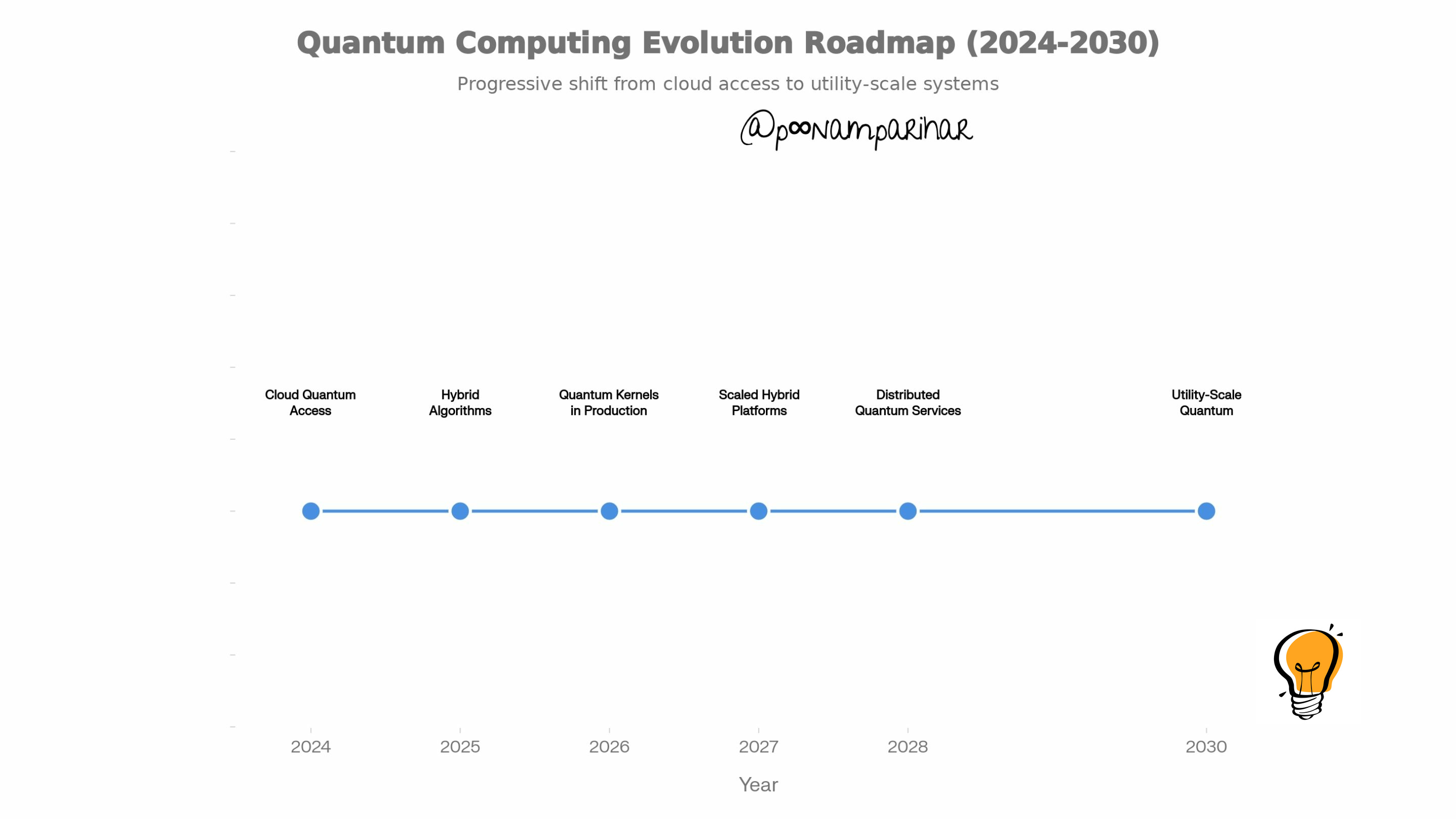
This roadmap above shows how quantum is evolving from a lab curiosity into a general‑purpose capability that any industry can tap into. Today, most organizations meet quantum through cloud access and small experiments. Over the next few years, the real value comes from hybrid algorithms and quantum kernels quietly embedded inside existing software, where they handle the hardest optimization or simulation steps. By the end of the decade, quantum is expected to feel less like a separate technology and more like another invisible layer of infrastructure powering finance, logistics, healthcare, manufacturing, and more in the background.
2024 – Cloud Quantum Access
Basic access to quantum processors via cloud platforms; mostly experimental and research-focused.
