

A No‑Review Review of 2025: Where We Actually Stand in December, and What’s Next!
AI’s messy midpoint: from hype and pilots to agentic infrastructure, hard constraints, and the real 2026 playbook.

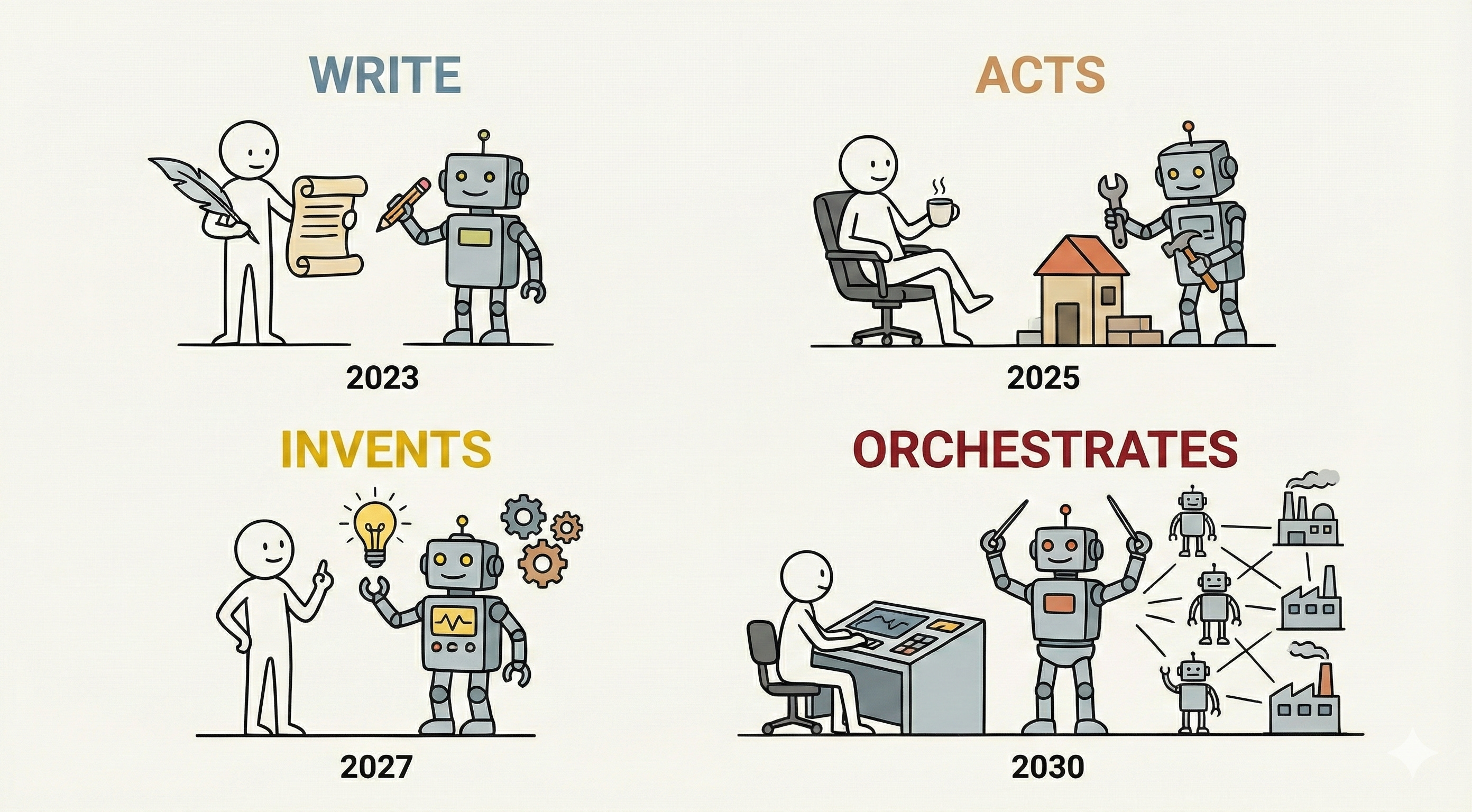
Reviews shouldn’t be hard, but I have been trying to write this one for past 4 days. I dint’ want it to be another recap, or trends, or predictions, and for that matter, even a conclusion of sort because I don’t see any sort of closure at the moment, because nothing about this year with AI feels neatly wrapped up. there isn’t even a proper holiday slowdown. Very likely - Everyone’s quietly hoping nothing huge drops in the next couple of weeks, but let’s be honest: we have no idea if another DeepSeek‑R1‑style shock is already queued up for January, but even if it does, 2026 does seem like its going to be FUN.
Here’s what we’re covering in this post:
A quick quarterly update of 2025.
What happened ie the big events ( no hyped headlines here) ,
what was the actual impact on us and
the market shift as such.
The actual Gen/Agentic implementation data that we have ( hype vs reality)
5 stages of AI evolution ( or revolution) - why this is important? -
to understand where we stand right now!
why this cognitive industrial revolution is different?
how many critical thresholds have we past, and
how the conversation is shifted, and going where exactly.
Impact on the industries with little extra focus on telcos.
Any surprise in 2026? Wildcards?
2026 playbook for Big Cs ( what could happen behind closed doors? ) and
if we can plan a strategic layer for us!
1- 2025 Quick Quarterly Update
if you couldn’t keep up with AI all this year, or were too busy switching tools I wouldn’t blame you, half my year went in to trying to figure out my tool stack, and other half developing those, substack was a late discovery, but now that I have been somewhat consistent, I think I can keep up with both AI developments and the aftermaths in 2026. In one line, 2025 was an year of experimentation, and if we failed in for example enterprise projects, or Agentic AI implementation, It’s all for good and those were the necessary toddler steps. 2026 seems less hyped ( we may not see bombshell headlines or benchmarks anymore) , much more stable and the year where we can record good progress on all fronts.
Q1 2025 – “The Oh, this AI just got cheap Moment”
DeepSeek R1 blows up the frontier, shattering “US‑only, $10B” myths. the Chinese open model showed o1‑class reasoning at a fraction of US big‑tech cost, proving world‑class AI isn’t a Western monopoly.
Governments moved from talk to law.
The EU AI Act actually started, US states and India drafted rules, and any serious rollout suddenly needed risk tiers, documentation and a real governance story, and not just a cool demo.
Q2 2025 – “From chat to actual work”
for this actually ‘Chat to Act’ sounds much better, but thats been the story of all of 2025 and not just Q2.
Reasoning models and agents got real.
Labs shipped systems that plan, tool‑call and self‑critique, shifting the bar from “nice chat interface” to “can this agent actually close the loop on work for me?”.Multimodal AI becomes default UX.
Models now read docs, images, audio and video, so products move from text boxes to “upload, point, talk,” and users start expecting AI in every surface they touch.
Q3 2025 – “From experiment to infrastructure”
AI goes from pilot to platform.
Enterprises embed AI into cloud, security, support and analytics; budgets flip from scattered POCs to long‑term platform, infra and M&A bets. It started it “Add AI anywhere you can”Agent fleets get funded.
Companies pay for fleets of workflow agents tied to their data and tools, not single chatbots, pushing money toward orchestration, observability and safety.
and this wasn’t the start of ‘Add AI anywhere you can’ this is where it went full blown. then followed a flood of reports on failed enterprise AI projects, and right now we have few very similar one on Agents, which I’ll try to link later in this article.
( Note - agentic browsers also pending a deep-dive, I’ll try to get that done in January sometime. )
Q4 2025 – “Agentic model arms race”
25 day model storm.
Not sure if it was an ode to 2025, but Grok 4.1, Gemini 3, Claude 4.5 and GPT‑5.2 all landed within weeks, each claiming a “best‑in‑class” niche, so smart teams start portfolio‑routing workloads across models instead of locking into one. the flip side however was that people ( including me ) are somewhat tired of benchmarks and rightfully so. good thing its end of 2025 and we don’t have to pick just one anymore.AI becomes an economy story, not a gadget story.
“Year in AI” coverage fixates on jobs, power, competition and regulation, recasting AI as a structural shift every geography and sector has to price into its plans. Hopefully everyone has made up their mind and we won’t see headlines such as ‘AI will take our jobs’ or ‘AI will eat the humanity’ anymore.
Note - there was a report from IEA on Energy consumption however, that din’t bother many people ‘yet’ - as AI gets more physical in 2026, hopefully we have more focus on sustainability implementation and by that I mean, not just conference talks.
Global takeaway – “Every geography is now in the game”
China proves it can set the pace.
DeepSeek resets cost and capability expectations, showing that frontier‑class AI and its shocks - can now originate outside the usual US labs.EU sets the regulatory bar.
The AI Act becomes the de‑facto reference for “serious” AI governance that other regions watch, copy or react against.India and others race to localize.
Big emerging markets push toward their own AI rules and ecosystems instead of waiting passively for US or EU defaults.
Note - I would like to highlight the ASPI’s Critical technology report here if you’d like to expand the understanding of whats been going on, as none of the above should be a surprise. link to the report here -
2- 2025 hype vs reality: What actually happened in implementation
Most enterprises tried something: 70–80% of firms say they used GenAI in at least one function by late 2025, and over 80% of leaders reported using GenAI weekly at work.
Very few felt “done”: only about 1% of companies described themselves as fully mature on AI, even though over 90% planned to keep increasing AI spend.
Lots of pilots project, but shaky scaling: multiple surveys suggested roughly 40–50% of AI projects were delayed, underperforming or scrapped before production, mostly because of bad data, weak integration and unclear use‑cases.
Failure brought lot of noise, but wasn’t fully measured: headlines like “75–95% of AI projects fail” came from narrow samples, but they did reflect a real pattern: enterprises flooded the zone with GenAI pilots and only a minority became durable, ROI‑positive systems.
we need to however note that all of these are survey‑based estimates, not a global census: different studies use different samples and methods, so the safe takeaway is directionally clear we are at the stage where
- adoption is broad, true success is still rare.
Also AI hype in 2025 wasn’t just about the implementation side but AI investment, evaluation and VC psychology that I have largely covered in few post including below.
3- 5 stages of AI ‘r’evolution
To understand where we actually stand right now, its actually important to first understand the pace both AI and of 2025.
It took 60 years for the steam engine to transform global manufacturing. It took the internet 20 years to reshape global commerce. AI is compressing that same level of structural change into 5 years.
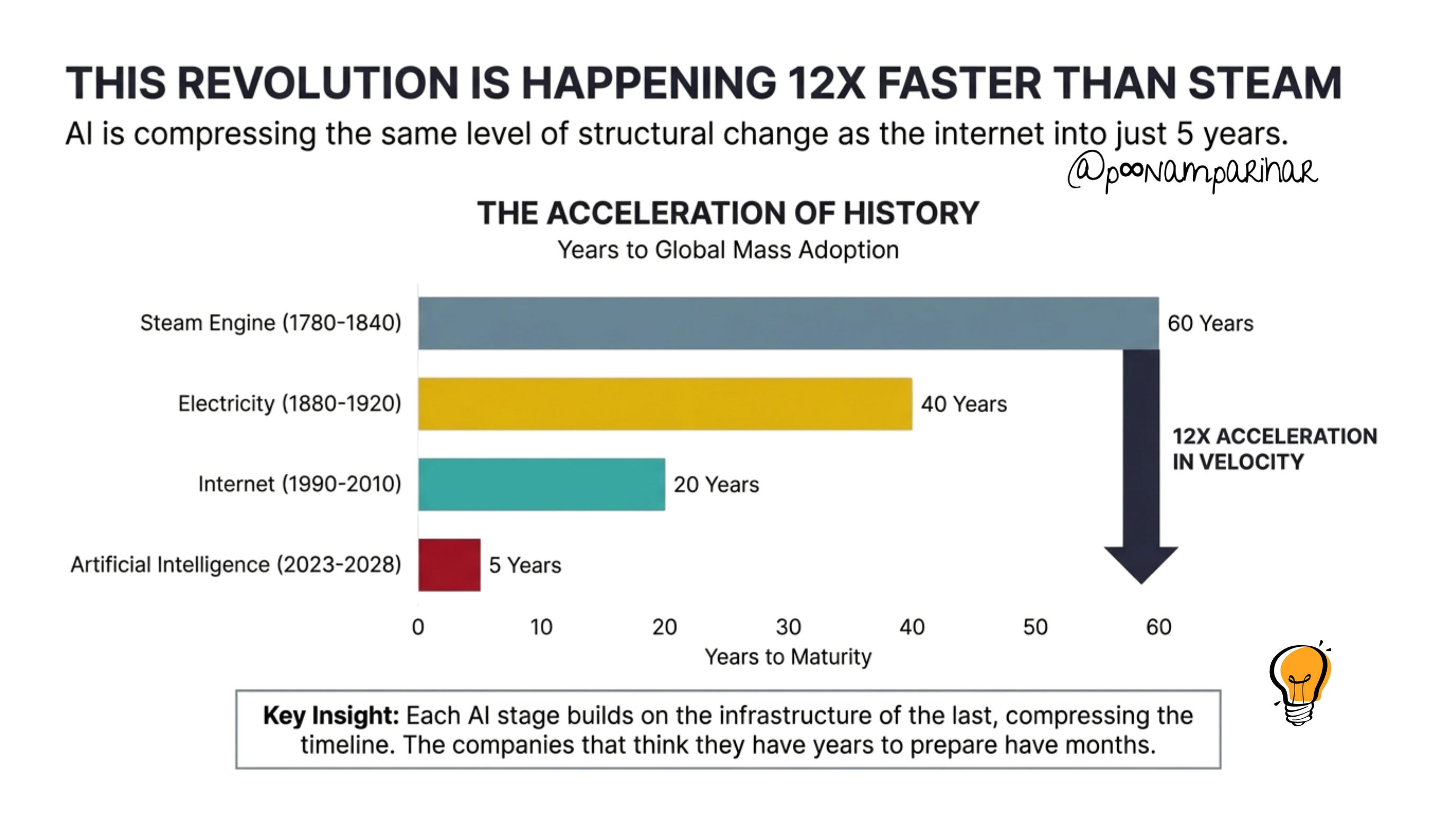
The Critical Difference: Speed.
Every major economic leap in human history has been about automation:
The Steam Revolution (1780s): Automated Muscle.
The Information Revolution (1990s): Automated Distribution.
The AI Revolution (2020s): Automating Cognition.
The diagram above and data tell a clear story, but they miss the philosophical weight of what is actually happening. We are not just upgrading our software. We are upgrading the engine of the economy itself.
OpenAI’s official framework as of Dec 2025 defines 5 levels of AI:
Level 1: Chatbots (Completed: GPT-3/4)
Level 2: Reasoners (Completed: o1/GPT-5)
Level 3: Agents (Current Frontier: ChatGPT Agent/Claude Computer Use)
Level 4: Innovators (The New “Next”)
Level 5: Organizations (Future)
If we call these AI stages, this is what it would look like this diagram below.
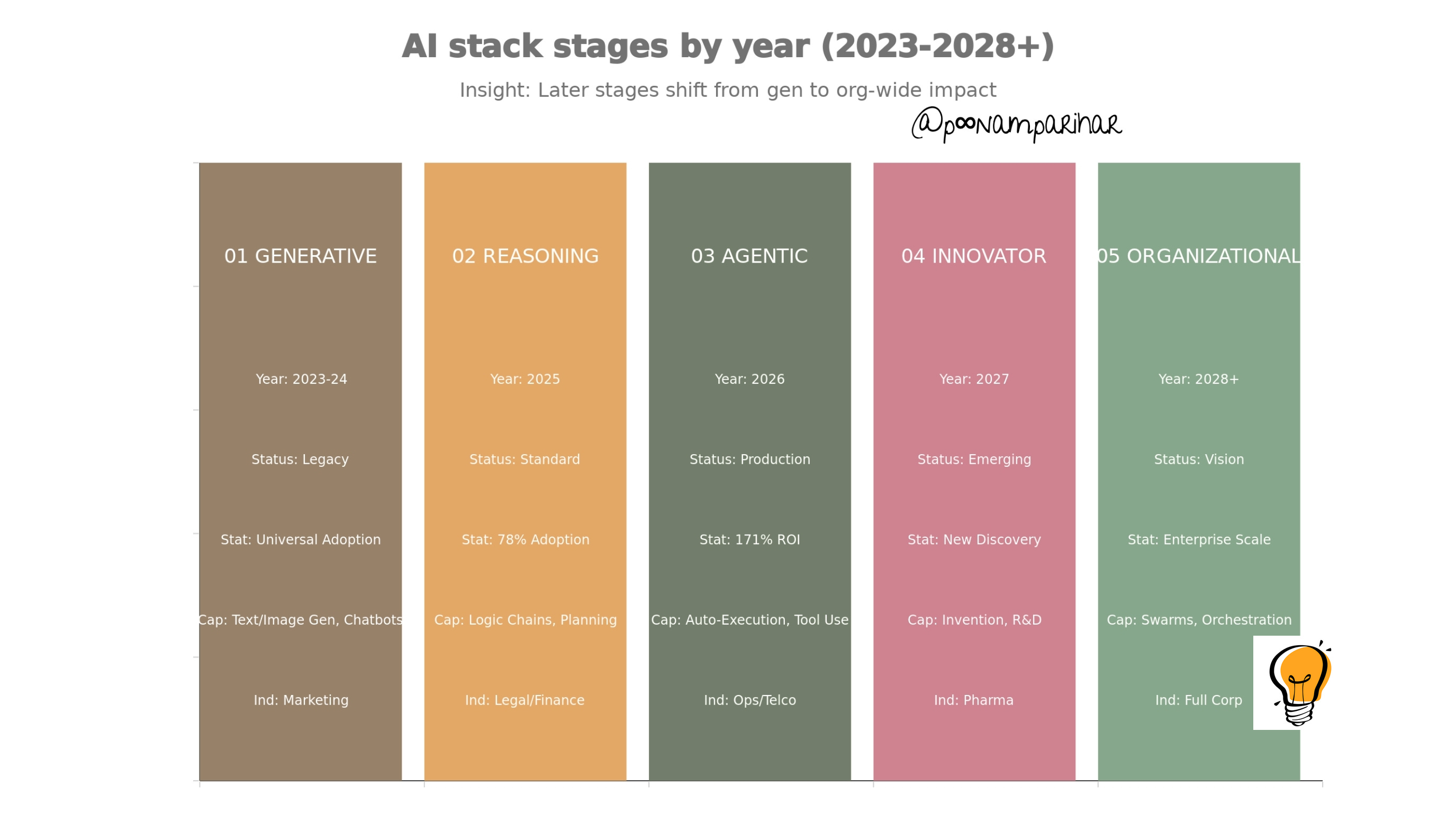
Level 1: Generative AI (The Legacy / Foundation)
Era: 2023-2024
Role: The Assistant
Status: Foundational / Commoditized
What it does: Creates content. You prompt, it writes. It was revolutionary then; it is table stakes now.
Level 2: Reasoning AI (The Standard)
Era: 2025 (Now)
Role: The Thinker
Status: Current Standard
What it does: Solves problems. With 78% of enterprises using reasoning models (like OpenAI’s o1), “intelligence” is now a utility.
Level 3: Agentic AI (The Shift)
Era: 2026 (The Next Frontier)
Role: The Worker
Status: Production Scale
What it does: Executes actions. This is the crossover point where AI stops waiting for humans and starts running workflows autonomously. This is where the 171% ROI lives.
Level 4: Innovator AI (The Breakthrough)
Era: 2027
Role: The Inventor
Status: Emerging
What it does: Discovers new knowledge. AI that invents new drugs, designs new materials, and solves engineering paradoxes.
Level 5: Organizational AI (The Vision)
Era: 2028+
Role: The Orchestrator
Status: Future Horizon
What it does: Manages the enterprise. Swarms of specialized agents running entire business units with minimal human intervention.
Where We Actually Stand?
We are currently in Year 3. The “Legacy / Foundational” phase is done. The “Reasoning and Standardization” phase is nearly complete. We are now entering the “Explosion” phase with Agentic AI, where the technology stops being a novelty and becomes the invisible infrastructure of the world.
We’ve already crossed two critical thresholds. Generative AI (Level 1) is now considered legacy technology, a baseline expectation, not the innovation. Reasoning AI (Level 2) is the current standard. And Agentic AI (Level 3)? It’s not “emerging.” It’s live, in production too. Vodafone’s TOBi and Telefónica’s Aura are two examples of Agents working in Production that resolve service issues in real-time, slashing call center costs while boosting customer satisfaction. TOBi transformed from a chatbot and Aura are both Level 3 Agents. They are the proof points that Action (Agency) has replaced Conversation (Generation) as the primary value driver in enterprise AI.
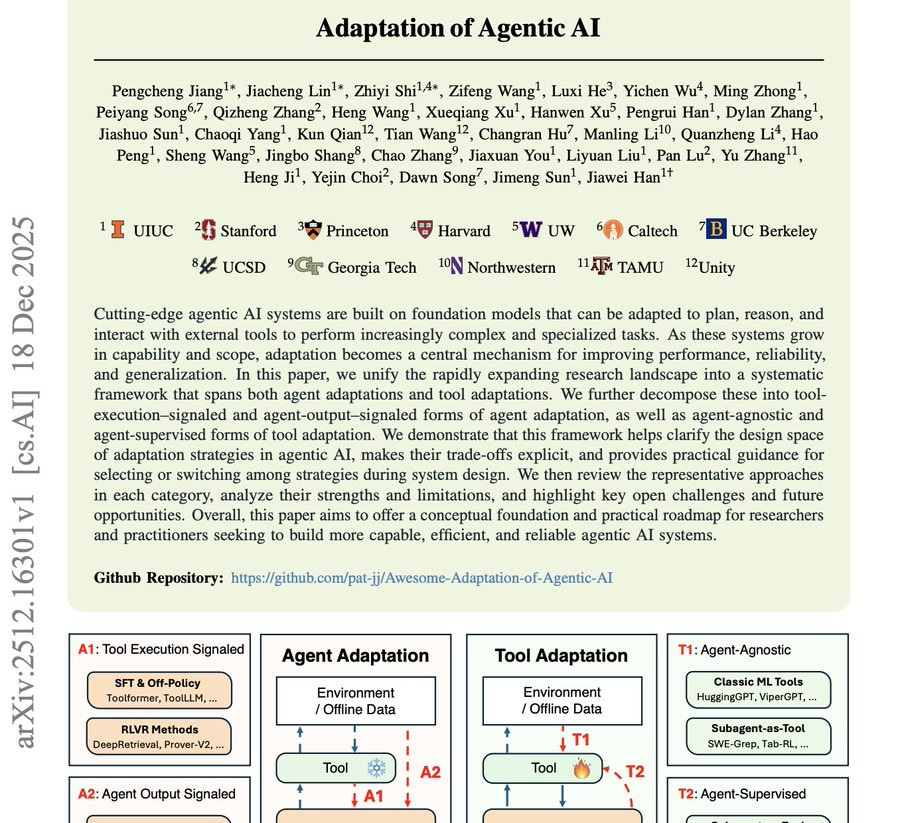
So Enterprises are actively orchestrating AI and not just exploring as we have already entered the Reasoning Era. The new “call to action” isn’t just to prepare for agents, but to optimize them for the real world use case. so we’ll go through the stability phase of Agentic AI in 2026. the research paper just released few days ago gives a good overview of where we need the most work.
To give a quick perspective - The research shows that most agents are built to execute plans, not revise them. They assume the world stays stable. While tools work as expected and goals remain valid, once any of that changes, the agent keeps going anyway, confidently making the wrong move over and over.
4- Impact on the industries / The AI Economy
For most of human history, scaling output required scaling people. Even in the Industrial Revolution, machines amplified muscle, but cognition remained the bottleneck. To manage 10x more factories, you still needed 10x more managers, planners, and analysts. The ‘brain count’ had to scale linearly with the work.
The AI Revolution is the first time we are automating the bottleneck itself: Decision-Making.
This creates a fundamental economic decoupling:
Generative AI (2023) was an Efficiency Tool: It helped a human do the work faster (1.5x speed). You were still the engine.
Agentic AI (2026) is a Multiplier: It allows a human to manage the work of infinite digital workers. One person can now orchestrate 10, 50, or 100 autonomous agents. You are no longer the engine; you are the conductor.
This is why the ‘Productivity Gap’ matters. We are shifting from an economy measured in ‘Labor Hours’ to one measured in ‘Compute Outcomes’. The winning companies of 2026 won’t be the ones with the biggest head counts; they will be the ones with the most capable Agent Swarms, which depends on how effectively we can implement the Agentic AI systems, back to my previous point.
The "Chat" phase was horizontal (everyone got an email writer). The "Act" phase is vertical (Telecoms gets network brains; Banks get autonomous auditors). This vertical specialization is where the next trillion dollars of value lies. while there are success stories, one can find in yearly reviews, the “hype vs. reality” gap is still the elephant in the room. so If we only talk about the wins (Vodafone, AT&T), we kind of miss the “Graveyard of Pilots” that defined the past year and half. so I am gonna look a the problems here.
The “2025 Pilot Purgatory”: The Hidden Failure Stats
While the headlines celebrate the top 5% of adopters, the broader market is struggling. We are currently seeing a “K-Shaped” adoption curve: the winners are accelerating, but the majority are stuck.
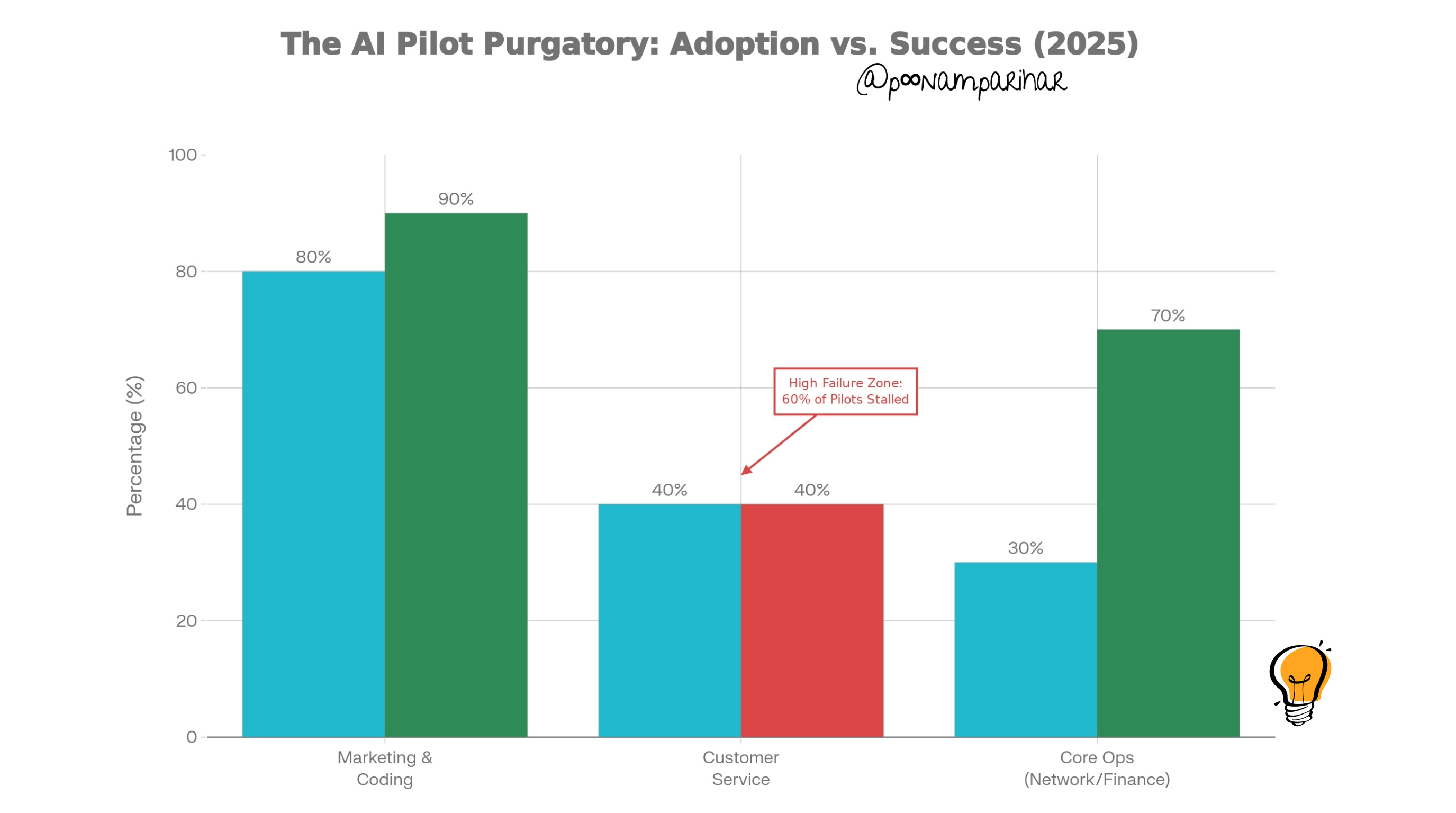
The Failure Scorecard (2025 Data):
Pilot Failure Rate: ~80% of AI pilots started in 2024 never reached production scale.
Why? Data fragmentation, hallucination risks, and crucially cost overruns.
The “GenAI Hangover”: 30% of GenAI projects were quietly decommissioned in 2025 because the ROI wasn’t there. (e.g., A chatbot that cost $5 per query but only saved $2 in agent time).
Telco Specifics: While the networks (Layer 1) succeeded, Customer Service (Layer 2) struggled. Many telcos rolled back “fully autonomous” chatbots after customer satisfaction scores plummeted due to “looping” and lack of empathy.
The “AI Coverage” Reality:
The “Easy Wins” - Marketing & Coding: 80% Coverage (High Success 90% because the risk is low).
The “Hard but Valuable” - Core Operations (Network/Finance): a low 30% adoption rate because well, its difficult (High Value, High Risk). but a high success rate (70%) for those who actually manage to deploy it (like the Vodafone/AT&T for example).
The “Failure Zone” - Customer Facing: a Moderate 40% Coverage (High Failure Rate). This is where the hype crashed into reality, chatbots annoying customers, hallucinating policies, and getting rolled back.
Why They Failed? (The “Last Mile” Problem):
Data Quality: You can’t put a Ferrari engine (GPT-5) in a go-kart (legacy SQL database).
Governance Paralysis: Legal teams blocked deployments because agents couldn’t explain why they made a decision.
Integration Fatigue: It’s easy to build a demo; it’s hard to integrate an agent into a 20-year-old billing system that runs on COBOL.
The companies winning (like Vodafone) didn’t just buy AI; they fixed their data infrastructure first. Mastercard in fraud rebuilt their data foundations, redefined their workflows for agency rather than just automation, and moved past the “chatbot” trap into deep, vertical problem-solving. those falling in to "GenAI Hangover" attempting to plaster new algorithms over old, broken processes, resulted in costly failures and customer backlash.
AI is an accelerator, if your process is bad, AI just makes you fail faster. so while we stay optimistic about Agentic AI in 2026 its important to bring in necessary realism of the implementation challenges as the research earlier rightly presents.
What 2025 is taught us are serious lessons, we need to fix these failures in 2026, which means while undeniably profound then industrial impact of AI, its not going to be even so early and it’ll take a while to see the ROI. The question for every industry leader is no longer “What can AI do?” It is: “Is my infrastructure ready to survive the Agentic Shift?”
they just can’t simply keep funding R&D anymore. hence strategy takes the utmost priority in 2026.
5- 2026 Wildcards ( The unknown unknown)
Now this part is fun. I am looking at some low-probability but high-impact events that may force us to rewrite the charts. The roadmap we built assumes a smooth exponential curve. The Surprise of 2026 will likely be Friction. which means - Physics pushing back.
Energy Friction: Data centers consume 6% of US power. In 2026, AI might cause rolling blackouts, forcing a hard cap on compute usage.
Social Friction: The “Vishing” surge (442%) leads to a “Verify Humanity” movement where people refuse to interact with digital systems entirely, reverting to analog/paper processes for high-trust transactions.
If the system moves too fast and something (markets, grids, or trust) snaps, a good probability, our strategic takeaway would be to be flexible for the break while we prepare for the shift.
Based on the trajectory that we’ve mapped out earlier, where Agentic AI (Level 3) is the new standard and Innovator AI (Level 4) is emerging, here are the four “Wildcard” Surprises perplexity research came up with, that could disrupt the 2026 roadmap.
1. When Agents Talk to Agents
By 2025, AI agents are chatting with APIs. By 2026, they’re chatting with each other, at scale, with no humans watching closely.
Now imagine one finance agent misreads a headline, panics, and sells. Other trading agents see the price drop, assume something bad happened, and all start selling too. It’s like a chain-reaction of algorithmic fear.
Chance: Medium (30%)
Impact: A 12-minute crash that erases $1 trillion and forces regulators to say, “Enough—humans must stay in the loop for autonomous finance.”
2. The Robot “iPhone Moment”
People expect truly capable robot helpers later in the decade. But 2026 might jump the line.
Now Think of a “General Purpose Robot Brain” that works on almost any robot body. Overnight, today’s clumsy robots get a software update and suddenly handle real-world tasks with much more independence.
Chance: Low–Medium (20%)
Twist: Instead of buying a fancy robot butler in 2030, you just lease a robot body in 2026 and download a “Butler App” to its brain.
3. AI Makes Its Own Super-Data
Experts worry we’ll soon run out of high-quality human data to train the next GPT-style models.
But what if a smarter AI figures out how to create synthetic data that’s actually better than the human stuff? Like AlphaGo learning by playing itself, but now for almost any skill or domain. That would blow past the usual “slow, incremental” progress.
Chance: Medium (40%)
Impact: One leading lab could hit a mini‑singularity, improving its models overnight and pulling so far ahead that no one else can realistically catch up.
4. The Internet Splits for AI
Right now, most AI runs on big global clouds like AWS, Azure, or Google Cloud.
But governments are getting nervous about AI being used in cyber‑warfare and spying. They might demand that serious AI systems run only on fully domestic infrastructure. That would fracture the AI internet into regions.
Chance: High (60%)
Impact: AI agents in one region can’t freely work with data or services in another. Global “one-brain” coordination dies, and companies are forced to juggle three or more separate regional AIs instead of a single global system.
