
OpenAI co-founds the Agentic AI Foundation under the Linux Foundation
What is Open-Source Future of Autonomous Intelligence, and What does it mean for us!
Earlier today, Dec 9th when I am writing this, OpenAI, Anthropic, and Block co-founded the Agentic AI Foundation (AAIF) under the Linux Foundation to steward open, interoperable standards for agentic AI systems. While Google, Microsoft, AWS, Cloudflare, Bloomberg are the supporting members -
“The Agentic AI Foundation (AAIF) is a directed fund under the Linux Foundation”
and each co-founder has contributed / donated a foundational project to the foundation -
Anthropic → Model Context Protocol (MCP)
Block → Goose (agent framework)
OpenAI → AGENTS.md (agent instruction format)
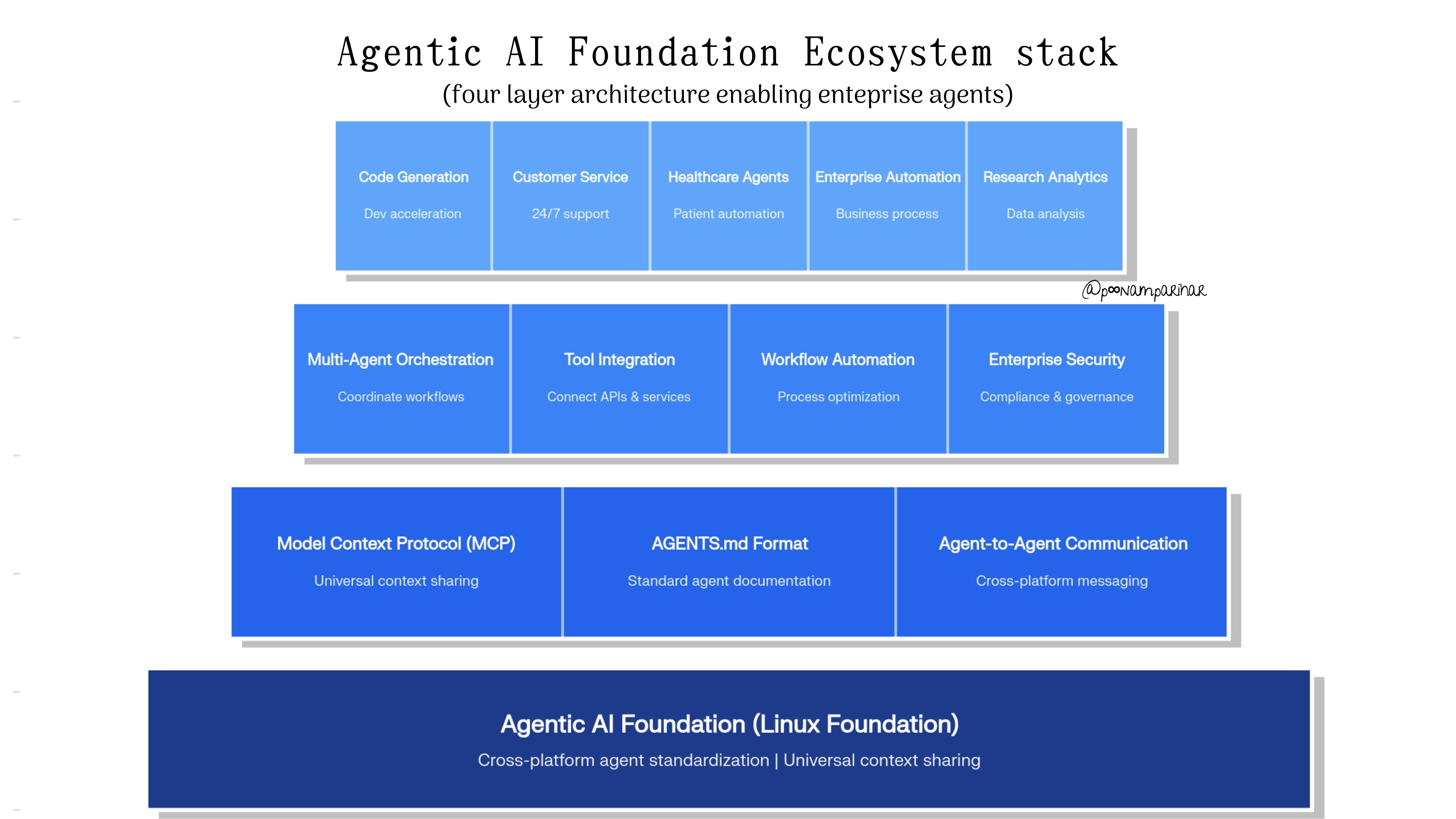
Anthropic’s MCP is an open standard (Model Context Protocol) that lets AI agents securely connect to external tools, data, and systems in a consistent way. OpenAI’s AGENTS.md, is a widely adopted Markdown convention that acts as a “README for AI agents,” giving coding agents project-specific instructions like commands, tests, and code style, Block’s Goose is a local-first, open-source AI agent framework that automates complex developer workflows using LLMs and MCP-connected tools. Bringing these frameworks and protocols together, the new foundation aims to prevent ecosystem fragmentation and ensure agentic AI infrastructure is developed transparently and in the public interest. but above all, this step signifies that the tech industry has reached a pivotal consensus, which is that the future of AI agents belongs to open standards, not proprietary silos.
None of it happened overnight however. Throughout 2025, there’s been storms of changes forcing a reshape of AI landscape. while the foundation models achieved reasoning and tool-use capabilities rivaling human experts, open-source variants also became cost-competitive (100x cheaper than proprietary alternatives), and enterprise customers demanded transparency and control. In this article I plan to understand this strategic realignment and power play between the open-source and proprietaries.
The year 2025 has changed everything
proprietary models are smarter has been the narrative for years, starting with OpenAI’s GPT-4, Google’s Gemini, and Anthropic’s Claude, all these models have dominated benchmarks. But its end of 2025 and the benchmarks are dead. I’d go in to the details of that in another post, but if we have to look quickly why this narrative can’t work anymore, all we have to see is last few open source releases. -
Meta’s Llama 4 (April 2025) introduced native multimodality.
DeepSeek’s V3.2 (November 2025) - Sparse Attention, a novel architecture that reduced computational overhead for long-context tasks by 50% while maintaining quality.
Mistral’s Large 3 (December 2025) - The 675B-parameter MoE model matched GPT-4-class performance with a 256,000-token context window and exceptional multilingual capabilities, which is crucial for global enterprises wary of US or Chinese vendor lock-in.
The implication has been profound: intelligence was becoming a commodity. When your competitive advantage can’t be proprietary models, it shifts to something else entirely: standards, integration, and orchestration.
The Enterprise Demand Crisis
Enterprises wanted AI that was simultaneously powerful AND auditable, but did they get it in 2025?
By Mid 2025 we saw a number of major lawsuits over training data, regulatory scrutiny from the SEC and EU, and high-profile AI failures (hallucinations causing financial losses, agents taking unintended actions) creating not only a “trust crisis” that gripped enterprise AI adoption but also an impossible demand and the Closed-model APIs couldn’t satisfy.
You couldn’t audit what data a model was trained on, how it made decisions, or exactly why it took a particular action. Now Open-source models solved this, but only if the entire orchestration layer was transparent. and this is where the problem of fragmentation became acute. By late 2025, enterprises could choose from hundreds of agent frameworks:
Microsoft’s AutoGen (powerful multi-agent orchestration)
LangChain’s LangGraph (structured, deterministic workflows)
Crew AI’s CrewAI (role-based team agents)
Block’s Goose (lightweight, extensible agents)
AWS Strands (model-first simplicity)
Hugging Face smolagents (minimal, transparent agents)
But here came another nightmare: if you built an agent on LangGraph with Claude, you couldn’t easily port it to CrewAI with Llama without rewriting significant portions. because each framework had different conventions for how agents accessed tools, how they handled state, how they logged decisions. hence enterprises faced a perpetual retraining/rewriting problem every time they wanted to switch frameworks or models.
Could Agentic Frameworks under Open Governance be the solution?
The Agentic AI Foundation din’t emerge overnight, as the answer to this fragmentation issue. This has been in works but before that, lets look at the pillars of this foundation - Anthropic’s Model Context Protocol, donated to the AAIF, solves one most fundamental problem:
How does an AI model access external tools and data sources in a standardized way?
Think of MCP as the “USB-C for AI”. Just as USB-C created a universal connector that works with any device, MCP creates a universal interface for connecting AI models to:
Databases and data warehouses
APIs and web services
File systems and cloud storage
Business applications (Salesforce, ServiceNow, etc.)
Hardware and sensors
The magic: A developer writes a single MCP connector for “Google Drive” once. That connector now works with Claude, GPT-4, Llama, Mistral, and any other model that speaks MCP. No vendor lock-in. No rewriting for each model. by end of the year, over 10,000 public MCP servers are available, connectors for everything from GitHub and Slack to custom enterprise systems. The Official SDKs has achieved 97 million+ monthly downloads.
While MCP solves “how agents access tools,” AGENTS.md solves -
how agents understand their environment.
AGENTS.md is a standardized file format (similar to README.md) that specifies agent behavior rules, constraints, and specialized knowledge for a specific project or codebase. When an agent encounters a project with an AGENTS.md file, it knows:
Which tools are available in this environment
Which actions are forbidden (don’t delete production data)
What the project’s architecture looks like
Domain-specific context (financial regulations, medical terminology, etc.)
This prevents the “rogue AI” problem, an agent trained to maximize efficiency might optimize away critical error-checking logic. AGENTS.md enforces guardrails. together with MCP, under Linux Foundation governance, all competing frameworks agree to:
Converge on MCP/AGENTS.md standards
Publish roadmaps showing interoperability timelines
Participate in working groups focused on safety, evaluation, and long-term alignment
Microsoft’s AutoGen and Semantic Kernel, AWS’s Strands, and Hugging Face’s frameworks all committed to MCP-first development. The message to enterprises: “Pick any framework. You’re not locked in to one model vendor.”
2025 Open-Source Release Timeline
If we look at the last 11 months of breakneck innovation, here is what it looks like how AAIF may have been in the works.
[Chart: 2025 Agentic AI Ecosystem Timeline]
January: Microsoft released AutoGen 0.4 with async messaging and production observability—enabling enterprise-grade deployments at scale.
February: Block open-sourced Goose, a lightweight agent framework emphasizing extensibility. This signaled Jack Dorsey’s commitment to preventing OpenAI/Anthropic from monopolizing the agent layer.
March-April: Llama 4 launched with native multimodal capabilities, proving open models could handle complex visual reasoning.
May:
AWS open-sourced Strands Agents SDK, bringing internal production experience to the community
Hugging Face released Transformers Agents 2.0 with iterative refinement capabilities
June:
Microsoft’s Semantic Kernel Agent Framework reached general availability
Google launched Gemini CLI, a free, open-source terminal-based agent with generous rate limits
June-July: Mistral released reasoning models, entering the “thinking AI” space previously dominated by OpenAI’s o1.
November: DeepSeek-V3.2 redefined the cost-performance frontier, forcing a reckoning across the industry about proprietary model advantages.
December 1: Mistral Large 3 launched with 675B parameters and multimodal capabilities.
December 9: The Agentic AI Foundation formally announced, consolidating all these advances under one governance umbrella.
Market Positioning & Competitive Landscape
[Chart: Market Positioning Matrix]
The December 2025 landscape reveals a clear stratification: No single solution dominates all dimensions.
This is actually healthy, it means enterprises genuinely have options based on their specific constraints. here is what the breakdown looks like -
Enterprise-Grade Production: Semantic Kernel (Microsoft), AutoGen (Microsoft Research), and Strands (AWS) dominate : these are frameworks backed by companies already managing critical infrastructure at global scale.
Developer Speed: CrewAI and Goose excel at rapid prototyping , which menas developers can build functional agents in hours, not weeks.
Cost-Efficiency: Open-source models like DeepSeek, Mistral, and Llama offer 10-100x better cost-performance than proprietary alternatives, though they may sacrifice some edge-case reasoning capabilities.
Balanced Approach: Claude (Anthropic) + MCP achieves a sweet spot for enterprises willing to pay a premium for proven safety, while retaining full flexibility through MCP connectivity.
Enterprise Value & Implementation Timeline
[Chart: Cost Reduction Potential by Function]
Analysis of early 2025 deployments reveals significant ROI from agentic AI:
Customer Service: 20-30% cost reduction through autonomous triage and first-response handling
Code Generation & DevOps: 20-40% reduction in development cycle time and boilerplate work
Process Automation: 25-35% reduction through autonomous RPA-plus agents that handle exceptions
Knowledge Work: 15-25% efficiency gains in contract analysis, research synthesis, and compliance reviews
Risk & Compliance: 15-25% cost reduction through continuous monitoring and anomaly detection agents
The AAIF Governance Model
Founding Members: OpenAI, Anthropic, Block, and a coalition of 150+ companies including Microsoft, Google, AWS, IBM, Meta, Cisco, JetBrains, Arcade.dev, and more.
The Agentic AI Foundation operates under Linux Foundation governance, the same model that stabilized Docker, Kubernetes, and the Linux kernel itself.
Governance Structure:
Technical Steering Committee: Elects representatives from major contributor organizations
Working Groups: Domain-specific efforts (Safety, Evaluation, Enterprise Integration, Standardization)
Project Incubation: Emerging standards and tools can be incubated and promoted to graduated status
The Key Promise: No single company can hijack the foundation’s direction. Decisions require consensus or supermajority votes. This is why even competitors like OpenAI and Anthropic felt comfortable joining, the governance structure prevents either from monopolizing agentic AI standards.
The Bigger Picture
The AAIF’s formation represents a strategic realignment of AI power:
2022-2024 Narrative: “Whoever builds the smartest model wins.”
→ Result: OpenAI (GPT-4) and Anthropic (Claude) dominated.
2025-2026 Narrative: “Whoever controls the integration standards wins.”
→ Result: Open standards under neutral governance trump proprietary APIs.
This mirrors historical tech shifts:
1990s: The browser wars (IE vs. Netscape) ended when standards prevailed
2000s: Proprietary UNIX variants lost to Linux (open standard)
2010s: Kubernetes orchestration standardized containers (defeating proprietary Docker Swarm)
For Enterprises: You now have leverage. You can choose models and frameworks based on your actual constraints—> cost, safety, performance, legal jurisdiction without being locked into one vendor’s ecosystem.
For Open-Source Contributors: The AAIF provides a home for tools that might not be profitable individually but are valuable collectively. MCP, AGENTS.md, and open agent frameworks represent $billions in value that no single company would fully fund alone.
For Developing Nations: DeepSeek, Mistral, and Llama are democratizing frontier AI. A startup in India or Brazil can now deploy cutting-edge agentic AI without US tech dependence, a geopolitical shift with profound implications.
What’s Next?
The AAIF has announced three major priorities for 2026:
1. Safety & Alignment Standardization
Develop universal benchmarks for agentic AI safety
Create shared evaluation frameworks to replace proprietary safety testing
Publish research on preventing unintended agent behaviors
2. Enterprise Integration Layer
Extend MCP to support agent-to-agent communication (not just agent-to-tool)
Develop standard formats for agent provenance (tracing decisions back to training data)
Build compliance modules for regulated industries (healthcare, finance, government)
3. Global Accessibility
Ensure frameworks and standards are documented in 10+ languages
Support deployment on resource-constrained hardware (mobile, edge devices)
Create pathways for non-English-native developers to contribute
Conclusion: The Era of Open, Composable AI
The Agentic AI Foundation marks the end of one era and the beginning of another.
The era of closed, proprietary AI moats is over. When foundation models are commoditized and open-source frameworks match proprietary ones, the only sustainable advantage is being the “hub” that connects everything and hubs work better as commons than as corporate fiefdoms.
But whats the most exciting part is: For the first time, an enterprise can deploy agentic AI with genuine optionality. You’re not choosing between “OpenAI’s ecosystem” or “Anthropic’s ecosystem.” You’re choosing components, pick the models that best fit your cost/performance needs, the frameworks that match your engineering culture, and the tools that integrate with your systems, all held together by open standards.
This is how transformative technology gets democratized. Not by revolution, but by standards. Welcome to the open age of agentic AI.


